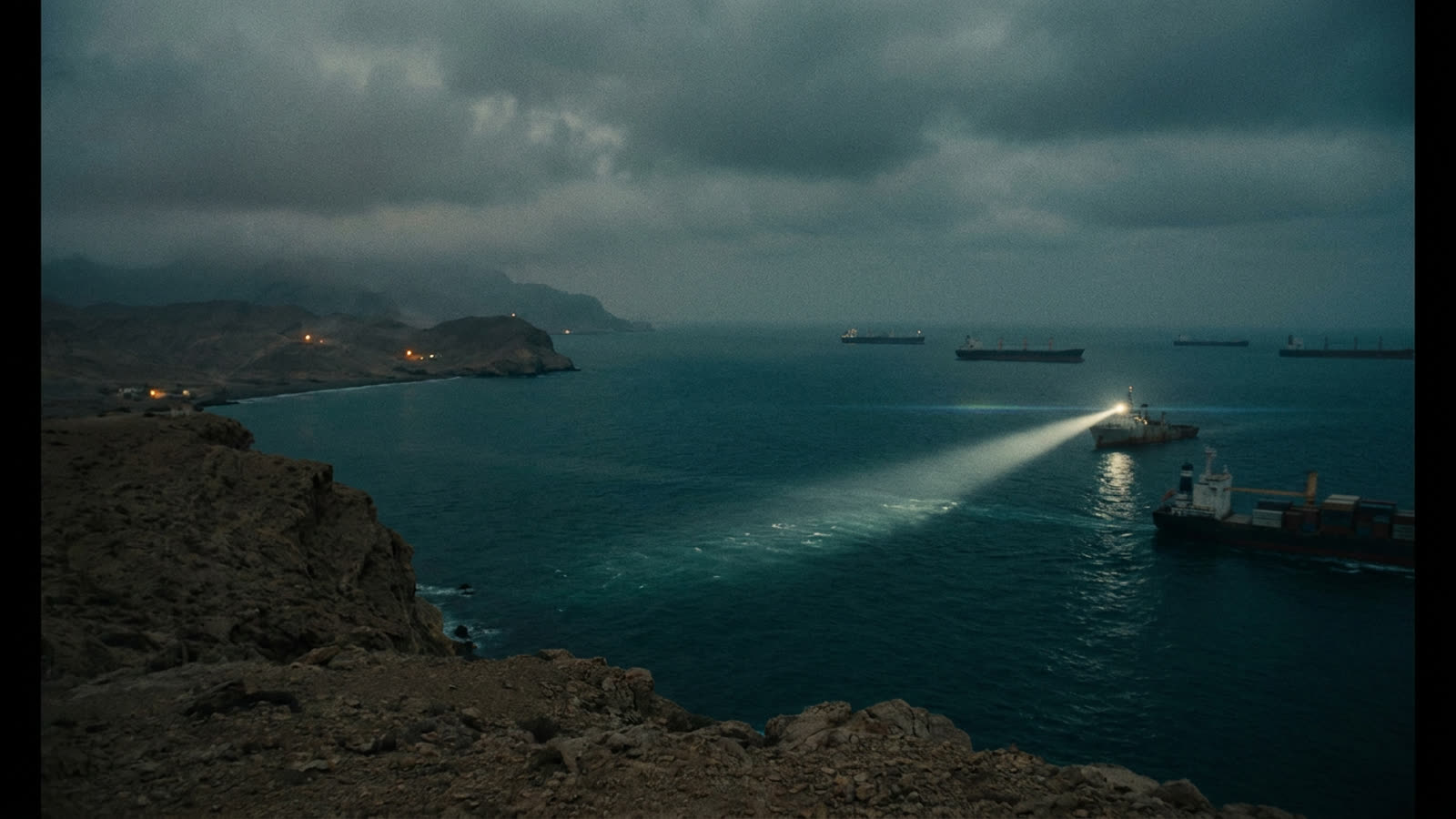
The Strait of Hormuz, that narrow ribbon of water between Iran and Oman through which roughly a fifth of the world's petroleum passes daily, is experiencing a phenomenon that keeps shipowners awake at night: an unprecedented swell in "dark" oil flows—tankers that have switched off their transponders to avoid detection, sanctions, or both.
The implications extend far beyond maritime law enforcement. When a meaningful share of global oil supply becomes invisible to tracking systems, price discovery breaks down, insurance markets seize up, and the geopolitical calculus around energy security grows considerably more fraught.
The mechanics of going dark
Every commercial vessel is required to broadcast its position via the Automatic Identification System, a GPS-based protocol that allows port authorities, insurers, and other ships to track movements in real time. Switching off AIS is technically illegal in most jurisdictions, but enforcement in international waters remains spotty at best. The incentives to disappear are substantial: a tanker carrying sanctioned Iranian or Russian crude can command premium freight rates precisely because it operates outside the visible market.
What's changed recently is scale. Industry analysts report that the volume of oil moving through Hormuz on vessels with intermittent or absent AIS signals has grown markedly in recent months, coinciding with tightened Western sanctions and increased Iranian export activity. These aren't rogue operators at the margins; this is a parallel logistics network that has matured into something resembling a shadow industry.
Why shipowners are nervous
Legitimate tanker operators face an uncomfortable bind. Their vessels transit the same waters as dark fleets, often without knowing which ships nearby might be carrying sanctioned cargo—or might be targets for interdiction. Insurance underwriters have responded by raising premiums for Hormuz transits and, in some cases, refusing coverage altogether for certain routes or flag states.
The knock-on effects ripple through supply chains. Refiners in Asia who depend on Middle Eastern crude must now factor in not just the price of oil but the price of uncertainty: Will their cargo arrive? Will their insurer honor claims if something goes wrong in a zone increasingly populated by vessels that don't officially exist?
The price of opacity
Energy markets function on information. Traders, refiners, and governments make decisions based on visible inventories, tanker movements, and production data. When a growing share of supply disappears from tracking systems, the market loses its ability to price risk accurately. Volatility increases. Hedging becomes more expensive. And the temptation for producing nations to exploit the opacity—by quietly exceeding quotas or evading sanctions—grows harder to resist.
For consuming nations, particularly in Europe and Asia, the dark fleet phenomenon represents a slow erosion of the rules-based energy order that has prevailed since the 1970s oil shocks. The architecture of sanctions, shipping regulations, and insurance requirements was designed for a world where vessels could be tracked and held accountable. That world is quietly dissolving.
Our take
The Hormuz dark fleet story is one of those slow-burn developments that rarely makes front pages until something goes catastrophically wrong—a collision, an environmental disaster, a geopolitical incident involving a vessel that wasn't supposed to be there. The current trajectory suggests that moment is more a question of when than if. For now, the world's most important oil chokepoint is becoming a zone where the rules apply only to those who choose to follow them, and the number making that choice shrinks by the month.