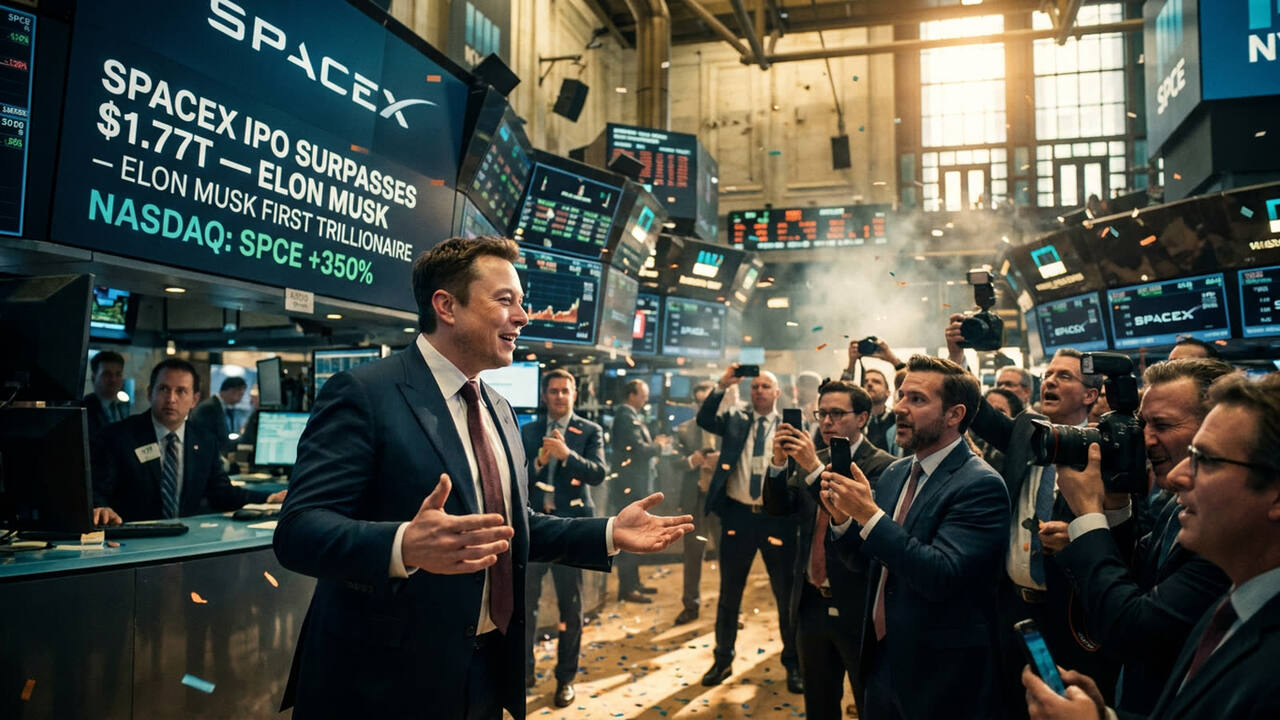
Elon Musk became the world's first trillionaire on Friday, June 12, after his rocket company SpaceX completed the largest initial public offering in history, a debut so large it reorganized the global wealth rankings in the space of a single trading session.
SpaceX, listed on the Nasdaq under the ticker SPCX, priced 555.6 million shares at $135 apiece, raising roughly $75 billion and valuing the company at about $1.77 trillion, according to The National and reporting carried by Reuters and Bloomberg. The stock opened near $150, up about 11 percent, briefly carrying the company's valuation past $2 trillion intraday. The Washington Post, The New York Times, The Guardian, NBC News and ABC News all reported that the surge lifted Musk's net worth above $1 trillion.
The deal that broke every record
The offering dwarfed the previous record holder, Saudi Aramco's $29.4 billion listing in 2019, by more than double. Demand was ferocious: retail investors alone placed more than $100 billion in orders, Bloomberg reported, and the deal drew bids for over four times the available shares. SpaceX's banks were handed an overallotment option for an additional 83.3 million shares at the IPO price.
The valuation reflects a company transformed. SpaceX absorbed Musk's AI venture xAI in February, a deal that vaulted the combined entity's private valuation to roughly $1.25 trillion. Contracts to supply computing infrastructure to Anthropic and Alphabet's Google, worth as much as $2.17 billion a month, are set to become its largest revenue source, pushing it from a rocket-and-satellite firm toward an aspiring AI juggernaut.
How far ahead he now stands
The gap between Musk and everyone else is now without precedent. According to Bloomberg Billionaires Index figures cited by ABC News as of June 9, the second-richest person, Alphabet co-founder Larry Page, is worth about $309 billion, followed by Sergey Brin at roughly $287 billion and Amazon's Jeff Bezos. Musk now commands more wealth than the next three richest men combined.
Not everyone is convinced the figure is durable. "It's out of whack at every level," Australian shareholder activist Stephen Mayne told ABC's 7.30, noting SpaceX loses around $5 billion a year and carries accumulated losses of $41 billion. Economic historian Cameron Gordon called the moment a "second Gilded Age," but warned that "the connection between money value of fortunes and real value are a lot more tenuous" than in the era of Rockefeller and Frick.
Our take
A trillion dollars is a number the human brain cannot really hold, and that is rather the point. Musk's milestone is real in the only sense markets recognize, namely what investors were willing to pay on Friday afternoon, yet it rests on a company that still bleeds cash and on a valuation that doubled in six months largely on an AI pivot. The first trillionaire has arrived. Whether the title survives the next earnings cycle is a separate question entirely.