The greatest trick the luxury hotel ever pulled was convincing you that its lobby belongs to you.
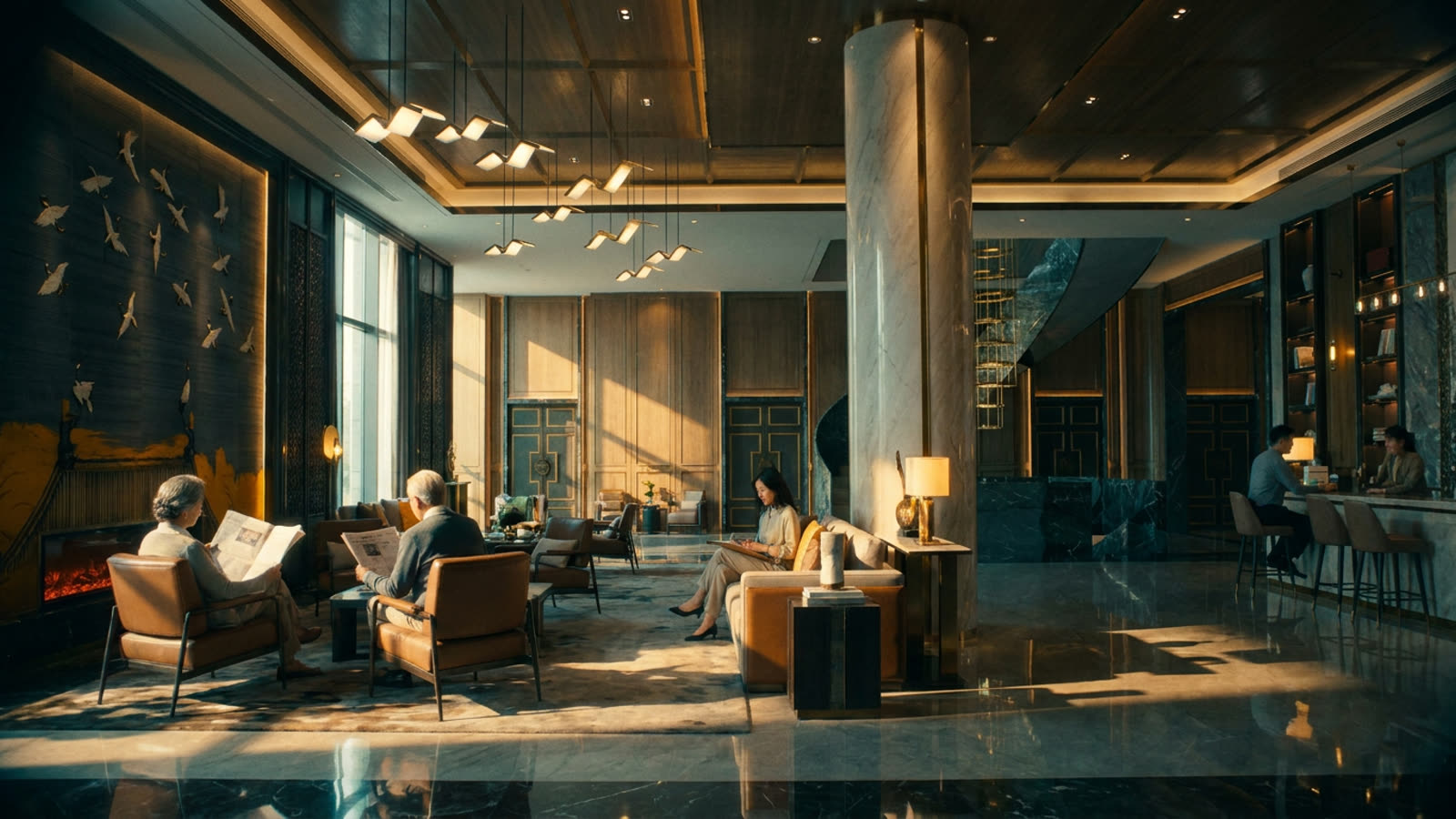
Walk into the Peninsula in Hong Kong, the Carlyle in New York, or the Connaught in London, and something curious happens: you slow down. You lower your voice. You order a drink you wouldn't normally order and sit in a chair that costs more than your sofa. You are, in the most literal sense, a guest in someone else's house — and yet the space feels like an extension of your own personality, a stage you've been rehearsing for without knowing it.
This is not an accident. It is the result of more than a century of careful calibration, a design philosophy that treats the lobby not as a waiting room but as a destination unto itself.
The invention of the public parlor
The modern hotel lobby emerged in the late nineteenth century as cities industrialized and travel became aspirational rather than merely functional. The Savoy in London, which opened in 1889, pioneered the idea that a hotel could be a social venue for people who had no intention of sleeping there. César Ritz understood that the lobby's true customers were locals seeking glamour by proximity — the theater crowd, the financiers, the women who wanted to be seen reading the afternoon papers in a room full of orchids.
The formula was deceptively simple: create a space grand enough to impress but intimate enough to encourage lingering. High ceilings for drama, low seating for conspiracy. Staff trained to recognize regulars but never to acknowledge that they noticed. The lobby became a third place before the sociologist Ray Oldenburg coined the term — neither home nor office, but somewhere you could be your most polished self without the exhausting obligations of either.
Why the model survived the boutique revolution
When Ian Schrager and Steve Rubell opened Morgans in New York in 1984, they were supposed to have killed the grand lobby. The boutique hotel promised something different: small, cool, knowing. The lobby shrank to a sliver; the real action moved to the bar, the restaurant, the rooftop. For two decades, serious hoteliers treated the monumental lobby as a relic, the architectural equivalent of a fax machine.
And yet the grand lobby never disappeared. It adapted. The Ace Hotel chain, which launched in Seattle in the late 1990s, reimagined the lobby as a co-working space before co-working existed — communal tables, strong Wi-Fi, a studied indifference to whether you had a room key. The Edition hotels, Schrager's later collaboration with Marriott, brought back the theatrical entrance but stripped it of stuffiness. The message was clear: people still wanted a room to perform in. They just wanted the performance to feel less scripted.
The economics of the empty chair
Here is the dirty secret of the hotel lobby: the people sitting in it are often not paying for the privilege. The couple nursing a single pot of tea for two hours, the freelancer camped at the corner table, the tourist who wandered in to use the restroom and stayed for the atmosphere — none of them are checking in. And yet the hotel wants them there.
A busy lobby signals success. It creates the impression of a place worth being, which is the most valuable form of advertising a luxury brand can buy. The Chateau Marmont in Los Angeles has understood this for decades: the lobby is deliberately underlit, the furniture deliberately mismatched, the staff deliberately unhelpful, because the point is not service but mystique. You are paying for the privilege of being ignored in the right room.
Our take
The hotel lobby endures because it solves a problem that never goes away: the human need for public grandeur without public accountability. You can be anonymous and important at the same time. You can watch and be watched without commitment. In an era when every coffee shop has become a laptop farm and every bar demands you perform authenticity, the hotel lobby remains the last space designed for pure, unapologetic theater. The best ones know exactly what they are selling, and it has never been the rooms upstairs.