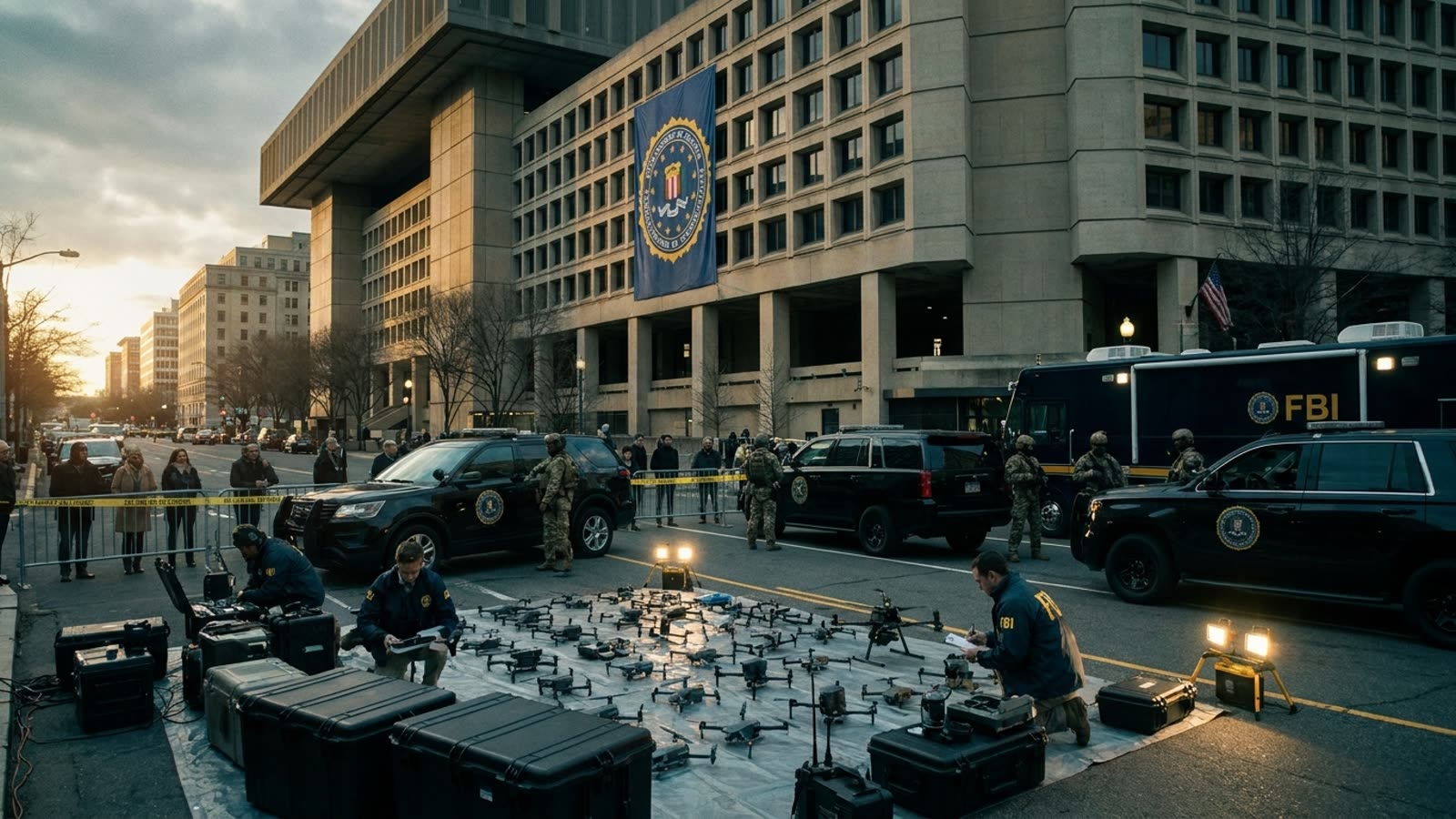
The number is staggering enough to merit a pause: more than 500 drones seized by federal authorities since the World Cup kicked off on American soil. The FBI's quiet interdiction campaign, conducted in coordination with local law enforcement and the Secret Service across host cities, represents the largest airspace security operation in U.S. sporting history—and a stark illustration of how fundamentally the threat matrix has shifted since the last time America hosted a major FIFA tournament.
The seizures span the predictable and the concerning. Most confiscated devices belong to enthusiastic fans attempting to capture aerial footage of stadium approaches, tailgate scenes, or the matches themselves. But officials have also intercepted drones equipped with high-resolution cameras circling team hotels, devices probing the perimeters of training facilities, and at least a handful of units whose operators have not been identified or located.
The geometry of modern vulnerability
Stadiums are uniquely exposed targets in the drone age. Their open-air design, predictable crowd density, and fixed locations create what security professionals call "persistent target geometry"—the same vulnerabilities, in the same places, on a published schedule. The NFL began investing heavily in counter-drone systems after 2020, and Major League Baseball followed. But the World Cup presents a scale of challenge those leagues never face: dozens of matches across multiple cities, with crowd sizes exceeding 80,000 and global broadcast audiences measuring in the billions.
The FBI has deployed a layered detection system combining radar, radio-frequency sensors, and acoustic monitoring. When a drone enters restricted airspace, operators can attempt to jam its control signal, force it to land via electronic countermeasures, or—in extreme cases—physically intercept it. The agency has declined to specify how many of the 500-plus seizures involved active interdiction versus voluntary compliance after warnings.
The legal gray zone
Drone operators face federal charges under the temporary flight restrictions FIFA events trigger, with penalties ranging from fines to imprisonment. But enforcement remains inconsistent. Many seized drones were registered to their owners; many were not. The FAA's recreational drone registration system captures only a fraction of devices in circulation, and the secondary market for unregistered units is vast.
More troubling for authorities is the sophistication gap. Consumer drones have become remarkably capable—longer range, better cameras, quieter motors—while counter-drone technology remains expensive and imperfect. A determined adversary with modest technical skills can defeat basic jamming. The FBI's success rate during the tournament has not been disclosed, and officials have been careful to avoid claiming they've intercepted every unauthorized incursion.
Our take
Five hundred drones is a lot of drones. It's also, almost certainly, a fraction of the attempts. The World Cup is stress-testing American security infrastructure in ways that will inform mega-event planning for decades, and the early lesson is sobering: the sky is no longer a passive backdrop to public gatherings. It's contested terrain. The FBI deserves credit for the scale of its operation, but the sheer volume of seizures suggests we're in an arms race where defense is perpetually catching up to offense. The next World Cup host—wherever that may be—is taking notes.