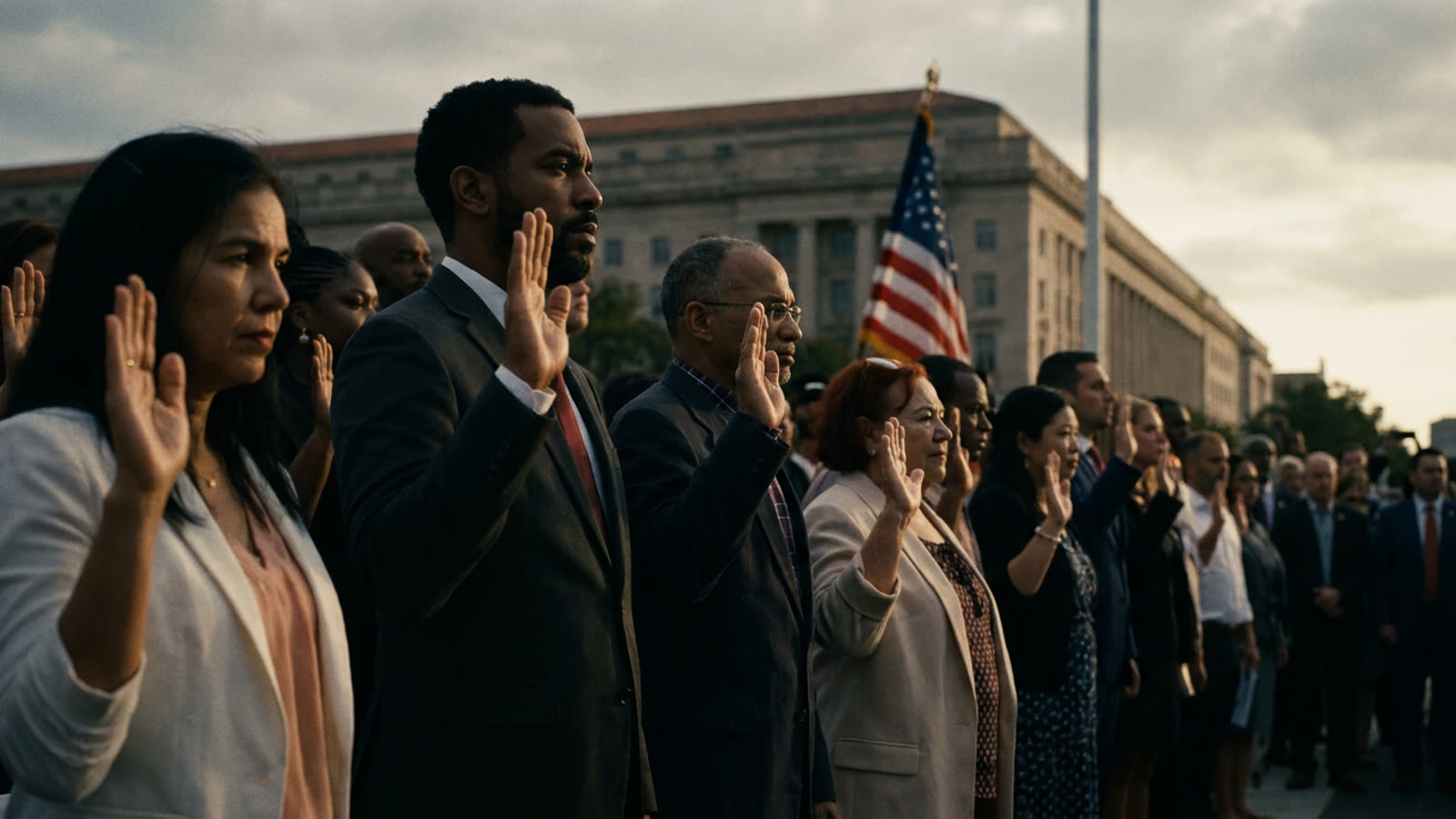
The Department of Justice has filed to revoke the citizenship of seventeen naturalized Americans in what officials describe as an aggressive new enforcement posture—and what civil liberties advocates call the most significant challenge to citizenship security in modern American history.
The cases, announced in a coordinated filing across multiple federal districts, target individuals the government alleges obtained citizenship through fraud or material misrepresentation. But the scale and apparent coordination suggest something more systematic than routine fraud enforcement: a deliberate effort to establish that naturalized citizenship exists on fundamentally different legal footing than birthright citizenship.
The legal architecture of belonging
Denaturalization is not new. The government has always retained the theoretical power to revoke citizenship obtained through fraud. What is new is the apparent appetite to use it at scale and the expansive interpretation of what constitutes a material misrepresentation.
Historically, successful denaturalization cases involved clear-cut fraud—Nazi war criminals who lied about their wartime activities, for instance, or individuals who concealed serious criminal histories. The bar was high by design. Courts recognized that stripping citizenship is among the most severe sanctions the government can impose, rendering someone stateless or deportable to a country they may not have seen in decades.
The current batch of cases reportedly includes individuals whose alleged misrepresentations are considerably more ambiguous: discrepancies in travel histories, associations the government now deems problematic, or omissions that were not flagged during the original naturalization process. The message to the roughly 23 million naturalized American citizens is unmistakable: your status is contingent in ways that native-born citizenship is not.
Political timing and institutional signals
The coordinated announcement arrives as the administration faces pressure from its base to demonstrate immigration enforcement beyond border security. Denaturalization offers a way to extend enforcement's reach to individuals who believed they had achieved permanent legal security.
It also creates a chilling effect that requires no additional legislation. Naturalized citizens may become more hesitant to engage in political activity, travel internationally, or do anything that might invite governmental scrutiny of their original applications. The mere existence of an aggressive denaturalization program changes the calculus of civic participation for millions.
Immigration attorneys report a surge in inquiries from naturalized citizens seeking to review their original applications for any potential vulnerabilities—a form of defensive legal work that would have seemed paranoid a decade ago.
The constitutional question
The Supreme Court has historically been protective of citizenship once conferred. In Afroyim v. Rusk (1967), the Court held that citizenship cannot be taken away without the citizen's consent. But that case involved voluntary acts of expatriation, not fraud allegations. The question of how much procedural protection attaches to denaturalization proceedings—and whether the government's burden of proof is being quietly lowered—may eventually reach the Court.
For now, the seventeen individuals face civil proceedings where the government need only prove its case by clear and convincing evidence, not beyond a reasonable doubt. They will have the opportunity to contest the allegations, but they will do so as defendants whose most fundamental status is suddenly negotiable.
Our take
There is a legitimate governmental interest in ensuring that citizenship is not obtained through fraud. But there is also a profound difference between prosecuting clear-cut deception and launching a systematic campaign that treats naturalized citizenship as perpetually provisional. The latter does not merely punish wrongdoers; it degrades the meaning of citizenship itself. When millions of Americans must wonder whether some long-forgotten form discrepancy could cost them their country, the government has not strengthened the rule of law—it has weaponized legal uncertainty against its own people.