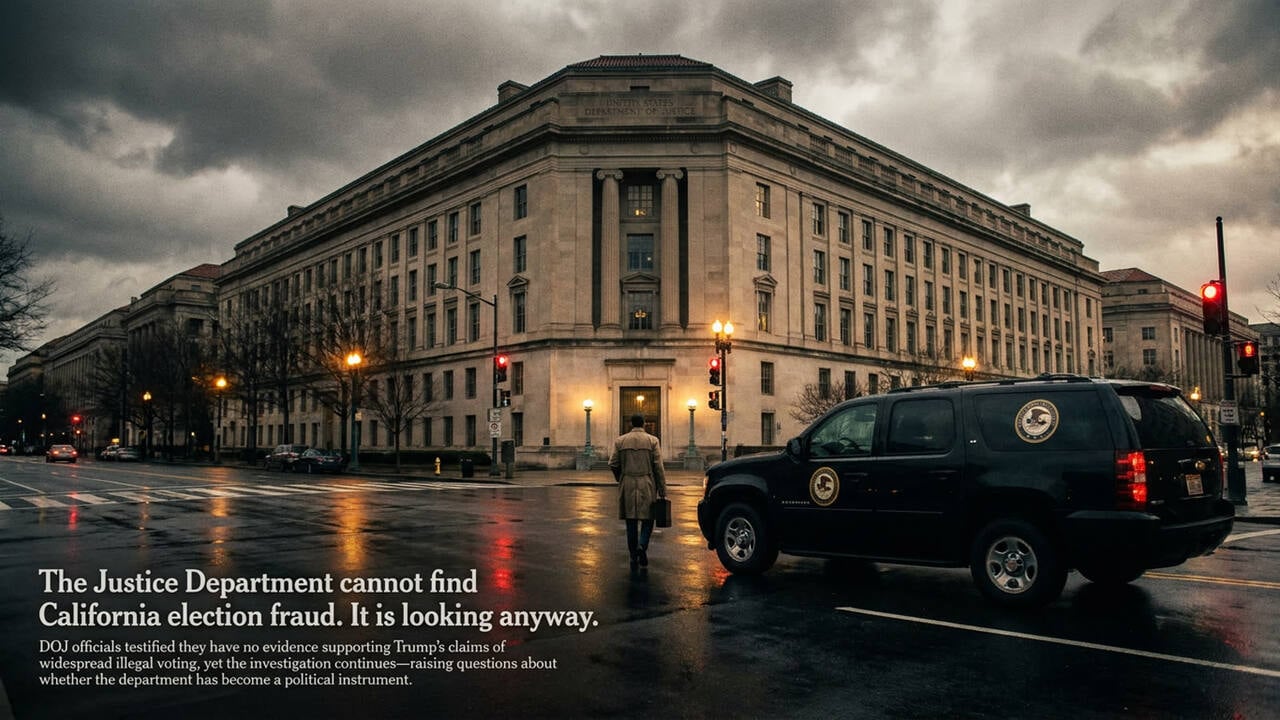
When Justice Department officials appeared before Congress this week, they faced a simple question: does evidence exist to support President Trump's repeated assertions that California's 2024 election was riddled with fraud? The answer, delivered with the bureaucratic delicacy of officials who understand their jobs depend on a mercurial principal, was effectively no.
Yet the investigation persists. This is the tell.
The testimony two-step
DOJ officials performed what has become a familiar Washington choreography: acknowledging the absence of evidence while refusing to close the case. They could not point to credible allegations of systematic illegal voting. They could not identify criminal referrals from state officials. They could not explain what, precisely, they were investigating beyond the president's public statements.
What they could do was decline to rule anything out. In the current Justice Department, this passes for independence.
The California fraud narrative has been a Trump fixture since 2016, when he claimed without evidence that millions of illegal votes explained his popular-vote loss. A presidential commission convened to find such fraud disbanded in 2018 having found nothing. State audits, court challenges, and independent analyses have consistently shown California's elections to be administered competently and counted accurately.
None of this has altered the president's position, and the Justice Department's willingness to chase claims its own officials cannot substantiate suggests the institution has absorbed a troubling lesson: the investigation is the point.
What precedent permits
Defenders of the DOJ's posture argue that investigating presidential concerns, however thinly sourced, falls within prosecutorial discretion. This is technically true and entirely beside the point. Prosecutors have discretion precisely so they can decline to pursue cases lacking evidentiary foundation. Using that discretion to pursue them anyway inverts the principle.
The practical effect is a permanent cloud over California's electoral legitimacy—useful for delegitimizing the nation's largest Democratic stronghold, corrosive for public faith in elections generally. That DOJ officials seemed uncomfortable with this arrangement during testimony is the thinnest of reassurances. Discomfort is not resignation.
Our take
The Justice Department's dance around Trump's California claims is not a mystery requiring investigation; it is a demonstration requiring observation. An institution that investigates claims its officials cannot support, at the direction of a president who has made those claims a political brand, is an institution that has traded independence for survival. The officials who testified may believe they are threading a needle. They are illustrating a surrender.