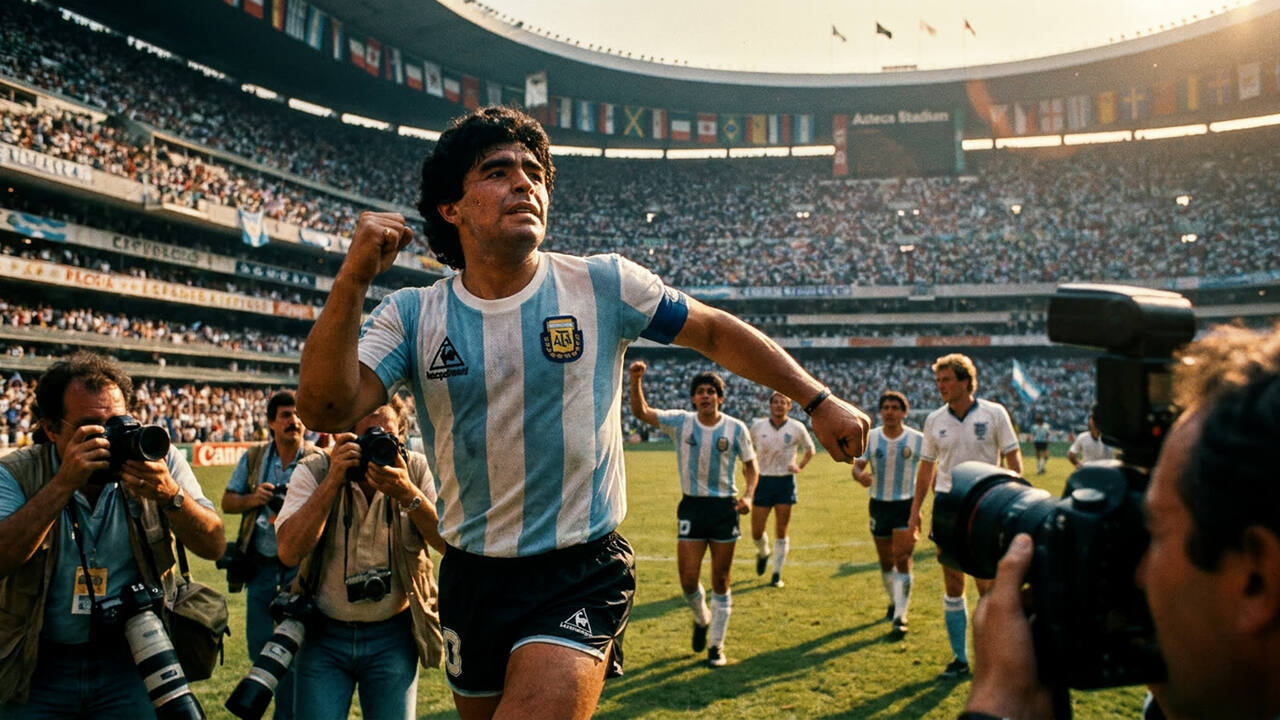
Football has produced countless moments of genius, but only one has its own theological nickname. When Diego Maradona's left fist connected with the ball before Peter Shilton's gloves could reach it in the 1986 World Cup quarter-final, he created something more durable than a goal: he created a permanent argument.
The facts are not in dispute. Maradona, all five feet five inches of him, rose improbably above England's goalkeeper and punched the ball into the net. The Tunisian referee saw nothing. Argentina went ahead. Four minutes later, Maradona scored what many consider the greatest goal in World Cup history, slaloming past half the English team. Argentina won 2-1 and eventually lifted the trophy.
The politics nobody can escape
To understand why this particular piece of gamesmanship transcended sport, you must understand timing. The match came four years after the Falklands War, in which Britain and Argentina fought over islands in the South Atlantic. Nearly a thousand people died. The wound was fresh, and Maradona knew it. "It was like stealing the English's wallet," he later said, with characteristic lack of diplomatic restraint.
This context transformed a handball from an officiating failure into an act of symbolic revenge. In Argentina, it became a David-versus-Goliath moment, the scrappy kid from the Buenos Aires slums outwitting the colonial power. In England, it became evidence of Latin duplicity and referee incompetence. Both narratives missed the point while also making it.
Why football tolerates the con artist
The Hand of God exposed something uncomfortable about football's moral architecture. The sport has always maintained an uneasy relationship with deception. Diving is condemned but rewarded. Time-wasting is universal. The dark arts of defending—shirt-pulling, tactical fouling, psychological warfare—are taught at academies worldwide.
Maradona understood this better than anyone. He operated in a sport where the rules are suggestions and enforcement is theatrical. His genius was recognizing that referees are human, crowds are partisan, and history is written by winners. The handball was not an aberration from his character; it was its purest expression.
The goal that complicated everything
What makes the Hand of God truly maddening is what followed it. Had Maradona scored only the handball, he might be remembered as a cheat who got lucky. Instead, he produced the Goal of the Century, a sixty-yard run of such absurd beauty that it seemed designed to make the earlier transgression forgivable. It was as if a bank robber, having escaped with the vault's contents, returned to leave behind a Vermeer.
This sequencing matters. The two goals exist in permanent dialogue, each changing the meaning of the other. The handball looks less cynical when followed by transcendence; the brilliant goal looks more human when preceded by cunning. Together, they form a complete portrait of Maradona himself: part angel, part devil, entirely unforgettable.
Our take
The Hand of God endures because it refuses to resolve into a simple lesson. It is not a story about cheating being wrong, because Maradona was never punished and Argentina won the World Cup. It is not a story about cheating being acceptable, because the outrage has never subsided. It is, instead, a story about football's willingness to contain contradictions—to celebrate a man who broke the rules in the same breath as he transcended them. VAR would have disallowed the goal in seconds. Something irreplaceable would have been lost.