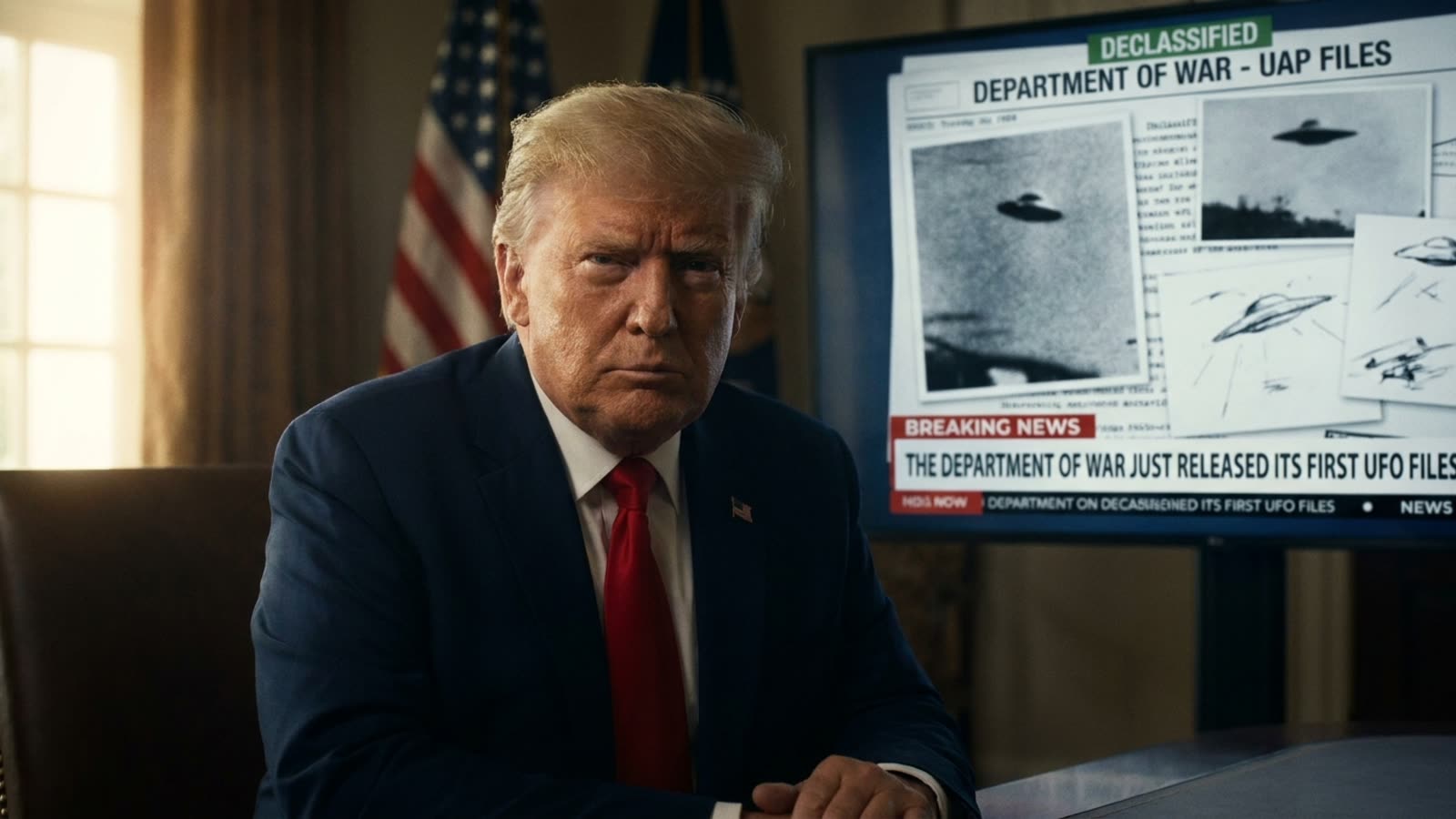
The Department of War on Friday released the first tranche of documents from what President Donald Trump called, in a February 2026 truth social post, "the full alien disclosure this country was promised forty years ago." The files include photographs taken during Apollo and Space Shuttle missions, redacted pilot debriefs from the Navy's 2004 Nimitz encounter, and — in the most viral addition — hand-drawn sketches submitted by alleged civilian eyewitnesses, some of them dating to the 1970s.
The release, which appeared on a newly built DoW transparency portal at 9:58 AM Eastern, is the first deliverable on a promise Trump made shortly after former President Barack Obama said on a podcast in February that "yes, there are things up there we cannot explain, and yes, we have footage." Within a week of that podcast, Trump had committed to a full declassification effort. Within three months, the Department of Defense had been renamed the Department of War. On Friday, the paperwork caught up.
What is actually in the files
Skeptics are, so far, not rioting. The documents released Friday include a substantial amount of already-public material — the infamous "Gimbal" and "Go-Fast" Navy videos, both of which have been in the public record since 2017, are included in high-resolution form. What is new is the written material around them: the internal chain-of-custody memos, the range safety reports, the logs from the E-2D Hawkeye controllers who were tracking the objects on radar that day.
There are also two items that had not been expected. The first is a set of photographs from the crew of STS-80, taken in 1996, showing what NASA at the time described as "ice crystals in sunlight," but which the declassified internal memo Friday describes as "unresolved." The second is a sketch collection — dozens of civilian reports submitted to Project Blue Book between 1966 and 1969 — that the government has simply never released before.
The skeptic community reacts
Mick West, the engineer who has spent a decade debunking UAP videos on YouTube, posted a cautious thread on X within an hour of the release. "Most of this is stuff I already have," he wrote. "A couple of the STS-80 images are new to me. I am going to need a day." Physicist Sean Carroll, who has been one of the more prominent skeptics of the disclosure movement, called the release "interesting, slightly underwhelming, and entirely consistent with the hypothesis that there is no physical anomaly here, but a lot of unexplained optical and sensor artifacts."
The believer community, predictably, is declaring victory. Luis Elizondo, the former Pentagon official who has been at the center of the disclosure push since 2017, called it "the beginning, not the end."
Why the politics matter
Trump is playing a long game. The UFO file release is bipartisan catnip — Obama endorsed the premise, Trump is executing it, and both sides of the political spectrum get to claim credit. It also provides a steady news drip for a White House that has spent the week managing a shaky Iran ceasefire and a renewed gas-price crisis. A headline about declassified UFOs is a headline that is not about the war.
Our take
The files are real, the release is historic, and nothing in it so far requires rewriting physics. But the political craft is flawless — Trump just monetized the one topic where Americans are willing to agree with a president from the other party. Whether or not there are aliens, the disclosure politics are a case study in how to dominate a news cycle without spending a dollar.