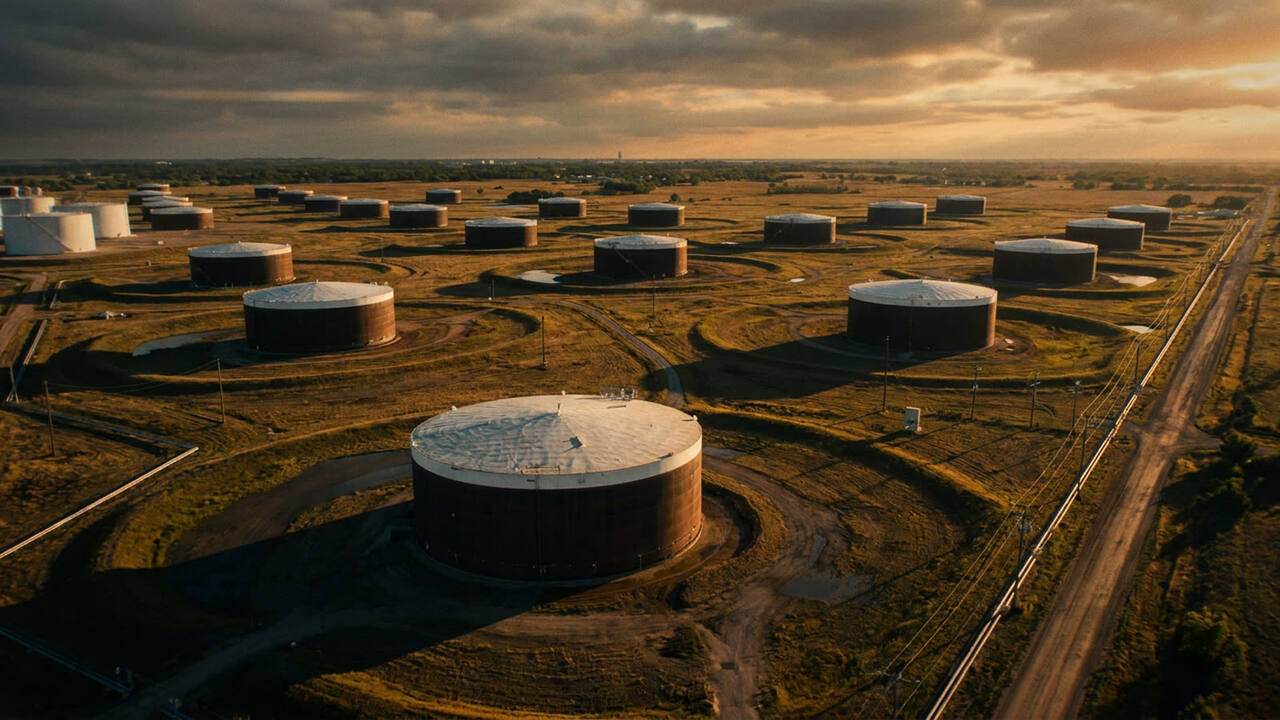
For decades, the sprawling tank farms of Cushing, Oklahoma have served as the beating heart of American oil markets — the delivery point for West Texas Intermediate futures, the benchmark against which billions of dollars in contracts are priced daily. Now that heart is approaching cardiac arrest.
Inventory levels at Cushing have fallen to roughly 22 million barrels, perilously close to the operational minimum of around 20 million barrels needed to keep pipelines flowing and contracts settling. Below that threshold, the infrastructure simply cannot function as designed. This is not a theoretical concern; it is a mechanical reality that traders are pricing into every barrel.
How we got here
The drawdown reflects a confluence of pressures that have been building for eighteen months. OPEC+ production cuts, implemented to support prices after the 2024 demand wobble, have tightened global supply precisely as Asian demand — particularly from India — has exceeded forecasts. Meanwhile, American shale producers, chastened by the capital destruction of the 2015-2020 boom-bust cycle, have maintained unusual discipline, prioritizing shareholder returns over volume growth.
The result is a market that has quietly shifted from abundance to constraint. Cushing, which peaked above 65 million barrels during the pandemic storage crisis, has been draining steadily. The current trajectory suggests operational minimums could be tested within weeks, not months.
What scarcity means for prices
When physical oil becomes genuinely scarce at the delivery point, the futures curve contorts. Backwardation — where near-term contracts trade at premiums to distant months — intensifies dramatically. Refiners scramble. Traders who sold contracts assuming easy delivery face expensive scrambles to source physical barrels.
The last time Cushing approached these levels, in late 2023, WTI spiked above $95 before Saudi Arabia signaled production increases. This time, the geopolitical backdrop is more fraught. The ongoing conflict in the Middle East has already removed Iranian barrels from legitimate markets, and the diplomatic maneuvering around potential peace deals has introduced wild volatility.
The diplomacy angle
Cushing's distress is not merely a trading story; it is becoming a foreign policy input. The pressure on American consumers — and by extension, American politicians — creates incentives for deals that might otherwise be unpalatable. When gasoline prices climb, administrations become remarkably creative about whom they will negotiate with.
The current chatter about potential Iran rapprochement, which sent oil tumbling and equities jumping earlier this week, is inseparable from the physical reality in Oklahoma. Diplomacy and tank levels are more connected than most foreign policy analysts care to admit.
Our take
The Cushing situation is a reminder that commodity markets are ultimately physical, not financial. All the derivatives and algorithms in the world cannot conjure barrels that do not exist. For years, American energy abundance made scarcity feel like a relic of the 1970s. That complacency is about to be tested. The tanks do not care about your models.