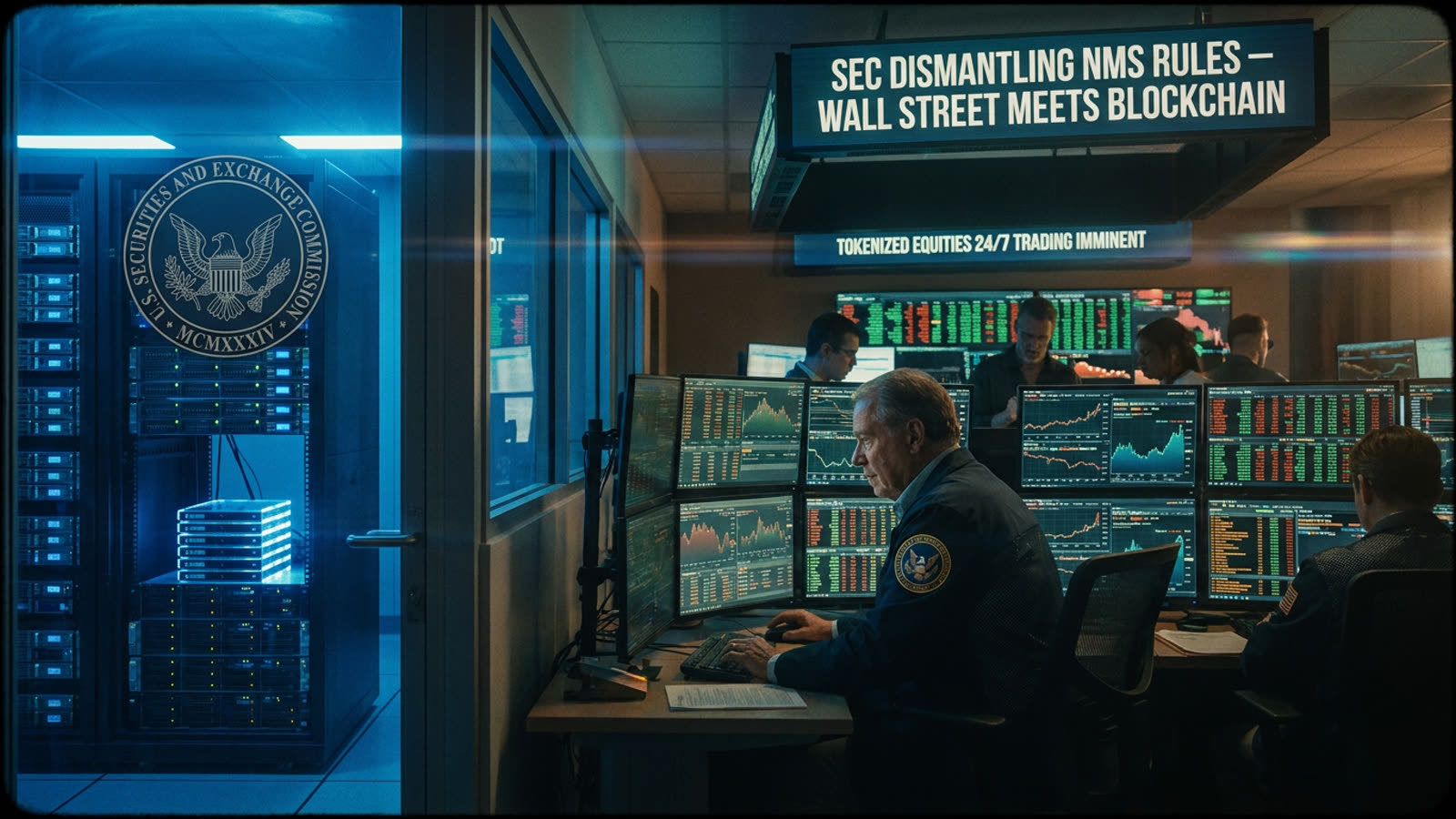
For decades, the National Market System rules have been the invisible architecture of American stock trading — a dense thicket of regulations ensuring that when you buy shares of Apple, you get the best available price across all exchanges. Now the Securities and Exchange Commission is proposing to scrap key provisions, and the implications extend far beyond traditional finance.
The immediate beneficiaries are obvious: established exchanges seeking more flexibility, high-frequency traders chafing under best-execution requirements, and brokerages tired of routing gymnastics. But analysts are pointing to a less obvious winner: the nascent industry of tokenized securities, which has spent years waiting for regulatory permission to exist.
Why NMS rules blocked tokenized stocks
The National Market System, established in 1975 and significantly updated in 2005, requires that stock trades be routed to whichever exchange offers the best price at any given moment. This sounds consumer-friendly, and it is — but it also means that any new trading venue must integrate seamlessly with the existing ecosystem of Nasdaq, NYSE, and their competitors.
Tokenized stocks, which represent equity ownership as blockchain tokens, cannot easily comply. They trade on decentralized infrastructure, often around the clock, and their price discovery mechanisms do not fit neatly into the consolidated tape that NMS mandates. The result has been a regulatory no-man's-land: companies like Dinari and Backed Finance have offered tokenized versions of stocks, but always with significant limitations or by operating offshore.
The SEC's proposal would eliminate the requirement that trades be routed to the venue with the best displayed price, instead allowing brokers more discretion. For tokenized securities, this is the unlock they have been waiting for.
The 24/7 trading question
American stock markets operate roughly six and a half hours per day, five days per week. Crypto markets never close. If tokenized stocks gain regulatory clearance, they would likely inherit crypto's always-on nature — letting retail investors in Tokyo trade Tesla at 3 a.m. Eastern time, or allowing someone to react to Sunday-night news without waiting for Monday's opening bell.
Proponents argue this democratizes access. Critics worry it would advantage sophisticated traders who can monitor markets continuously, while retail investors sleep through adverse price movements. The debate is not new — it has simmered for years in discussions about extended-hours trading — but tokenization would make 24/7 markets the default rather than the exception.
The institutional hesitation
Wall Street's largest players remain cautious. Tokenized securities require new custody solutions, unfamiliar settlement mechanics, and exposure to blockchain risks that traditional prime brokers are not equipped to assess. The SEC's rule change, if finalized, would remove one obstacle but leave many others intact.
Still, the direction of travel is clear. BlackRock's recent filings for yield-bearing crypto products suggest that the world's largest asset manager sees blockchain-based finance as inevitable rather than experimental. When BlackRock moves, others follow.
Our take
The SEC is not proposing these changes to help crypto — it is responding to pressure from traditional exchanges and market makers who want fewer constraints. But regulatory intent matters less than regulatory effect. By loosening the rules that kept tokenized securities in legal limbo, the commission is inadvertently building the on-ramp for a hybrid financial system where stocks trade like crypto and crypto trades like stocks. Whether that is progress or chaos depends on which side of the trade you are standing on.