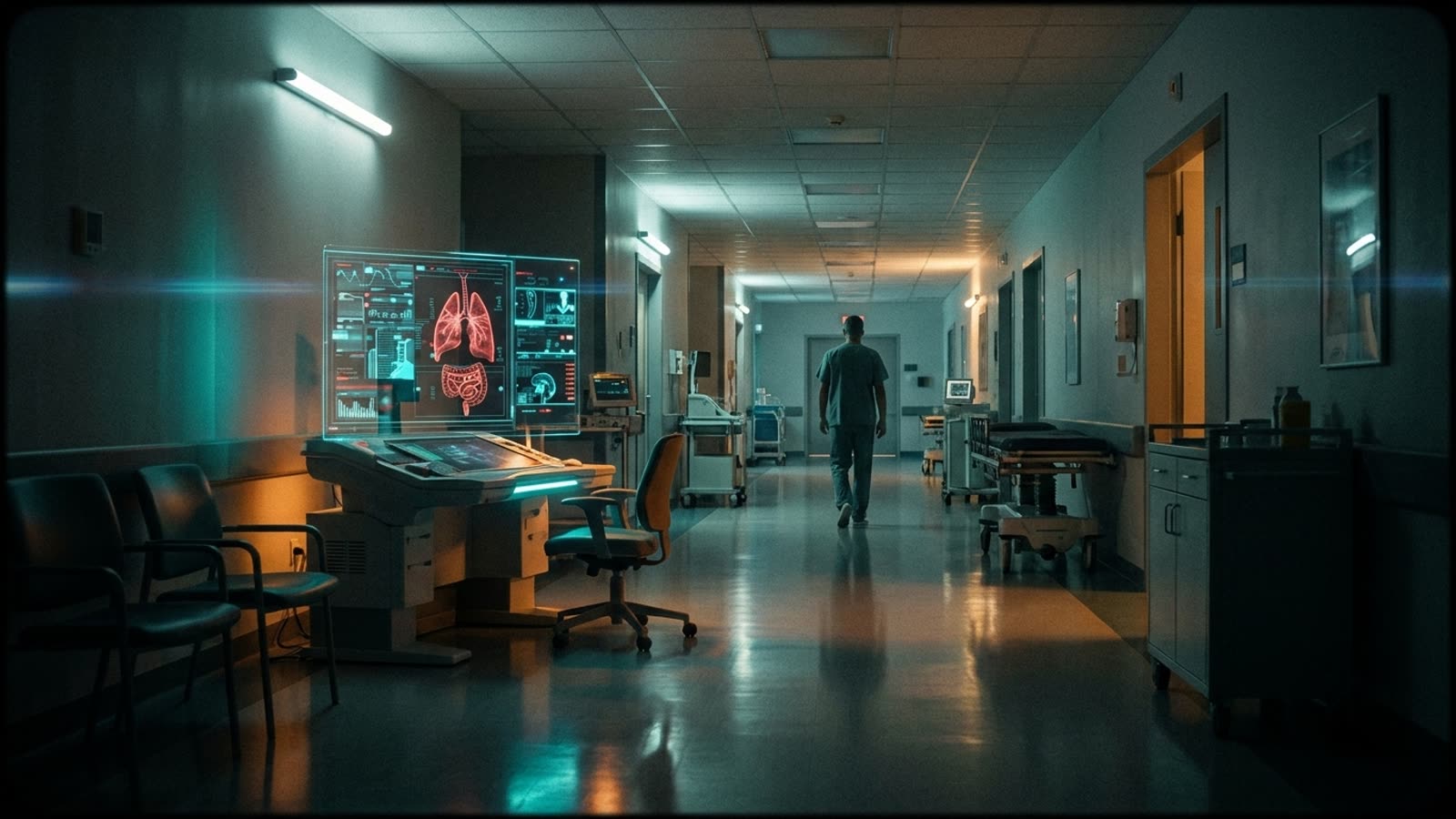
The transformation happened without fanfare. Across hospitals in Seoul, Munich, Boston, and São Paulo, radiologists now routinely consult algorithmic second opinions before signing off on chest X-rays, mammograms, and CT scans. The software flags suspicious nodules, measures tumor progression, and prioritizes urgent cases in the reading queue. Most patients never know their images passed through silicon judgment before reaching human eyes.
This quiet integration represents something genuinely new in medicine: not automation replacing a task, but augmentation reshaping how expertise itself functions. The radiologist still makes the diagnosis. But the cognitive process—what catches attention, what gets scrutinized, what confidence feels like—has been subtly rewired.
The workflow nobody talks about
Ask radiologists about AI and most will offer measured enthusiasm. The tools catch things. A study might show the algorithm detected a lung nodule the physician initially missed. Another demonstrates faster turnaround times in emergency departments. The efficiency gains are real.
But spend time in reading rooms and a more complicated picture emerges. Physicians describe a phenomenon some call "automation bias"—the tendency to trust the machine's assessment, particularly when fatigued or rushed. When the AI highlights a region, attention flows there. When it stays silent, vigilance can quietly erode. The software becomes a cognitive anchor, and anchors are difficult to escape.
There is also the inverse problem: alert fatigue. Systems calibrated for sensitivity generate false positives. Radiologists learn to discount certain warnings, developing intuitions about when the algorithm is crying wolf. This creates a strange new skill—reading the AI as much as reading the scan.
The liability question nobody has answered
Medical malpractice law assumes a physician exercised judgment. But what happens when that judgment was shaped by an algorithmic recommendation? If a radiologist follows AI guidance that proves wrong, who bears responsibility? If they override correct AI guidance based on their own assessment, does that constitute negligence?
These questions remain largely untested in courts. Hospitals have generally treated AI tools as they treat any diagnostic aid—useful but not determinative, with ultimate responsibility resting on the physician's signature. Yet this framework may not survive contact with a high-profile case where an algorithm's recommendation sits clearly in the medical record.
The deeper issue is epistemological. Modern AI systems—particularly deep learning models—do not explain their reasoning. They output probabilities, not arguments. A radiologist can articulate why a shadow looks concerning: its shape, density, location relative to anatomical structures. The algorithm simply assigns a number. When physician and machine disagree, the human cannot interrogate the computer's logic because, in any meaningful sense, there is no logic to interrogate.
What expertise becomes
The optimistic view holds that AI handles pattern recognition while humans contribute contextual judgment—integrating imaging findings with patient history, clinical presentation, and the ineffable sense of what matters for this particular person. The pessimistic view worries that skills atrophy when outsourced, that a generation trained with algorithmic assistance may never develop the deep perceptual expertise their mentors acquired through unassisted repetition.
Both views probably contain truth. Radiology residency programs are already grappling with curriculum questions: how much time on fundamentals versus AI-assisted workflows? The profession that emerges may be genuinely different—not worse, but different—in ways that will only become clear decades hence.
Our take
The AI transformation of radiology deserves attention precisely because it is so undramatic. No robot replaced a doctor. No algorithm made a decision. Instead, a subtle reconfiguration of perception and judgment is underway, one that physicians themselves struggle to fully articulate. This is likely how AI will reshape most knowledge work: not through displacement but through quiet partnership, with consequences that reveal themselves slowly and resist easy measurement. The radiologist's dilemma—how to remain genuinely expert while relying on tools that outperform human perception in narrow domains—will soon belong to lawyers, accountants, engineers, and editors. We are all learning to think alongside machines that do not think at all.