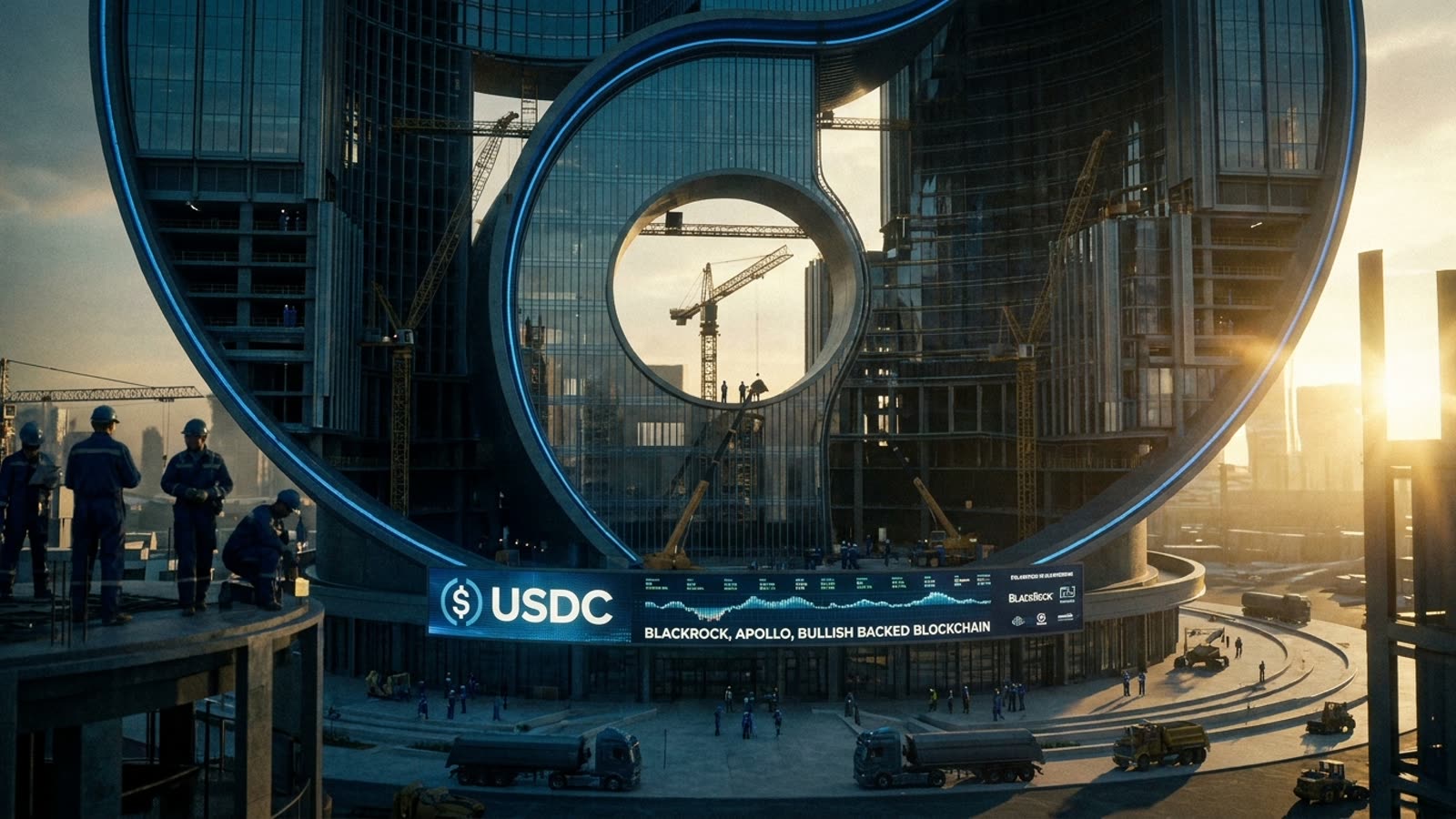
The stablecoin company that spent years convincing regulators it was boring has just done something decidedly un-boring: Circle has raised $222 million for Arc, a new blockchain, at a $3 billion valuation. The investor list reads less like a crypto cap table and more like a Davos dinner party—BlackRock, Apollo Global Management, and Bullish, the exchange backed by Peter Thiel and the founders of Block.one.
This is not a pivot. It is an escalation. Circle has spent the post-FTX era positioning USDC as the responsible stablecoin, the one that files paperwork and holds Treasuries and does not collapse spectacularly on a Sunday evening. Arc represents the next phase: owning not just the dollar-denominated token but the infrastructure those tokens move on.
Why the backers matter more than the blockchain
Blockchains are cheap to launch and expensive to make relevant. What Circle is buying with this raise is not technology—it is legitimacy by association. BlackRock does not need exposure to another Layer 1; it manages $10 trillion and could build its own. Apollo does not need yield; it underwrites the debt markets. Their participation is a signal to the regulated financial world that Arc is pre-approved for serious consideration.
The $3 billion valuation, meanwhile, is aggressive but not absurd in a market where Solana trades at a $70 billion fully diluted cap and even post-crash tokens like Avalanche hover near $10 billion. Circle is betting that a blockchain purpose-built for institutional stablecoin flows can capture value that generalist chains cannot.
The USDC empire expands
Circle's core business remains USDC, which currently has roughly $32 billion in circulation—a distant second to Tether's $110 billion but growing steadily in regulated corridors. Arc is designed to make USDC stickier: if institutions settle trades, move collateral, or tokenize assets on Circle's own chain, switching costs rise and Circle captures fees at every layer of the stack.
This is the Amazon Web Services playbook applied to money movement. Build the infrastructure, let others build on top, and take a toll on every transaction. Whether Arc can achieve the network effects required to matter is an open question, but the capital and credibility are now in place to make a serious attempt.
Our take
The crypto industry spent 2022 and 2023 learning that institutions would not save it from its own excesses. Now the lesson is reversing: institutions are not here to save crypto, but they are here to absorb it. Circle raising from BlackRock and Apollo is not a victory for decentralization—it is a sign that the most valuable parts of the crypto stack are being professionalized, consolidated, and priced accordingly. The question is no longer whether traditional finance will embrace blockchain rails. It is whether anyone outside the traditional finance tent will get to own them.