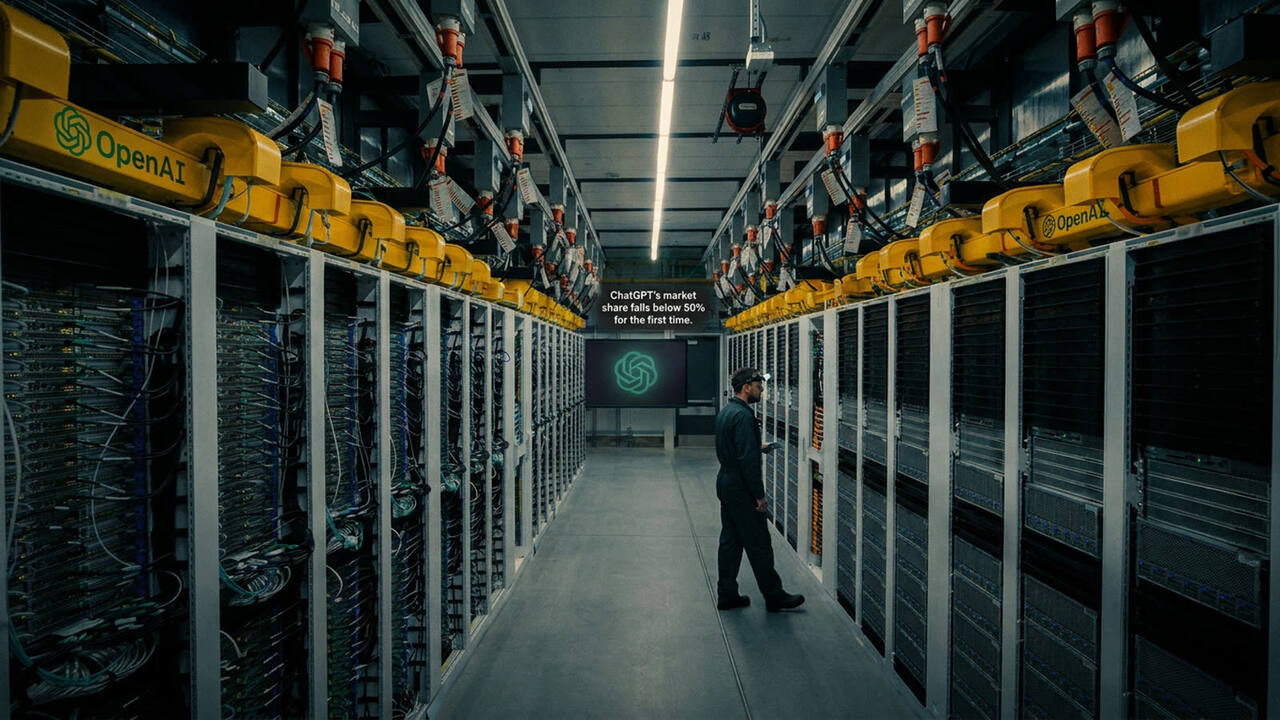
For nearly three years, ChatGPT was not merely the leading AI chatbot — it was, for most consumers, the only one that mattered. That era is over. According to new market data, OpenAI's flagship product has slipped below 50% market share for the first time since its November 2022 launch, ceding ground to a growing constellation of rivals including Google's Gemini, Anthropic's Claude, and a surprisingly resilient cohort of open-source alternatives.
The milestone is symbolic but not trivial. ChatGPT's dominance was so complete that "ChatGPT" became a generic term, the way "Google" became synonymous with search or "Kleenex" with tissues. Losing majority share suggests the underlying market dynamics are shifting from a monopoly-in-formation to something messier and more competitive.
The erosion was gradual, then sudden
OpenAI's share peaked somewhere north of 70% in early 2024, when GPT-4 still felt like science fiction and competitors were scrambling to catch up. But the moat proved shallower than expected. Google integrated Gemini across its product suite — Gmail, Docs, Search — giving it distribution advantages that even OpenAI's viral growth couldn't match. Anthropic carved out a niche among enterprise customers and developers who valued Claude's longer context windows and more cautious safety profile. Meanwhile, Meta's open-weight Llama models enabled a Cambrian explosion of fine-tuned alternatives that appealed to cost-conscious businesses and privacy-focused users.
OpenAI's own stumbles accelerated the decline. The company's leadership turmoil in late 2023 spooked enterprise customers. Pricing increases pushed budget-sensitive users toward alternatives. And the much-hyped GPT-5, delayed multiple times, has yet to deliver the generational leap that might have consolidated the company's position.
What fragmentation means for the market
A splintered AI chatbot market is good news for consumers and businesses, who benefit from competition on price, features, and safety practices. It's less encouraging for OpenAI's investors, who valued the company at north of $150 billion on the assumption that it would dominate generative AI the way Google dominated search.
The comparison to search is instructive. Google captured and held 90%-plus market share for two decades because search exhibits strong network effects: more users generate more data, which improves results, which attracts more users. AI chatbots, it turns out, don't work quite the same way. The underlying models are increasingly commoditized. Switching costs are low. And no single company has yet demonstrated the kind of compounding advantage that makes monopoly inevitable.
Our take
ChatGPT's slide below 50% is less a failure of OpenAI than a correction of inflated expectations. The company remains enormously influential, its models still best-in-class for many applications, its brand recognition unmatched. But the notion that generative AI would produce a single dominant platform — a new Google, a new Microsoft — now looks naive. The future is pluralistic, which is probably healthier for everyone except the venture capitalists who bet on winner-take-all.