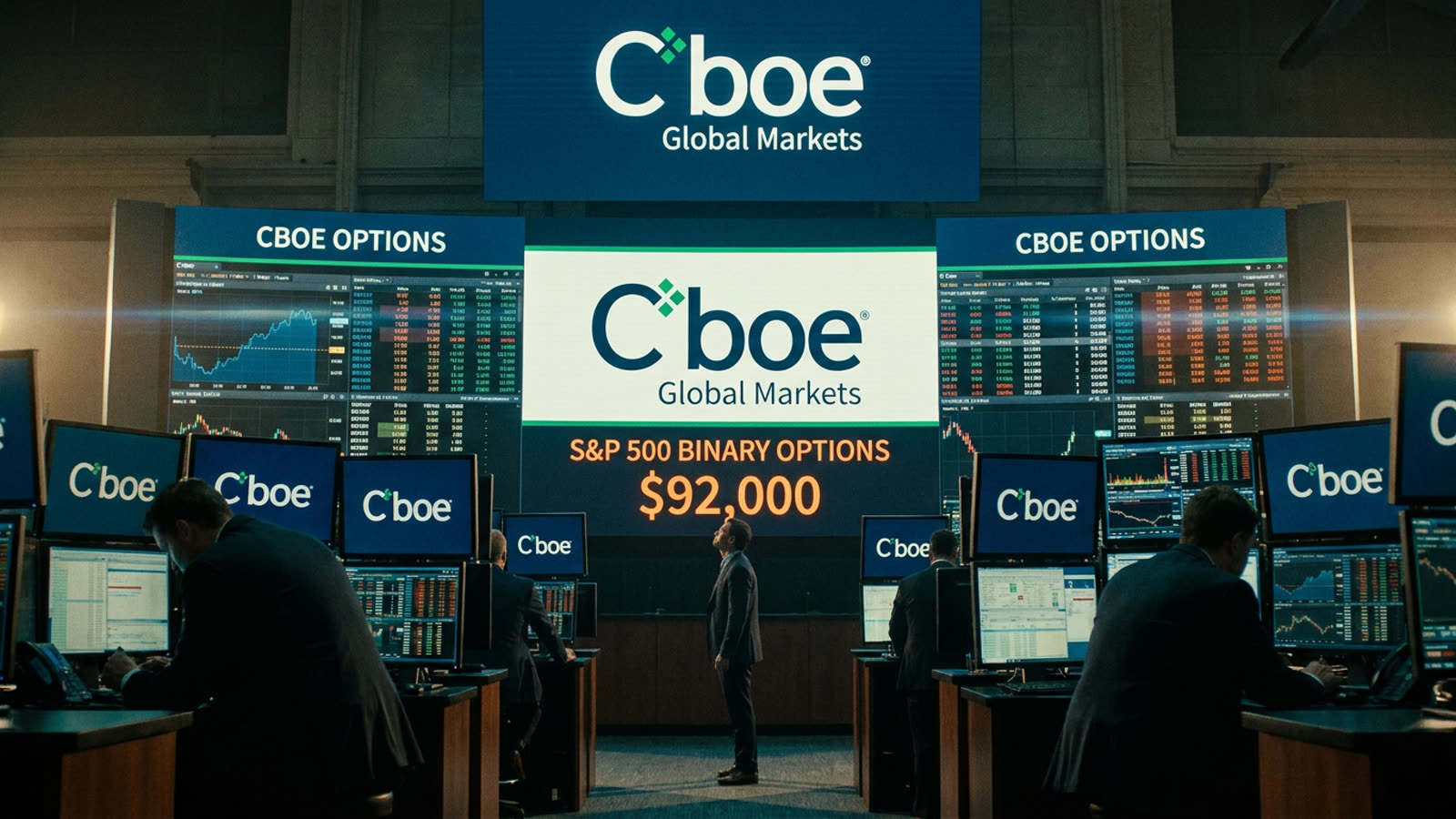
The Chicago Board Options Exchange, founded in 1973 as the first regulated options market in America, is returning to a product it abandoned years ago — binary options on the S&P 500 — because a bunch of crypto-native platforms proved there was real demand for simple yes-or-no wagers on market outcomes. This is not innovation; it is imitation dressed in regulatory respectability.
Cboe's announcement frames the revival as meeting "evolving trader demand," but the subtext is unmistakable. Polymarket, the blockchain-based prediction market that became a genuine cultural phenomenon during the 2024 U.S. election cycle, and Kalshi, the CFTC-regulated exchange that has spent years fighting for the right to list event contracts, have demonstrated that traders — retail and institutional alike — want cleaner, more intuitive instruments than the Greeks-laden complexity of traditional options.
The appeal of binary simplicity
A binary option is brutally straightforward: the S&P 500 closes above 5,500 on Friday, or it doesn't. You win a fixed payout, or you lose your stake. No delta hedging, no theta decay, no implied volatility surface to model. For a generation of traders raised on sports betting apps and crypto perpetuals, this legibility is the product's entire value proposition.
Traditional options desks have long sneered at binaries as the province of offshore bucket shops and unsophisticated punters. But Polymarket processed over $3 billion in volume around the 2024 election alone, and Kalshi has steadily expanded its menu of economic and political contracts. The condescension has become harder to sustain.
Regulatory arbitrage in reverse
What makes Cboe's move notable is the direction of regulatory flow. Typically, crypto products emerge in lightly regulated offshore venues and gradually seek legitimacy onshore. Here, a pillar of the traditional financial establishment is adopting a product category that prediction-market startups pioneered and popularized. Cboe is not bringing order to chaos; it is chasing a market that chaos created.
The exchange's regulatory moat remains formidable — Cboe binary options will settle in dollars, clear through established infrastructure, and carry the imprimatur of SEC oversight. For institutional allocators who cannot touch Polymarket's USDC-settled contracts, Cboe offers a compliant on-ramp. But the strategic initiative belongs to the disruptors.
Our take
Cboe's binary-options revival is a small product launch with large symbolic weight. It confirms that prediction markets have graduated from curiosity to category, and that even the most established venues now benchmark themselves against crypto-native competitors. The incumbents are not leading; they are following, and doing so somewhat sheepishly. In the long arc of financial innovation, this is how paradigms shift — not with a bang, but with a legacy exchange quietly copying the upstarts it once dismissed.