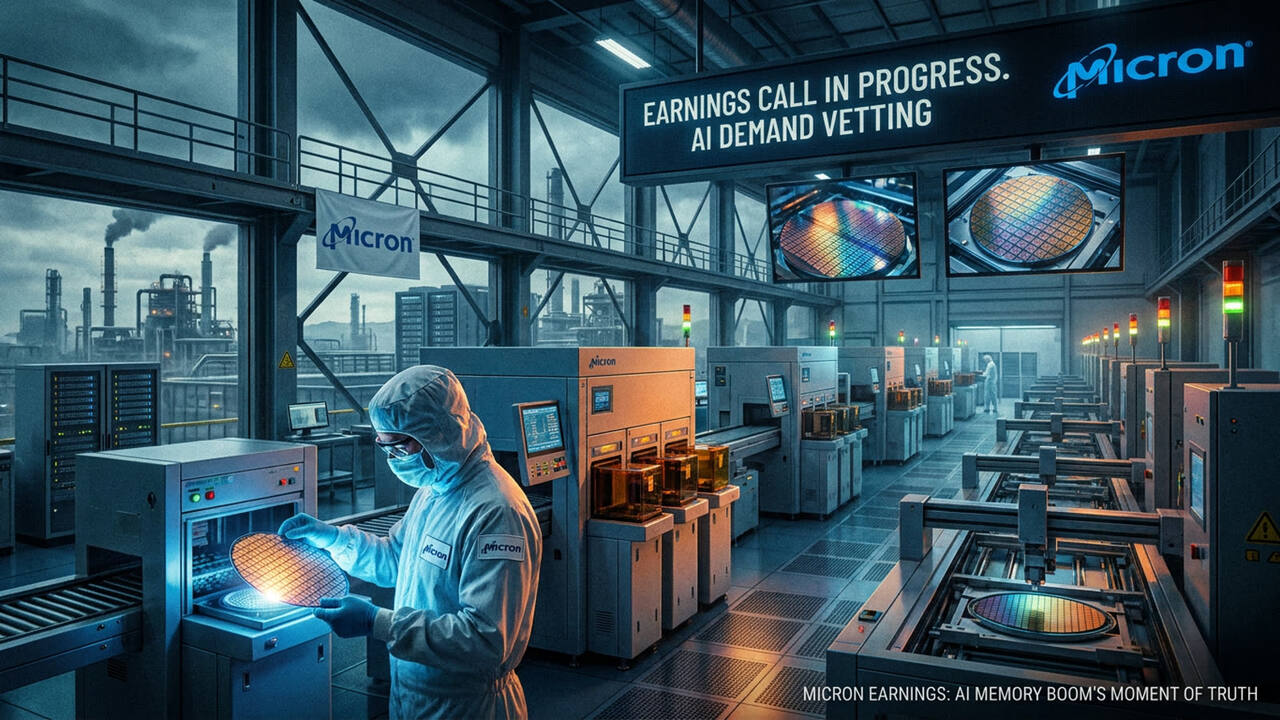
The semiconductor industry has spent 2026 riding a wave of AI enthusiasm that has lifted even the most cyclical chip names into the stratosphere. Today, Micron Technology reports earnings, and the results will serve as a referendum on whether the memory market's AI-driven renaissance is sustainable or simply another chapter in the sector's long history of boom-and-bust cycles.
Memory chips are the unglamorous workhorses of the AI revolution. While Nvidia captures headlines with its GPU dominance, every data center training large language models requires vast quantities of high-bandwidth memory to feed those processors. Micron, alongside Samsung and SK Hynix, manufactures the DRAM and NAND flash that makes AI inference possible at scale. The question Wall Street needs answered: is enterprise demand strong enough to absorb the industry's aggressive capacity expansion?
The stakes for the broader market
Micron's report arrives at a delicate moment. The S&P 500 and Nasdaq traded choppily today as investors sought direction after weeks of tech-sector volatility. Memory stocks have been particularly sensitive to sentiment shifts, having rallied hard on AI optimism only to give back gains whenever demand signals waver. A strong Micron quarter would validate the thesis that AI infrastructure spending remains robust despite macroeconomic headwinds. A miss would raise uncomfortable questions about whether chip companies have over-invested based on projections that assumed perpetual growth.
The company's guidance matters as much as its backward-looking numbers. Analysts will parse management's commentary on data-center orders, inventory levels at hyperscale customers, and pricing trends for high-bandwidth memory. Any hint of softening demand could ripple through the entire semiconductor supply chain.
Memory's peculiar economics
Unlike logic chips, memory is essentially a commodity. Prices swing wildly based on supply-demand imbalances, and the industry has historically suffered from coordination failures where all major players expand capacity simultaneously, crashing margins. The AI boom was supposed to break this pattern by creating a structural demand floor. Micron's results will test that theory.
The company has invested heavily in HBM3E, the latest generation of high-bandwidth memory designed specifically for AI accelerators. These chips command premium prices and fatter margins than standard DRAM. If Micron reports strong HBM sales but weakness in consumer-oriented segments, it would confirm that AI is genuinely reshaping the memory market's economics rather than just providing temporary relief.
Our take
Micron is the canary in the AI coal mine. The company lacks the pricing power of a GPU monopolist and cannot hide behind software margins. Its results reflect actual physical demand for silicon—how many chips are being pulled into data centers, at what prices, and whether customers are building inventory or depleting it. A beat would extend the semiconductor rally; a miss would force investors to reckon with the possibility that AI enthusiasm has outpaced AI reality. Either way, the answer matters far beyond Boise.