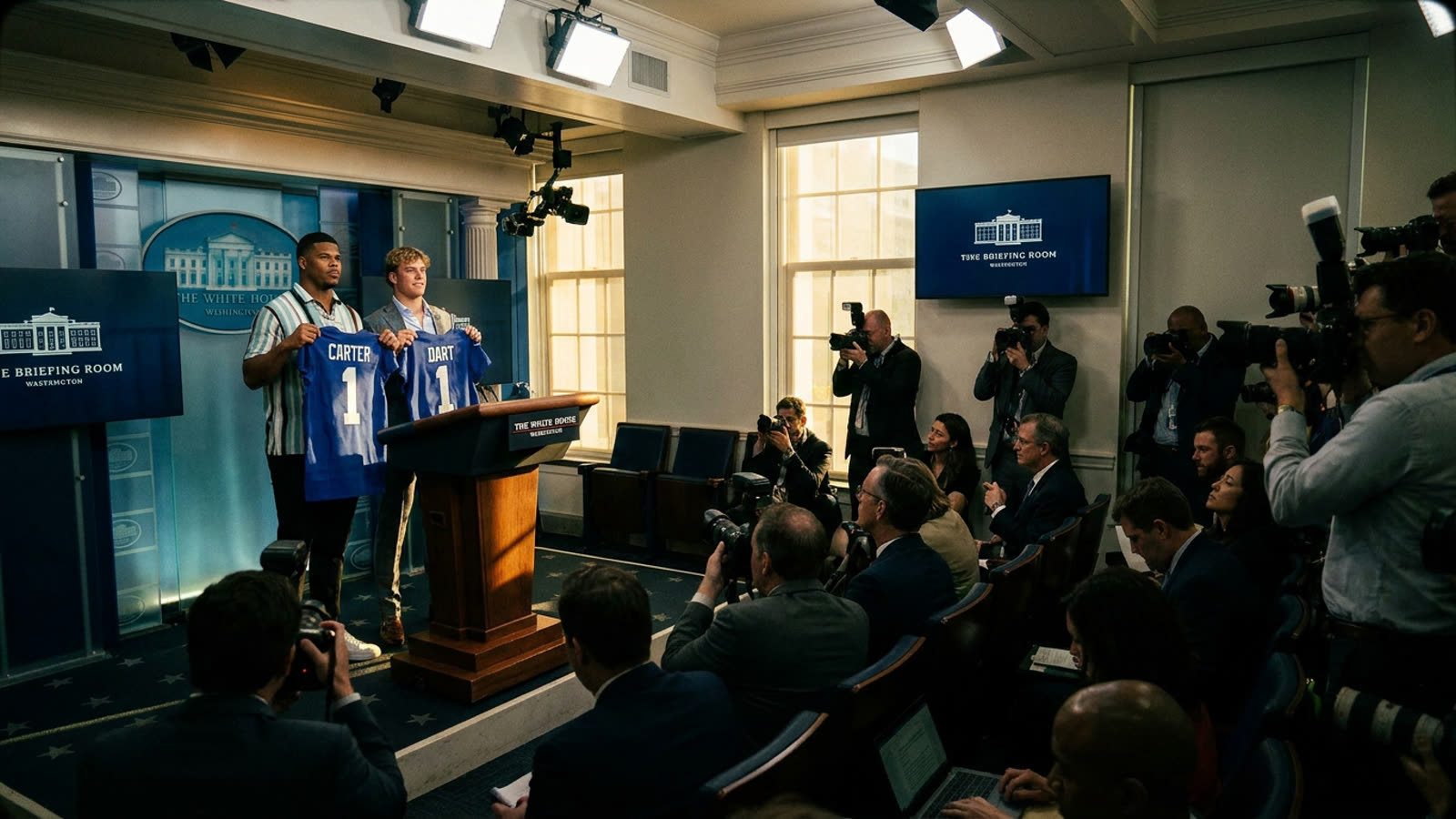
When sprinter Sha'Carri Carter and golfer Emily Dart issued a joint statement this week expressing unity following a dispute that had drawn presidential commentary, they demonstrated something increasingly rare in American public life: the capacity to disagree without requiring an external arbiter to declare a winner.
The two athletes had found themselves unexpectedly conscripted into a culture-war skirmish after former President Trump weighed in on their disagreement, framing it in the familiar terms of his ongoing campaign to position himself as the defender of women's sports against perceived threats. Carter and Dart, rather than accepting their assigned roles as combatants in someone else's political theater, chose to issue a statement that was notable for its studied blandness—and its implicit rebuke.
The conscription problem
Elite athletes have become accustomed to having their professional disputes weaponized for political purposes, but the speed and predictability of the cycle has accelerated. A disagreement that might once have been resolved in a locker room or through agents now becomes national news the moment it can be slotted into an existing narrative framework. The Trump campaign's focus on women's sports as a wedge issue means that any conflict involving female athletes is now potential ammunition.
Carter and Dart appear to have understood this dynamic and moved to neutralize it. Their joint statement emphasized their shared commitment to their respective sports and their mutual respect as competitors. The subtext was unmistakable: we did not ask to be part of your argument, and we decline the invitation.
The limits of conscription resistance
Whether this strategy can be replicated at scale remains uncertain. Carter and Dart had the advantage of genuine mutual respect and a dispute that was, by all accounts, relatively minor before it was amplified. Athletes facing more substantive disagreements, or those who genuinely hold opposing views on the political questions being projected onto their conflicts, may find it harder to present a united front.
There is also the question of whether declining to participate in political theater simply cedes the field to those willing to engage. The statement may have deprived the Trump campaign of two willing participants, but it did not prevent the dispute from being discussed in political terms, nor did it stop partisans on both sides from interpreting the athletes' silence as they wished.
Our take
The Carter-Dart détente is a small thing, easily dismissed as two professionals protecting their brands. But it represents something worth noting: a recognition that not every disagreement requires escalation, and that the parties to a dispute retain some agency over how it is characterized. In a political environment where conflict is the product and resolution is bad for engagement metrics, the decision to simply opt out carries its own quiet radicalism. The White House will find other athletes to conscript. The question is whether more of them will follow this template.