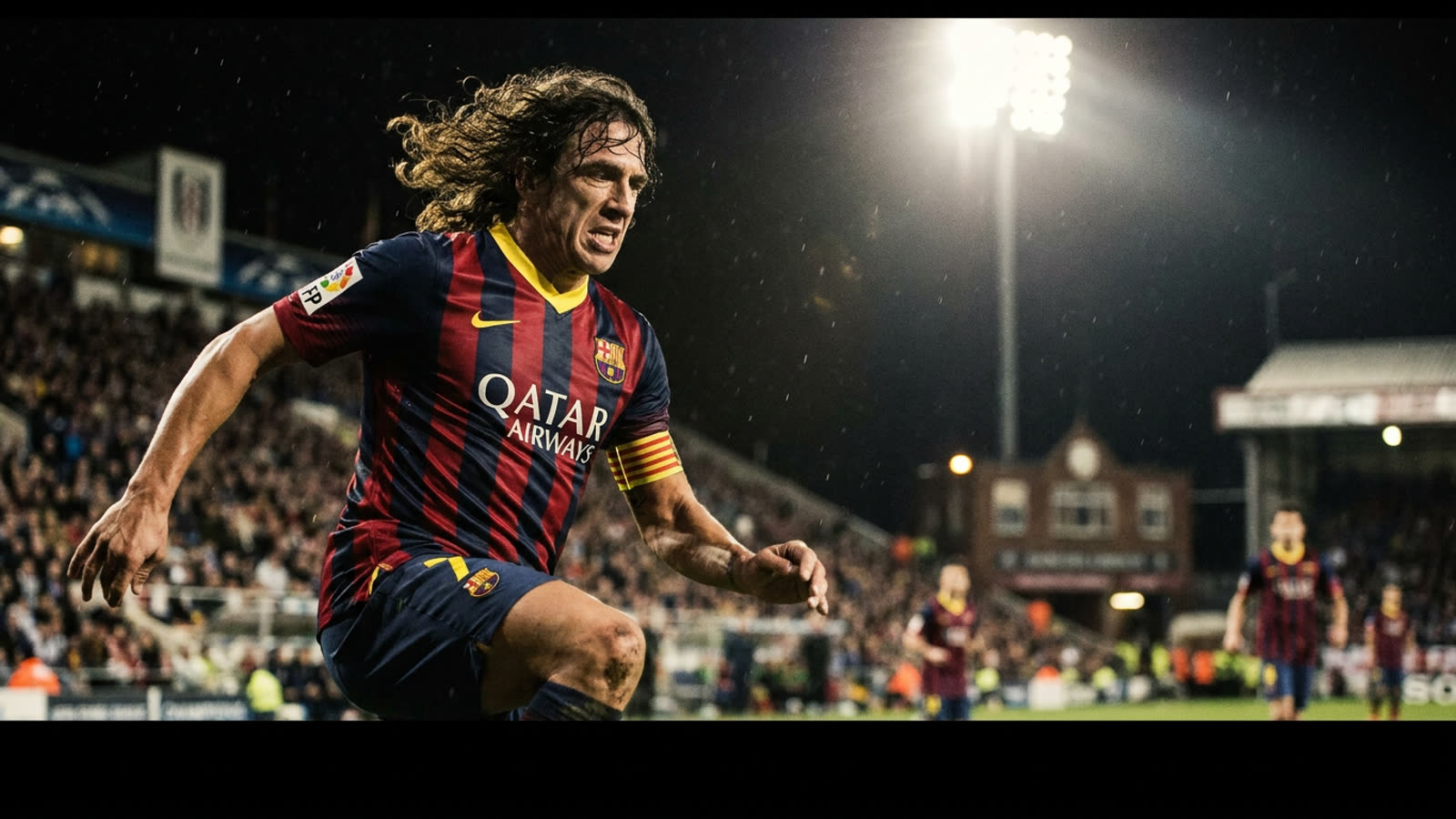
Modern football worships the orchestrator — the midfielder who dictates tempo, the forward who conjures magic from nothing. It has less vocabulary for the player who makes orchestration possible, the one whose job is to ensure the symphony hall doesn't collapse while the virtuosos perform. Carles Puyol spent his career being that structural necessity, and the game has struggled to replace him since his retirement.
The Catalan defender arrived at Barcelona's first team in 1999 with a mane of curly hair and a playing style that seemed almost anachronistic even then. He was not elegant like Paolo Maldini, not imperious like Franco Baresi, not blessed with the anticipation that made Fabio Cannavaro appear to read attackers' minds. What Puyol possessed instead was an almost irrational commitment to the collective cause — a willingness to sacrifice his body, his comfort, and his statistical profile for the team's benefit.
The architecture of selflessness
Puyol's career coincided with Barcelona's transformation into the most aesthetically celebrated club side in football history. The tiki-taka era demanded that every player contribute to possession, that defenders become auxiliary midfielders, that the back line push impossibly high to compress space. This system produced breathtaking football, but it also created enormous vulnerability. Someone had to be the last line of sanity when the high press was beaten, when Xavi's diagonal was intercepted, when Messi's dribble ended in dispossession thirty yards from goal.
That someone was almost always Puyol. His defensive statistics from this period tell an incomplete story — the interceptions and clearances are there, but they cannot capture the chaos he absorbed, the counterattacks he terminated through sheer bloody-mindedness. He played through injuries that would sideline more sensible professionals. He headed balls that more self-preserving defenders would have ducked. He treated his body as a resource to be spent rather than conserved.
The captain's burden
Spain's 2010 World Cup triumph and their consecutive European Championships are remembered through the lens of their midfield genius — the intricate passing triangles, the suffocating possession. But that tournament in South Africa required something beyond technical excellence. It required a defensive unit that could protect one-goal leads across knockout rounds against increasingly desperate opponents. Puyol's headed goal against Germany in the semifinal was uncharacteristic in its offensive contribution but entirely characteristic in its execution: a violent, committed leap into a crowded penalty area, the kind of aerial challenge that carries genuine physical risk.
His captaincy extended beyond the armband. Teammates from that era consistently describe him as the emotional center of both club and country — the voice that demanded more in training, the presence that steadied nerves before penalty shootouts, the figure who held younger players accountable without ever appearing to seek authority for its own sake.
Our take
Football's economics now favor defenders who can play as auxiliary playmakers, who add value in possession phases, who justify their wages through metrics that translate to highlight reels. Puyol's archetype — the warrior whose primary value is enabling others to shine — has become commercially unfashionable. This is the sport's loss. Every great attacking side requires someone willing to do the unglamorous work, to be the spine when spines are needed. Puyol understood that football is ultimately a team sport pretending to be a collection of individual performances, and he built his entire career around that understanding.