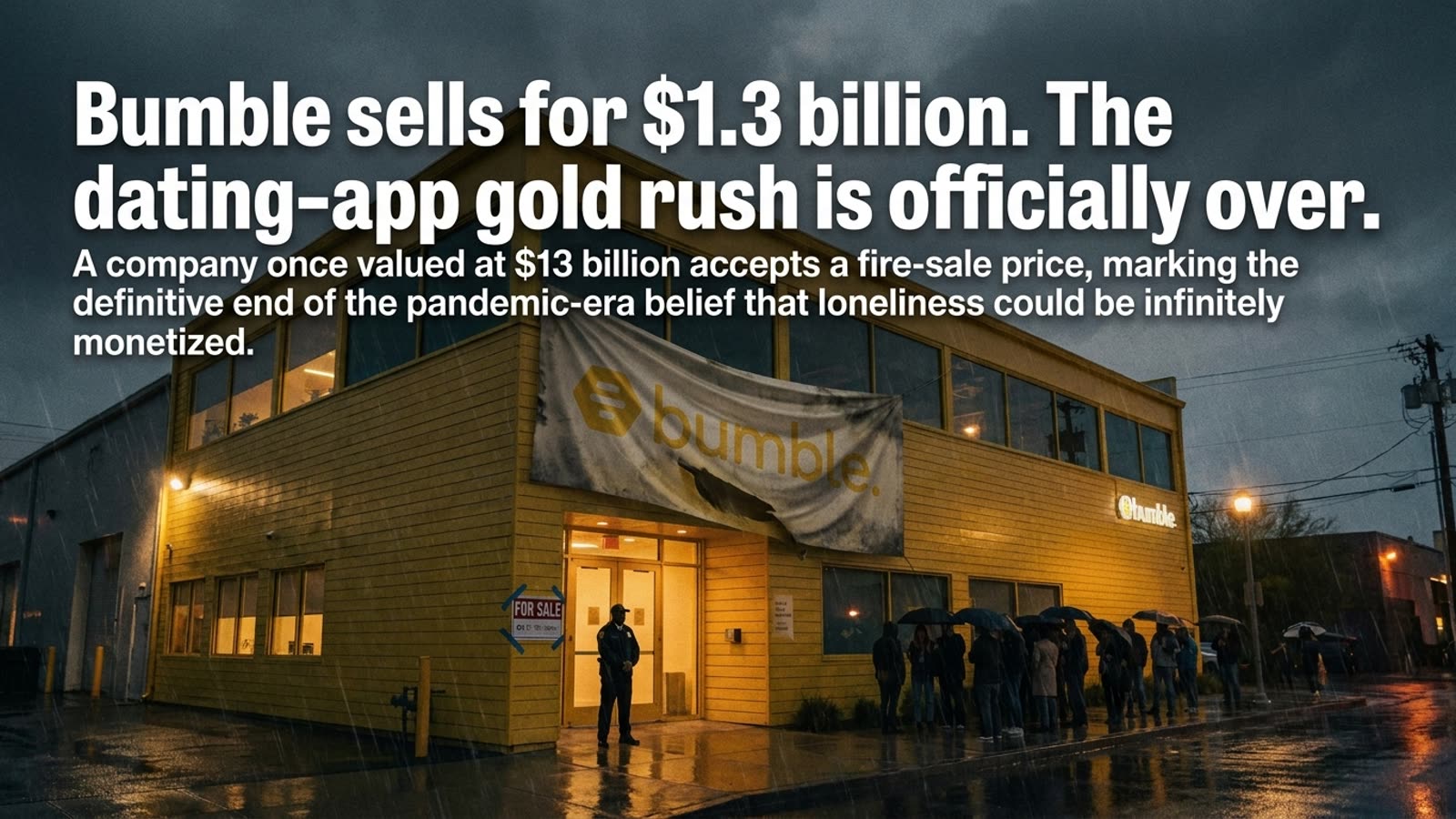
Five years ago, Bumble went public at a valuation north of $13 billion, the feminist dating app that was supposed to prove women-first design could conquer both hearts and markets. This week, the company agreed to be acquired for $1.3 billion — a 90 percent haircut that tells you everything about where consumer tech stands in late 2026.
The buyer and precise terms remain under wraps, but the number itself is the story. Bumble's collapse from pandemic darling to distressed asset encapsulates a broader reckoning: the subscription-fatigue economy has finally caught up with the loneliness industry.
The pandemic mirage
Dating apps enjoyed a freakish tailwind from 2020 to 2022. Lockdowns made swiping the only game in town; venture capital poured in on the thesis that digital matchmaking was a utility, not a fad. Bumble's IPO in February 2021 priced the company as if every single person on Earth would eventually pay $30 a month to find love. Match Group, Bumble's larger rival, traded at similarly intoxicating multiples.
Then the world reopened. Users who had tolerated algorithmic dating out of necessity returned to bars, gyms, and the chaotic serendipity of real life. Paying subscribers churned. Bumble's revenue growth, once north of 30 percent annually, slowed to single digits. The stock cratered.
A sector-wide malaise
Bumble is not alone. Match Group, owner of Tinder and Hinge, has seen its shares fall roughly 70 percent from their 2021 peak. Grindr, the LGBTQ-focused app that went public via SPAC in 2022, trades well below its debut price. Across the board, investors have concluded that dating apps face a ceiling: users resent paying for connection, competition is brutal, and the product itself — endless swiping — has become culturally exhausting.
The $1.3 billion Bumble deal suggests acquirers see value in the brand and user base, but only at a price that assumes modest, utility-like returns rather than hypergrowth. Whoever is buying is betting on consolidation, not reinvention.
Our take
Bumble's fire sale is less a company-specific failure than a correction of collective delusion. The pandemic convinced Silicon Valley that isolation was a permanent market opportunity. It was not. Human beings, it turns out, prefer meeting each other in person when given the choice — and they deeply resent paying recurring fees for the privilege of loneliness management. The next generation of dating products will need to reckon with that truth, or join Bumble on the auction block.