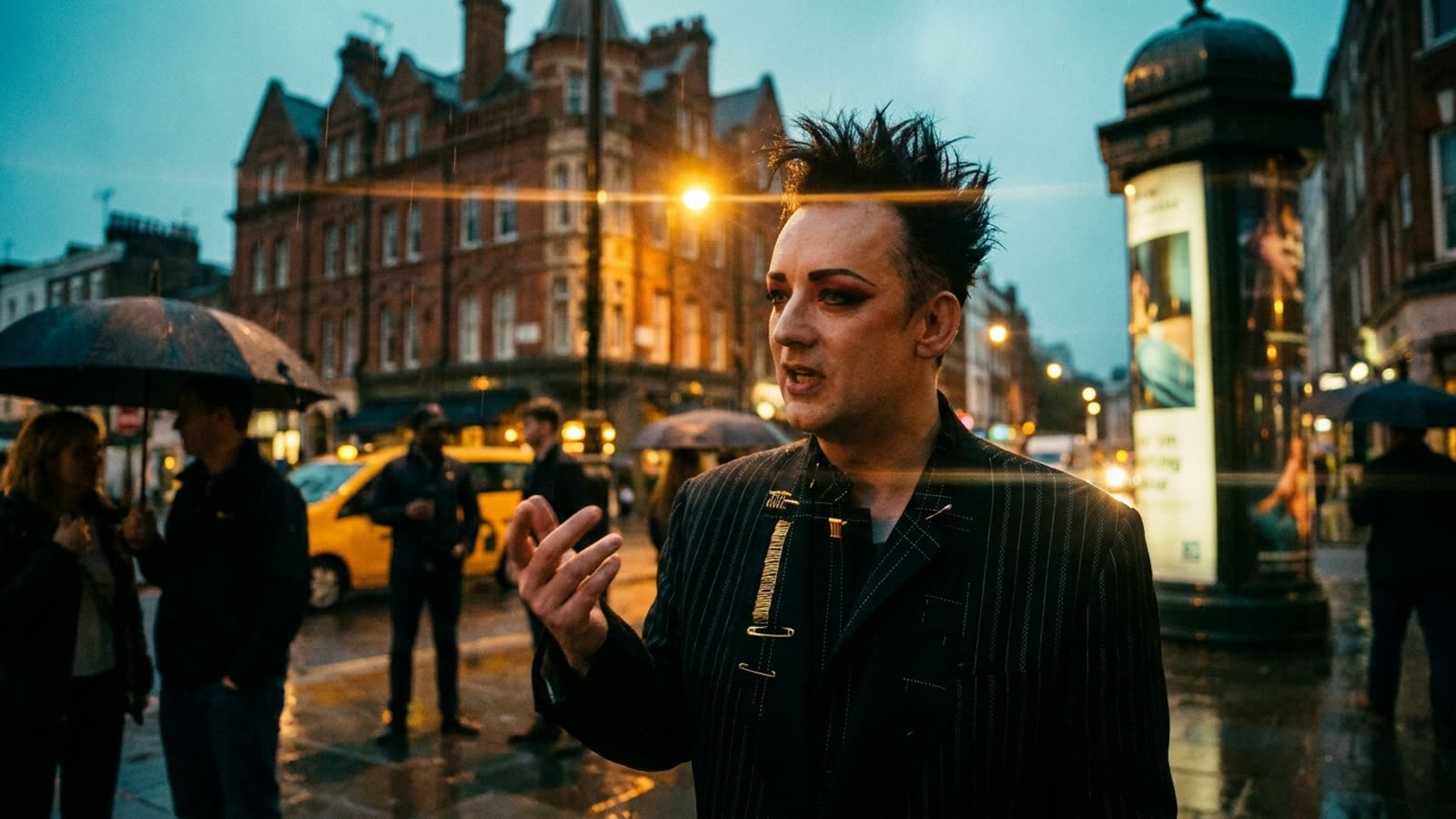
When Boy George decided to take aim at Dorit Kemsley—the Beverly Hills Housewife best known for her rotating accent and maximalist wardrobe—he was not merely settling a personal score. He was inadvertently staging a referendum on two incompatible theories of fame: the earned-through-suffering school versus the manufactured-through-exposure model. That the internet immediately chose sides tells us more about our fractured celebrity culture than either party probably intended.
The specifics of their dispute matter less than its architecture. George, who spent the eighties as a genuine cultural disruptor before a very public fall and painstaking rehabilitation, represents a generation of stars who believe credibility must be purchased with pain. Kemsley, a reality-television creation whose primary talent is remaining interesting enough to film, embodies the newer conviction that visibility itself confers legitimacy. Neither is wrong, exactly. Both are insufferable about it.
The authenticity industrial complex
George's critique—reportedly centered on Kemsley's perceived superficiality—echoes a complaint as old as Hollywood itself: that some people are famous for being famous. What makes the 2026 version notable is how thoroughly that distinction has collapsed. Kemsley's Bravo salary dwarfs what most working musicians earn. Her Instagram following exceeds George's by a comfortable margin. By every metric the entertainment industry actually uses, she is the bigger star. George's cultural capital, meanwhile, is largely nostalgic—valuable, but not convertible to the currency that matters now.
This is the quiet humiliation facing legacy celebrities who survived the tabloid era only to discover that survival confers no special status. The rules changed while they were busy staying alive.
Reality television's strange respectability
The Housewives franchise, once dismissed as trash television for people who hate themselves, has achieved something approaching institutional permanence. It has outlasted prestige dramas, survived streaming fragmentation, and produced more recognizable faces than most film studios. Kemsley is not an aberration; she is the template. Her willingness to perform wealth, marital tension, and personal crisis on camera is not a failure of dignity but a job description executed competently.
George, who built his career on subverting gender norms and shocking the bourgeoisie, now finds himself cast as the bourgeoisie—the establishment figure tutting at the new vulgarians. The irony is almost too neat.
Our take
This feud will be forgotten by August, but its underlying tension will not. We are watching two entertainment economies collide: one that rewarded talent filtered through gatekeepers, another that rewards the simple willingness to be watched. George is correct that something has been lost. Kemsley is correct that complaining about it changes nothing. The rest of us are left to choose our side in a war where both armies are fighting over territory that no longer exists.