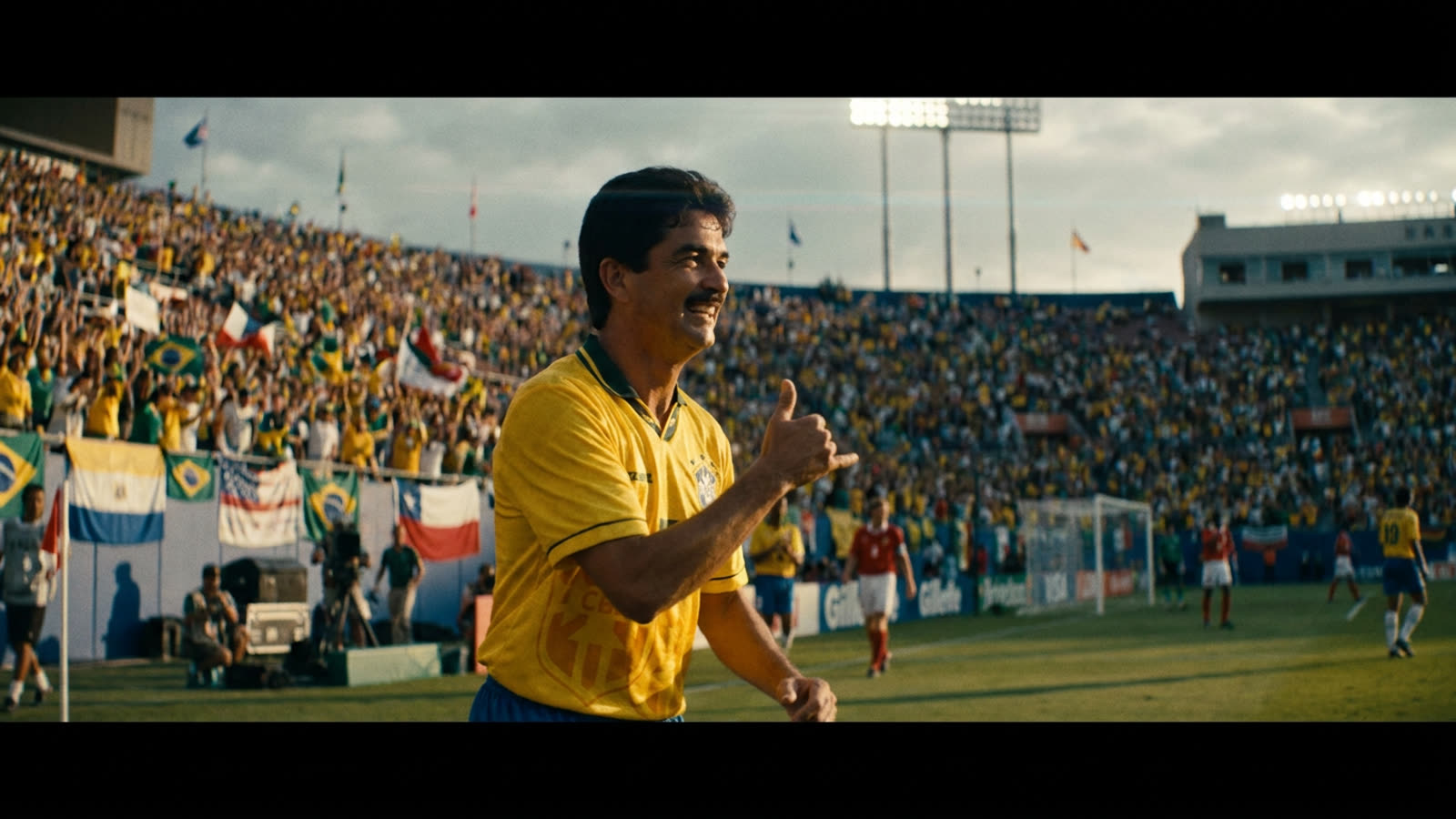
Before Bebeto cradled an invisible infant against his chest in the Rose Bowl on July 4, 1994, goal celebrations were largely functional affairs. A fist pump, a sprint to the corner flag, perhaps a slide across the grass. After he did it—twice, actually, once against the Netherlands in the quarterfinal and again in the semi against Sweden—the celebration became something else entirely: a broadcast medium, a personal statement transmitted to billions.
The context was straightforward. Bebeto's wife Denise had given birth to their son Mattheus three days before the Netherlands match. When Bebeto scored to put Brazil 2-0 up, he ran to the sideline, mimed cradling a baby, and was joined by Romário and Mazinho in what became one of the most reproduced images in World Cup history. It was spontaneous, sincere, and instantly comprehensible across every language barrier.
The grammar of celebration
What Bebeto inadvertently established was a visual grammar that subsequent generations would elaborate into baroque complexity. The celebration became a site of personal narrative—dedications to deceased relatives, political statements, choreographed routines rehearsed on training grounds. Before the cradle, celebrations were about the scorer. After it, they became about whatever the scorer wanted them to be about.
The timing mattered enormously. The 1994 World Cup was the first to be broadcast with truly global saturation, the first where slow-motion replays and multiple camera angles could dissect every post-goal moment. Bebeto's gesture arrived precisely when the infrastructure existed to immortalise it. A decade earlier, it might have been glimpsed once and forgotten.
The authenticity problem
The irony is that Bebeto's celebration worked because it was unrehearsed—a father's instinctive expression of joy at a moment when professional obligation and private emotion briefly aligned. The countless imitations since have struggled with this paradox. The more elaborate the celebration, the more obviously premeditated; the more premeditated, the less emotionally resonant.
Yet players keep trying. Cristiano Ronaldo's trademark leap-and-turn, Megan Rapinoe's arms-wide stance, Marcus Rashford's three-finger salute—each attempts to claim a piece of the visual real estate that Bebeto accidentally discovered was available. The celebration has become personal branding, a signature GIF, a moment designed for extraction from context.
Our take
The baby cradle endures because it captured something true: a man momentarily overwhelmed by the collision of his two lives. That Mattheus Bebeto grew up to become a professional footballer himself, that the celebration has been replicated thousands of times since, that it now looks almost quaint in an era of choreographed team routines—none of this diminishes the original. Football's most copied gesture remains its most human, a reminder that before the sport became a content factory, it occasionally produced moments of accidental grace.