There is a particular kind of football genius that announces itself not through speed or strength but through the conspicuous absence of both. Andrea Pirlo moved across the pitch as though he had received tomorrow's newspaper, already knowing where every player would be before they arrived. His gift was not athleticism but something rarer: an understanding of time itself, the ability to slow the game to his preferred rhythm while everyone else scrambled to catch up.
The paradox of Pirlo's career is that he became the most influential midfielder of his generation by appearing to do very little. No lung-busting runs, no crunching tackles, no theatrical celebrations. Just the ball, arriving precisely where it needed to be, over and over, until the opposition's structure simply collapsed from exhaustion.
The regista reinvented
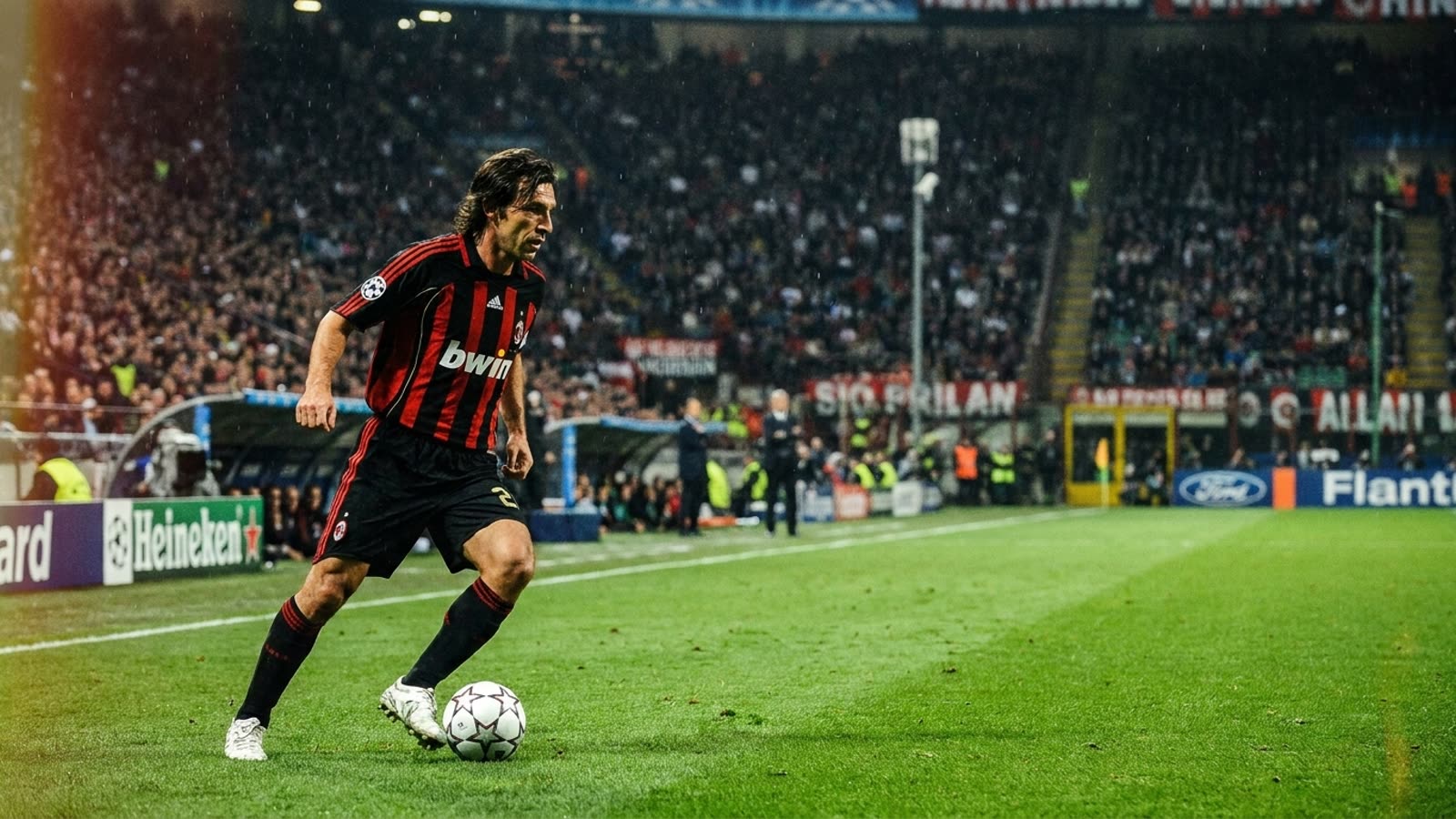
Pirlo did not invent the deep-lying playmaker role, but he perfected it so thoroughly that the position now bears his fingerprints. Before him, the regista was a tactical curiosity, a luxury item for teams wealthy enough in defensive cover to afford one. Pirlo made it essential. His years at AC Milan, orchestrating Champions League triumphs from the base of midfield, proved that a team could be built around a player who never ventured near the opposition's penalty area.
The key was his first touch, which eliminated pressure before it arrived, and his peripheral vision, which seemed to extend beyond the visible pitch. Pirlo would receive the ball with his back to goal, defenders closing in, and somehow the danger would evaporate—a half-turn, a weighted pass, and Milan were attacking again. He made the difficult look inevitable.
The World Cup as coronation
Italy's 2006 World Cup victory in Germany served as Pirlo's global coming-out party. He was named the tournament's best player, threading passes through defenses that had prepared specifically to stop him and failing anyway. The final against France, decided on penalties after a match of suffocating tension, showcased his sangfroid: Pirlo converted his spot-kick with a Panenka chip, the audacity of which still startles.
That tournament cemented his reputation, but it also illustrated his limitations as a narrative figure. Pirlo was never going to be a tabloid star. His autobiography, published years later, revealed a man of dry wit and expensive wine, more interested in discussing grape varietals than transfer gossip. The football public prefers its heroes sweaty and striving; Pirlo offered elegance and detachment.
The long shadow
Every deep-lying playmaker who has emerged since operates in Pirlo's shadow. Sergio Busquets, Toni Kroos, Jorginho—all have been measured against the Italian's standard, and all have acknowledged the debt. The modern obsession with possession football, with building from the back, with the goalkeeper as an eleventh outfield player, traces a direct line to Pirlo's demonstration that controlling the ball meant controlling the match.
His influence extends beyond tactics into aesthetics. Pirlo proved that football could be beautiful without being frantic, that patience was its own form of aggression. In an era increasingly dominated by pressing and counter-pressing, his style feels almost countercultural—a reminder that there are other ways to win.
Our take
Pirlo's career offers a quiet rebuke to the cult of effort that dominates modern sport. We celebrate players who run themselves into the ground, who leave everything on the pitch, who embody visible sacrifice. Pirlo suggested that true mastery looks like ease, that the highest form of control is making the difficult appear effortless. His legacy is not just tactical but philosophical: a reminder that sport, at its best, is not merely competition but art.