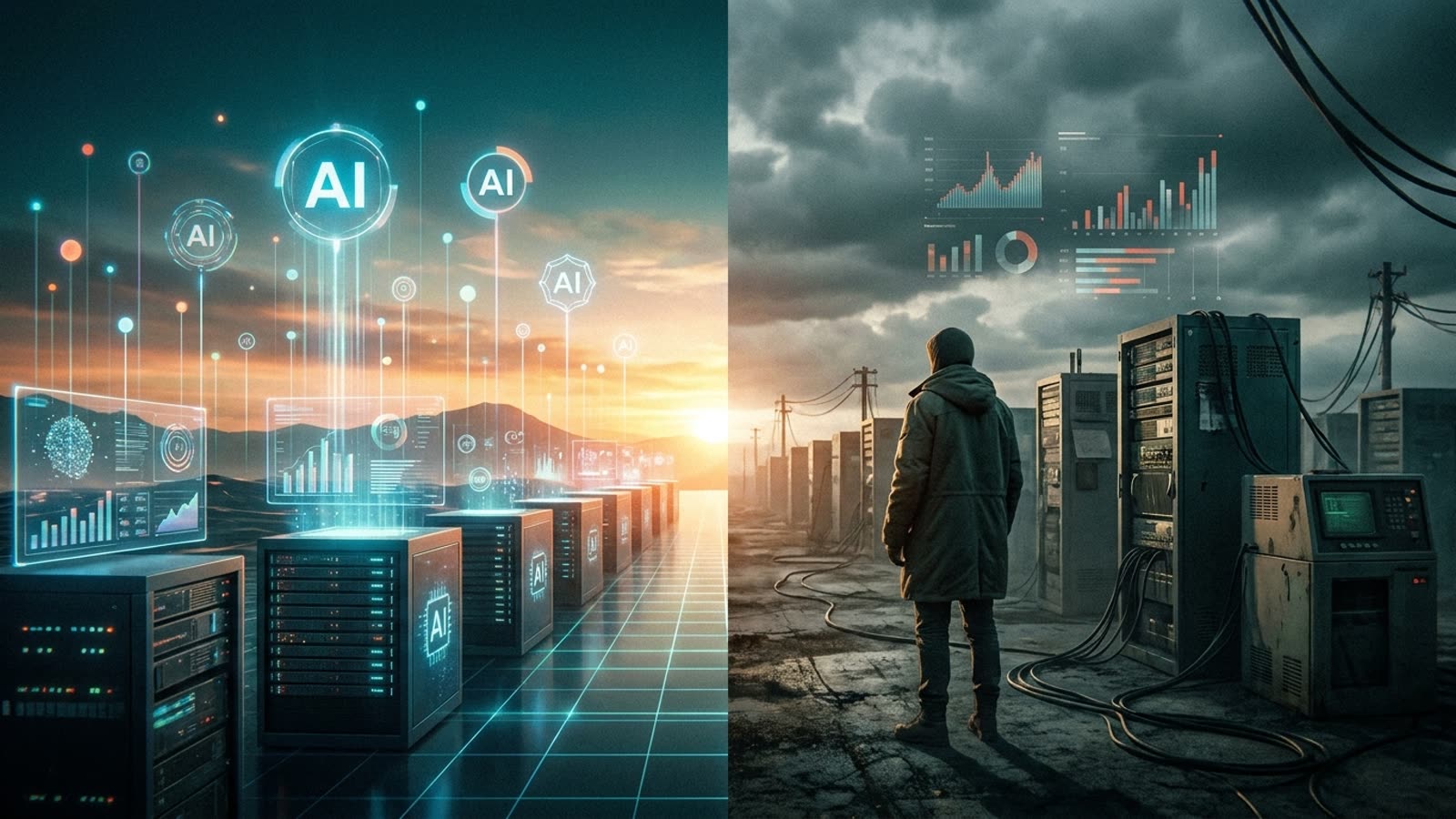
For seventy years, weather forecasting has operated on a simple if computationally brutal premise: simulate the atmosphere. Feed current conditions into equations governing fluid dynamics, thermodynamics, and radiation transfer, then let supercomputers grind through the math. The approach works, but it demands staggering resources—the European Centre for Medium-Range Weather Forecasts runs simulations on machines capable of hundreds of trillions of calculations per second.
Artificial intelligence is making all of that look quaintly industrial.
The pattern recognition revolution
Deep learning models approach forecasting from an entirely different angle. Rather than solving physics equations forward in time, they learn statistical relationships between historical weather states and what followed. Train a neural network on decades of atmospheric observations, and it discovers patterns no human meteorologist could articulate—subtle correlations between pressure systems, humidity gradients, and temperature anomalies that reliably precede specific weather outcomes.
The results have stunned the meteorological establishment. Google DeepMind's GraphCast model, trained on four decades of reanalysis data from the European weather centre, can generate ten-day forecasts in under a minute on a single machine. Traditional numerical weather prediction requires hours on dedicated supercomputers to produce comparable results. More remarkably, GraphCast matches or exceeds the accuracy of conventional models across most variables and lead times.
Why physics-based forecasting persisted
The dominance of numerical weather prediction was never arbitrary. Physics-based models offer something machine learning historically could not: interpretability and physical consistency. When a traditional model predicts a hurricane track, meteorologists can examine the underlying dynamics—the steering currents, the pressure gradients, the thermodynamic environment. The forecast makes physical sense even when it proves wrong.
AI models operate as black boxes. They identify correlations without explaining causation. A neural network might discover that certain satellite imagery patterns precede tornadoes without understanding why rotating supercells produce such signatures. This opacity troubled scientists trained to demand mechanistic explanations.
But accuracy eventually trumps elegance. When AI models consistently outperform physics-based systems, the meteorological community must reckon with an uncomfortable possibility: perhaps the atmosphere's behavior is too complex for humans to fully model from first principles, and pattern recognition on sufficient data captures dynamics our equations miss.
The hybrid future
The transition will not be absolute. Extreme weather events—the hurricanes, derechos, and atmospheric rivers that cause the most damage—remain challenging for AI systems trained primarily on typical conditions. Rare events offer limited training data, and neural networks can struggle with scenarios outside their experience.
The emerging consensus points toward hybrid approaches: AI models for rapid, accurate general forecasting, with physics-based systems providing sanity checks and handling edge cases. Some researchers are developing neural networks that incorporate physical constraints, preventing predictions that violate conservation laws while retaining the speed and pattern-recognition advantages of machine learning.
Our take
Weather forecasting represents AI's clearest victory over traditional scientific computing—a domain where brute-force physics simulation seemed unassailable until machine learning proved otherwise. The implications extend far beyond meteorology. Climate modeling, materials science, protein folding, and countless other fields built on numerical simulation may face similar disruption. The lesson is both humbling and exhilarating: sometimes the data contains more wisdom than our theories, and the machines are better at extracting it than we are.