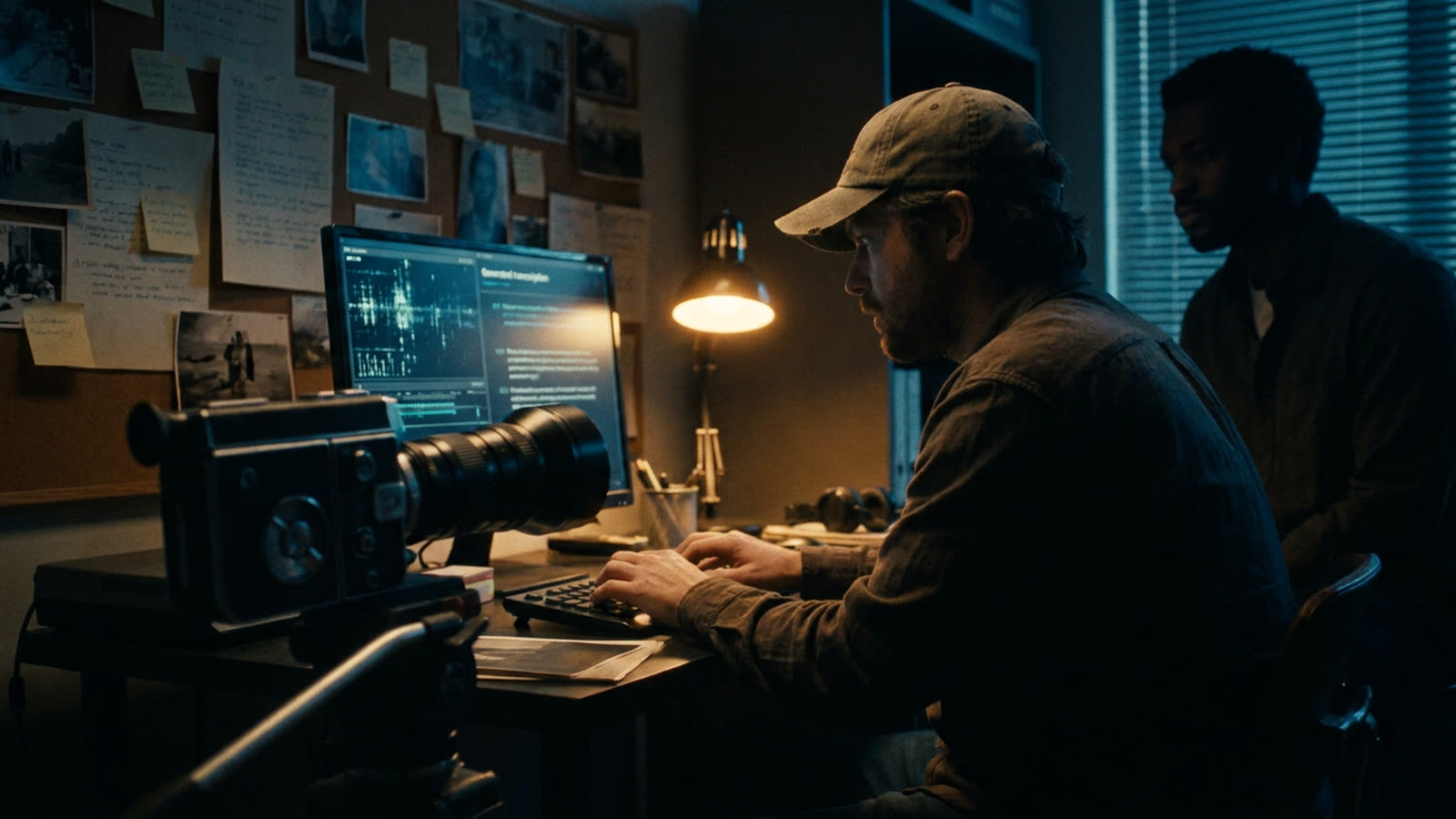
Documentary filmmaking has always been an exercise in selective truth-telling. A director shoots hundreds of hours of footage, then sculpts it into ninety minutes that feel inevitable. The craft lies in the curation, the rhythm, the decision to hold on a face two beats longer than comfortable. Now artificial intelligence is inserting itself into nearly every stage of that process, and the genre's practitioners are divided on whether they're witnessing a renaissance or a slow-motion betrayal of their medium's core promise.
The transformation began mundanely enough. Transcription services powered by speech recognition eliminated weeks of tedious work. Facial recognition helped editors locate specific subjects across sprawling archives. These were productivity gains, not philosophical challenges. But the technology didn't stop at the clerical.
The rough cut revolution
Modern AI editing assistants can now ingest raw footage and produce assembly cuts that identify narrative arcs, emotional peaks, and thematic throughlines. Feed the system forty hours of interviews and observational footage, and it returns a structured timeline with suggested sequences. Some filmmakers describe this as having an infinitely patient first assistant who never tires of reviewing material. Others see it as outsourcing the very act that defines directorial vision.
The practical appeal is undeniable. Independent documentarians working without studio budgets can now accomplish in days what once required months. A solo filmmaker covering a social movement can process footage at a pace that keeps up with unfolding events. The democratization argument writes itself.
Yet the discomfort runs deeper than nostalgia for analog workflows. Documentary's implicit contract with audiences rests on human judgment—the filmmaker as witness, interpreter, ethical gatekeeper. When an algorithm suggests which interview moments carry emotional weight, whose perspective is being centered? The training data that taught the system what "compelling" looks like carries its own biases, its own assumptions about whose stories deserve emphasis.
The authenticity paradox
Vérite filmmakers, who prize unmanipulated observation, face particular tensions. AI-powered tools can now stabilize shaky footage, enhance audio recorded in difficult conditions, even generate ambient sound to smooth jarring cuts. Each intervention improves watchability while incrementally eroding the rawness that distinguished the form. The question becomes whether polish serves the subject or merely the audience's comfort.
Archival documentaries present different challenges. AI can colorize historical footage, upscale degraded film, and interpolate frames to smooth motion. The results can be visually stunning and historically misleading in equal measure. Viewers may struggle to distinguish enhanced reality from synthetic reconstruction, a problem that compounds as the technology improves.
Some veteran documentarians have drawn firm lines. They use AI for logistics—scheduling, transcription, metadata organization—while keeping creative decisions exclusively human. Others embrace the tools fully, arguing that every generation of filmmakers adapted to new technology, from sync sound to digital cameras to drone cinematography. The medium survived and often thrived.
Our take
The honest answer is that documentary filmmaking was never as pure as its mythology suggested. Editors have always shaped reality; the question was always whose hand held the blade. AI doesn't introduce manipulation to the form—it accelerates and obscures it. The filmmakers who will matter in this new landscape are those who develop genuine fluency with these tools while maintaining the ethical reflexes that distinguish journalism from content. The technology is neutral. The humans wielding it are not, and that's precisely where the craft still lives.