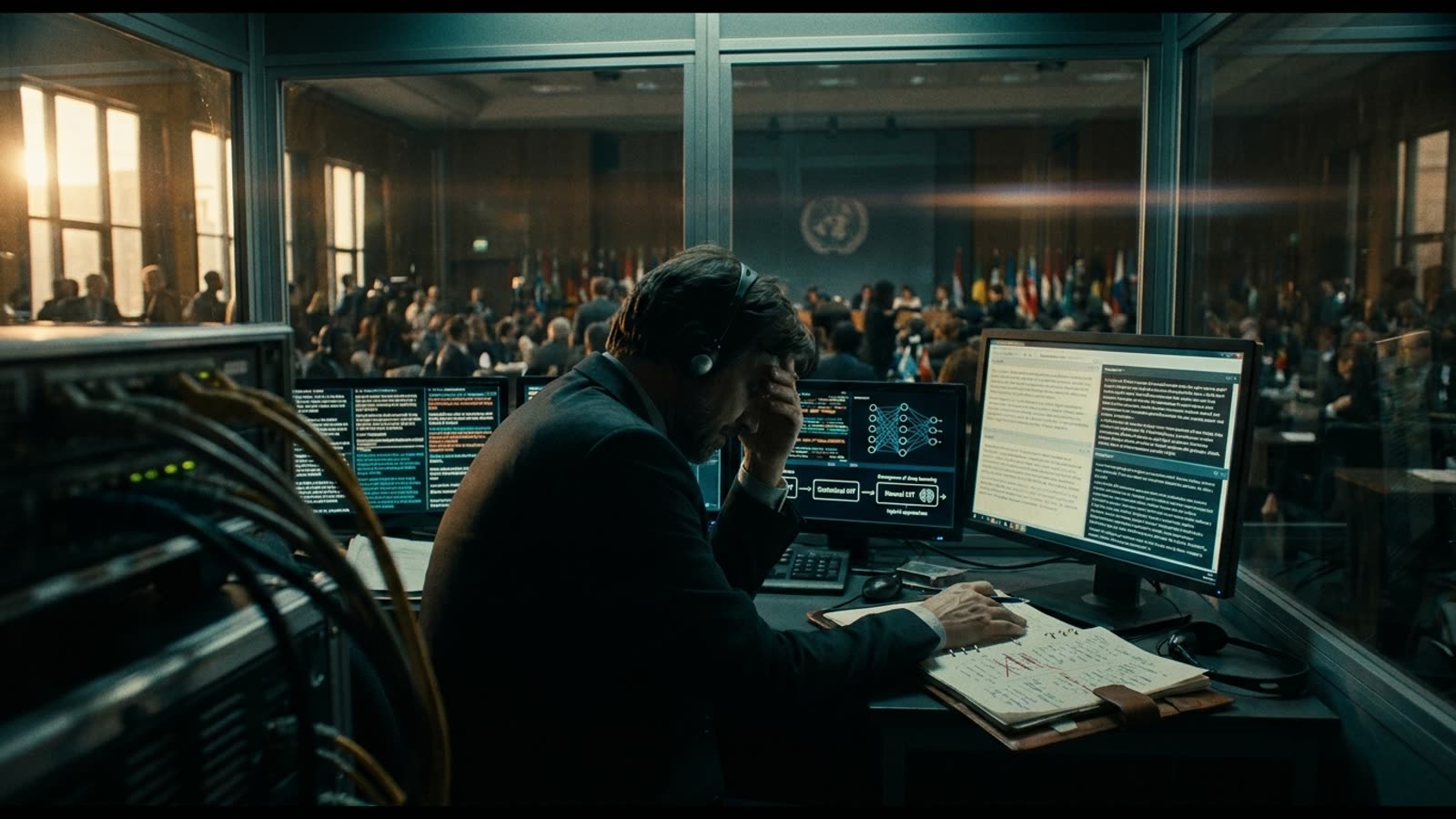
The United Nations still employs human interpreters in its six official languages, and the European Parliament maintains a corps of several hundred. These institutions could, in theory, pipe everything through neural machine translation and save considerable sums. They do not. The reason illuminates something profound about what artificial intelligence is actually doing to knowledge work: not eliminating expertise, but relocating it.
For decades, translation was considered a craft that machines would never master. Language is too contextual, too laden with cultural freight, too dependent on unstated assumptions. Then transformer-based models arrived, and suddenly a free web tool could render a German legal contract into passable English in seconds. The quality gap between human and machine output narrowed dramatically. But it did not close.
The new workflow
Professional translators today increasingly describe their work as "post-editing." A document arrives, runs through a neural engine, and emerges as a rough draft that is perhaps eighty percent acceptable. The human's job is to identify and fix the remaining twenty percent — the mistranslated idiom, the tone-deaf formality, the technical term rendered in a way that would confuse specialists.
This sounds like deskilling, and in some ways it is. Junior translators no longer spend years building vocabulary through sheer repetition; the machine handles that. But the senior practitioners report something unexpected: their work has become more intellectually demanding, not less. They are no longer doing the mechanical lifting. They are doing the quality control on systems that fail in subtle, unpredictable ways.
Consider medical translation. An AI might render a Spanish patient intake form into English with apparent fluency, but mishandle a regional euphemism for a symptom, or fail to flag that a medication name differs between countries. The human translator must catch these errors without the benefit of having done the initial translation themselves — a cognitively different task than translating from scratch.
Where machines still stumble
Neural translation excels at high-resource language pairs with abundant training data: English-French, English-Chinese, English-Spanish. It struggles with lower-resource languages, specialized jargon, and anything requiring real-world reasoning. A contract clause that hinges on a legal concept with no direct equivalent in the target language will be rendered literally, which is to say incorrectly. Humor, sarcasm, and deliberate ambiguity remain largely beyond reach.
The most dangerous errors are the confident ones. Unlike older rule-based systems that would flag uncertainty or produce obviously garbled output, neural models generate fluent-sounding text even when they are hallucinating. A human reader without source-language competence cannot tell the difference. This is why institutions handling high-stakes communication — courts, hospitals, diplomatic corps — still require human oversight.
The economics of augmentation
Translation agencies have responded to AI by restructuring their pricing. Pure machine translation is nearly free; light post-editing commands a modest fee; full human translation at the old rates is reserved for creative, legal, and reputational-risk contexts. Many translators report that their hourly rates have held steady or even increased, but the volume of work available at those rates has declined. The profession is bifurcating into a smaller elite handling complex assignments and a larger pool doing rapid post-editing at lower margins.
This pattern — technology augmenting the top of a profession while compressing the middle — is visible across knowledge work. Radiologists, paralegals, financial analysts, and now translators are discovering that AI does not replace judgment; it raises the stakes on judgment by handling everything that does not require it.
Our take
The interpreter's dilemma is everyone's dilemma. Artificial intelligence is not coming for jobs so much as coming for tasks, and the tasks it absorbs first are the ones that feel like work but do not require wisdom. What remains is harder to define, harder to train, and harder to automate: the ability to recognize when a system is wrong, to understand context the machine cannot see, to take responsibility for outcomes. Translators are simply learning this lesson earlier than most. The rest of us should be paying attention.