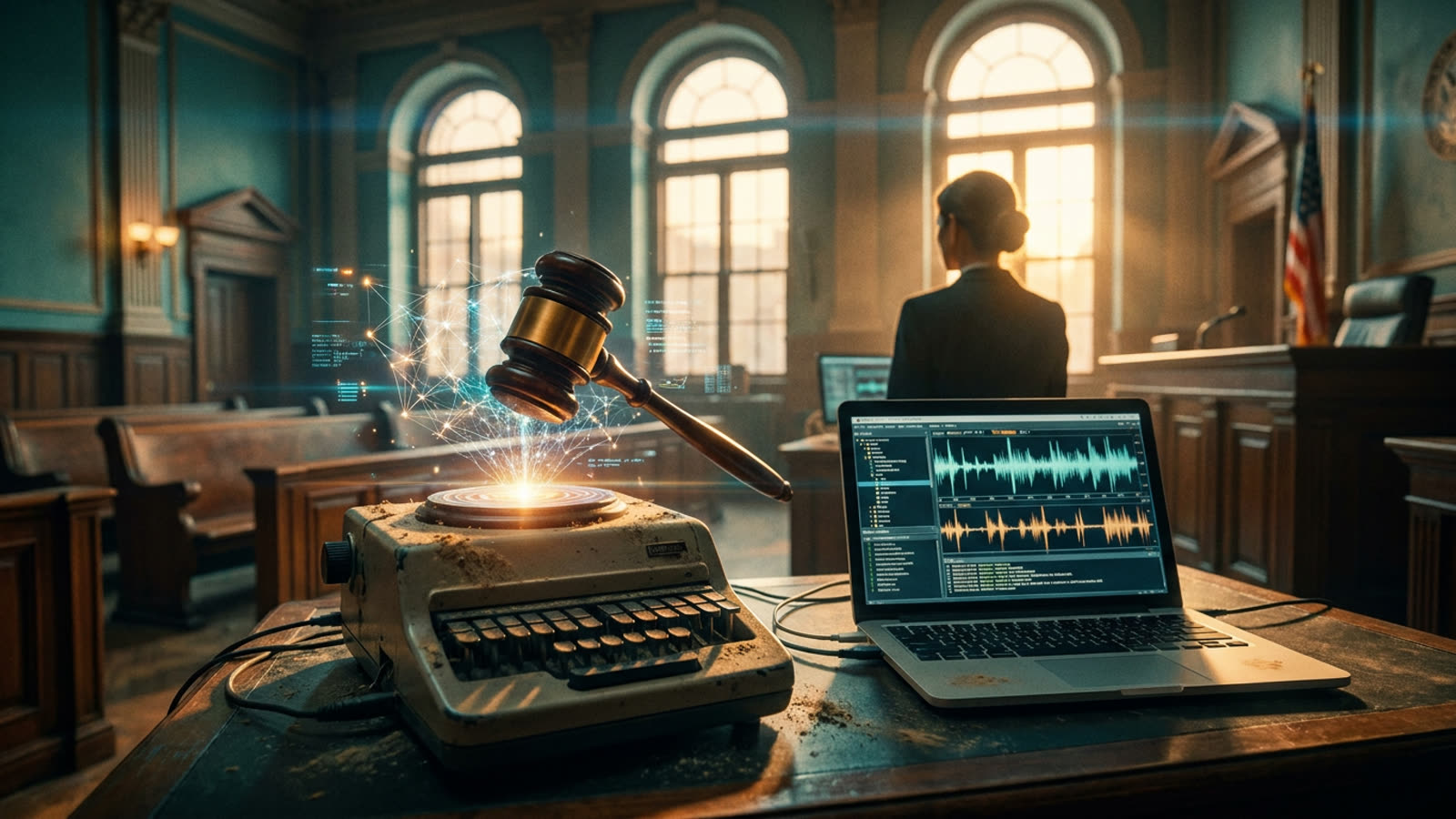
For more than a century, the court reporter occupied a peculiar throne in the American legal system: indispensable yet invisible, capturing every syllable of testimony while remaining professionally mute. Now that throne is being retrofitted with machine-learning components, and the profession's survival depends on whether its practitioners can adapt faster than the technology that threatens to automate them.
The anxiety is understandable. Speech-to-text software has improved dramatically, and several jurisdictions have experimented with replacing human stenographers with digital recording systems monitored by lower-paid clerks. Yet the wholesale extinction that some predicted has not materialized. Instead, something more interesting is happening: the best court reporters are becoming editors, quality controllers, and human fail-safes for AI transcription tools that are good but not yet trustworthy enough for legal proceedings where a single misheard word can alter a verdict.
The stenotype's unlikely persistence
The stenotype machine, that curious keyboard with its chord-based shorthand, dates to the late nineteenth century. A skilled operator can transcribe speech at speeds exceeding 225 words per minute with accuracy rates above 98 percent. Modern AI transcription systems can match or exceed that speed, but their accuracy in adversarial courtroom conditions—overlapping speakers, heavy accents, technical jargon, emotional outbursts—remains inconsistent. A 2024 study by the National Court Reporters Association found that automated systems in real courtroom settings produced error rates roughly three to five times higher than certified human reporters when dealing with complex multi-party proceedings.
This gap has created a hybrid model. Reporters increasingly work alongside AI, using automated first drafts as a starting point and applying their expertise to correct the machine's inevitable mistakes. The job has shifted from pure transcription toward something closer to legal editing with stenographic backup.
Who benefits, who loses
The transition is not frictionless. Older reporters who built careers on speed alone find their competitive advantage eroding. Younger entrants, comfortable toggling between their stenotype and AI-assisted workflows, are discovering that the profession rewards different skills than it did a decade ago: technical fluency, pattern recognition, and the judgment to know when a machine's confident-sounding output is subtly wrong.
Court systems themselves are split. Cash-strapped jurisdictions see automation as a budget solution; wealthier courts view human reporters as a hedge against appeals based on transcript errors. The result is a patchwork where the same deposition might be handled by a veteran stenographer in Manhattan and a digital recording system in rural Texas.
Our take
The court reporter's story is a useful corrective to the binary narratives that dominate AI discourse. The technology is neither a job-killer nor a savior; it is a force that reshapes labor by changing which human skills command a premium. Stenographers who treat AI as a tool rather than an enemy are finding that their expertise in legal language, speaker identification, and real-time accuracy still matters—perhaps more than ever, precisely because the machine cannot yet be trusted alone. The profession will shrink, but it will not vanish. What remains will be harder, more technical, and better paid. That is not extinction. It is evolution under pressure.