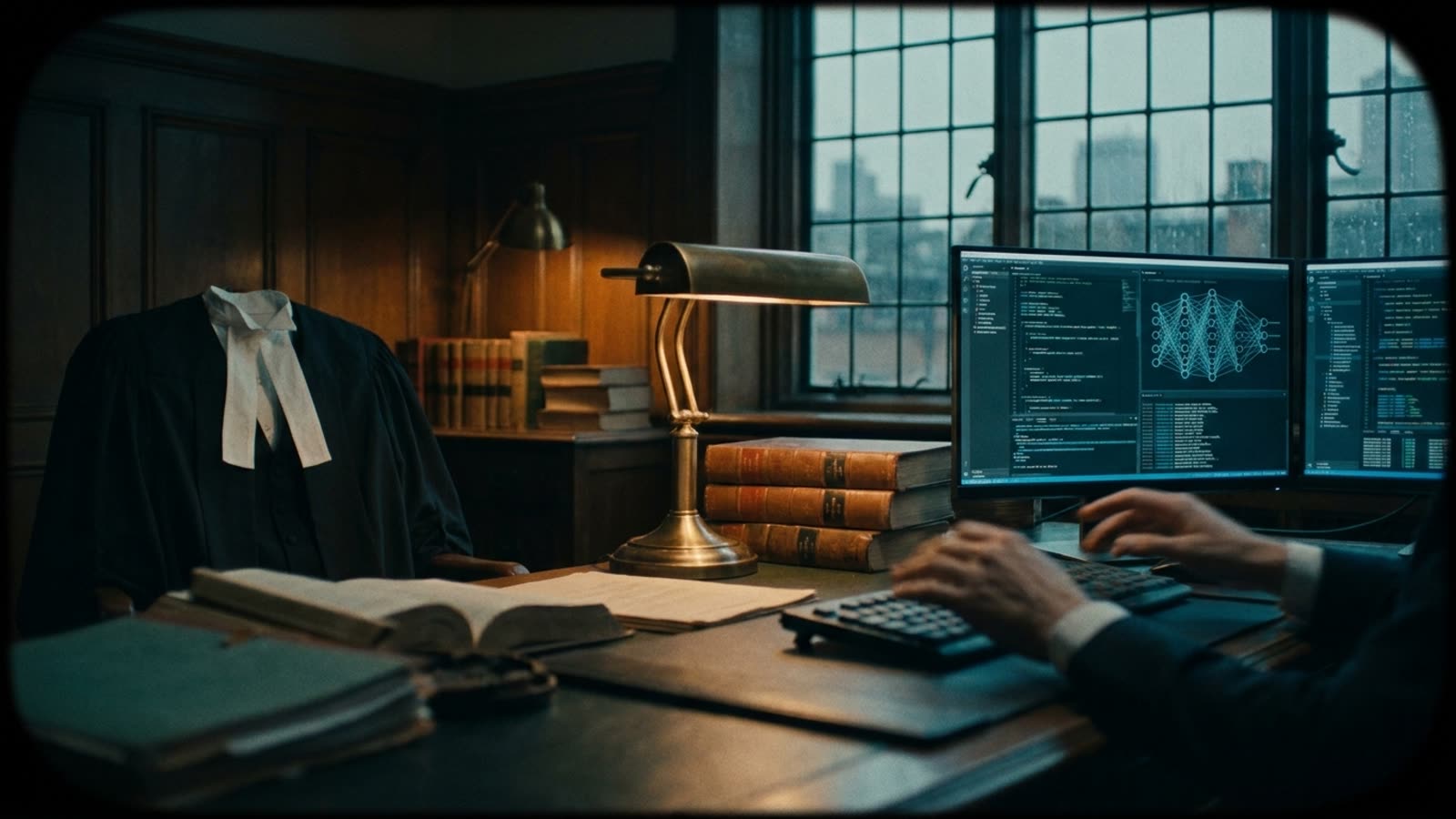
The most consequential change in patent law since the America Invents Act is not a statute or a court ruling. It is the quiet integration of large language models into the daily work of drafting, searching, and prosecuting patents—a shift that is remaking one of the legal profession's most technical corners from the inside out.
Patent attorneys have always occupied an unusual niche: part lawyer, part engineer, part prose stylist. Drafting a patent application requires translating an inventor's breakthrough into language precise enough to survive litigation yet broad enough to capture commercial value. It is painstaking work, and for decades the barrier to entry was simply the willingness to spend hundreds of hours mastering the art of claim construction.
That barrier is eroding. Not because AI can write a patent—it cannot, not reliably—but because it can produce a first draft that a skilled attorney can refine in a fraction of the time. The economics are shifting accordingly.
From blank page to revision
The traditional patent-drafting process began with a blank document and an inventor interview. The attorney would spend days, sometimes weeks, constructing claims from scratch, cross-referencing prior art, and iterating through internal review. Billing was measured in dozens of hours.
Today, a growing cohort of patent practitioners begins with a structured prompt. They feed an AI system the invention disclosure, relevant prior art, and stylistic constraints, then receive a draft specification and preliminary claims within minutes. The attorney's role shifts from author to editor—identifying where the machine has overreached, where it has missed nuance, where the language invites invalidity challenges.
This is not replacement. It is acceleration. The attorneys who have embraced the workflow report that their value now lies less in the mechanical act of drafting and more in strategic judgment: which claims to pursue, how to navigate examiner objections, where the competitive landscape leaves room for broader protection.
The prior-art problem, partially solved
Patent searching has long been a needle-in-haystack exercise. The global corpus of patent documents exceeds one hundred million, and relevant prior art can hide in obscure foreign filings, academic papers, or technical standards buried in industry archives. Human searchers, however skilled, operate under time and budget constraints that inevitably leave gaps.
AI-powered search tools are not perfect, but they are relentless. They can process semantic similarity across languages, surface non-patent literature that traditional keyword searches miss, and flag potential anticipation risks before an application is filed. The result is a subtle but meaningful shift in prosecution strategy: attorneys are filing with better knowledge of the landscape, which means fewer office-action surprises and, in some cases, narrower but more defensible claims from the outset.
Winners, losers, and the billable-hour question
The profession's internal economics are fracturing along predictable lines. Large firms with the capital to license or build proprietary AI tools are capturing efficiency gains and, in some cases, passing them to clients through fixed-fee arrangements. Solo practitioners and small boutiques face a choice: invest in technology or compete on relationships and niche expertise alone.
The billable-hour model, already under pressure across legal practice, is particularly strained here. If a task that once required twenty hours now requires five, the attorney who bills hourly earns less—even if the work product is superior. The firms adapting fastest are those willing to decouple compensation from time and tie it instead to outcomes: patents granted, litigation avoided, portfolios optimized.
Our take
The patent bar has always prided itself on a certain artisanal mystique—the idea that claim drafting is a craft that cannot be taught, only absorbed through years of apprenticeship. That mystique is not entirely wrong, but it is increasingly beside the point. The attorneys who will dominate the next decade are not the most elegant writers; they are the ones who understand what machines can and cannot do, and who deploy that understanding to deliver faster, cheaper, and more strategically sound work. The profession is not dying. It is being edited.