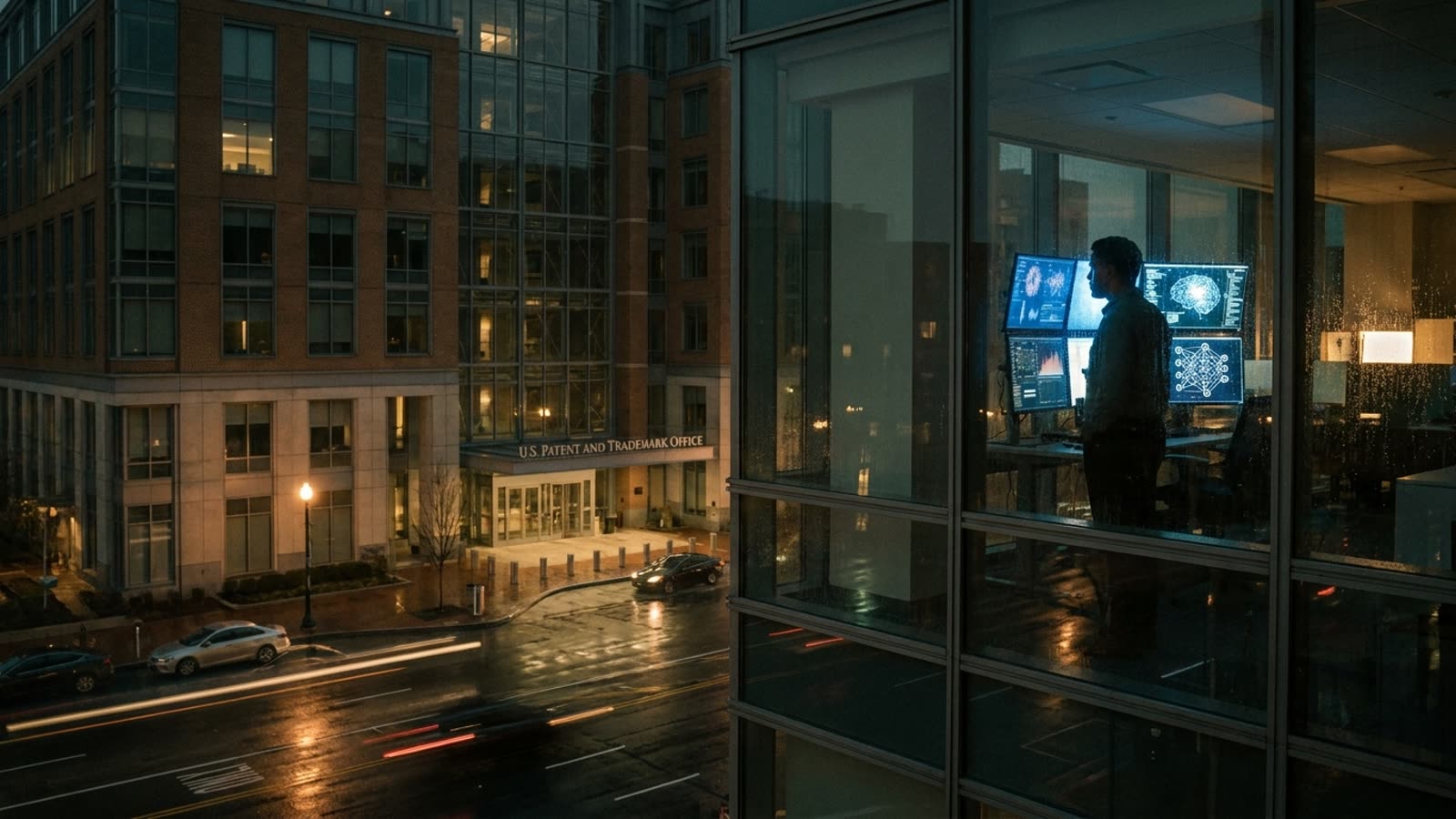
Patent examination has never been glamorous work. Examiners spend their days in a peculiar form of intellectual archaeology, sifting through millions of documents to answer a deceptively simple question: has anyone thought of this before? It is painstaking, highly specialized, and until recently, almost entirely human. That is changing faster than most people realize, and the implications extend far beyond the patent office.
The core challenge of patent examination is prior art search — finding existing inventions, publications, or disclosures that might invalidate a claim to novelty. A single patent application in biotechnology or semiconductor design might require an examiner to review thousands of documents across multiple languages, technical domains, and decades of accumulated knowledge. The cognitive load is immense. The backlog at major patent offices has, at various points, stretched into years.
The machine that reads everything
Modern AI systems excel at precisely this kind of exhaustive textual analysis. Large language models can parse technical documents, identify conceptual similarities across different terminology, and surface relevant prior art that human examiners might miss or lack time to find. Several patent offices have begun deploying such tools, not to replace examiners but to augment their search capabilities.
The European Patent Office has been particularly forward-leaning, integrating machine learning into its search and classification workflows. The United States Patent and Trademark Office has explored similar tools, though implementation has been more cautious. In China, where patent application volumes dwarf those of other jurisdictions, AI-assisted examination has become something closer to necessity than luxury.
What makes this transformation significant is not efficiency alone. The quality of prior art search directly shapes the boundaries of intellectual property — and therefore the boundaries of competition, innovation, and market power. A patent granted on insufficient search can block legitimate competitors for decades. A patent denied because AI surfaced an obscure foreign-language publication from the 1980s changes the competitive landscape entirely.
The limits of algorithmic judgment
Yet patent examination involves more than document retrieval. The harder questions — whether a claimed invention is truly non-obvious, whether the specification adequately enables the invention, whether the claims are appropriately scoped — require judgment that current AI systems cannot reliably provide. These are not search problems but interpretation problems, often involving contested technical and legal standards.
Examiners who work with AI tools describe a shift in their role: less time hunting for needles in haystacks, more time evaluating what the machine has found and making the substantive legal determinations that remain irreducibly human. The work becomes more analytical and less clerical. Whether this makes the job more satisfying or merely different depends on whom you ask.
There are also concerns about transparency and consistency. When an AI system surfaces certain prior art and not others, the reasoning behind that selection is often opaque. Patent applicants and their attorneys have legitimate interests in understanding why their claims were rejected, and algorithmic black boxes complicate that understanding.
Our take
The quiet integration of AI into patent examination is a useful corrective to both utopian and dystopian narratives about artificial intelligence. This is not a story of machines replacing human judgment wholesale, nor of technology failing to deliver on its promises. It is something more mundane and more instructive: a specialized profession adapting its workflows to tools that handle certain cognitive tasks better than humans do, while preserving the interpretive work that still requires human expertise. The patent examiner's job is not disappearing. It is evolving into something that looks less like librarianship and more like adjudication. That shift will shape who gets to own ideas for decades to come.