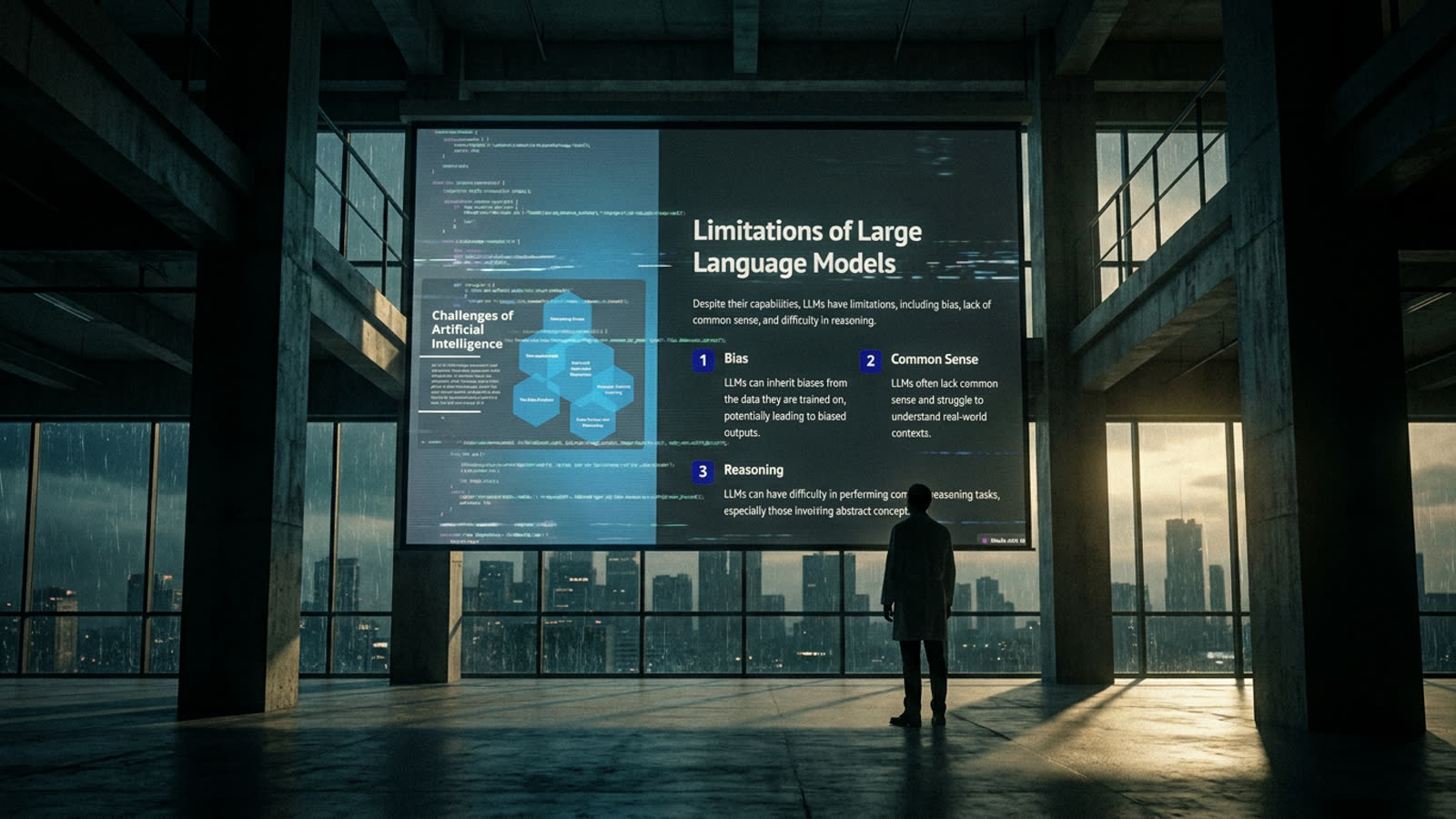
The most consequential misunderstanding in technology today concerns what happens inside a large language model when it produces an answer. The output often resembles reasoning so closely that distinguishing between the two requires deliberate effort — effort that neither the companies selling these systems nor the users benefiting from them are particularly motivated to expend.
The confusion is understandable. When a model solves a logic puzzle, writes functional code, or explains a complex concept in clear prose, it looks like thinking. The sentences arrive with the cadence of considered thought. The conclusions follow from premises. The whole performance is so convincing that even researchers who understand the underlying architecture sometimes catch themselves attributing intentions to these systems.
What actually happens
A large language model is, at its core, a prediction engine of extraordinary sophistication. It has ingested vast quantities of human text and learned statistical relationships between tokens — the fragments of words and punctuation that constitute its vocabulary. When given a prompt, it generates the most probable next token, then the next, then the next, each choice conditioned on everything that came before.
This process is not reasoning in any meaningful sense. The model has no internal representation of truth, no capacity for doubt, no mechanism for checking its work against reality. It cannot distinguish between a mathematical proof and a plausible-sounding fabrication, except insofar as proofs appeared more frequently in certain contexts during training. It produces text that looks like the output of reasoning because it has seen enormous quantities of text that was the output of reasoning.
The distinction matters less when the task is summarization or translation — domains where pattern-matching suffices. It matters enormously when the task involves novel problems, edge cases, or situations where the training data offers no reliable template.
The consequences of the confusion
Organizations are now deploying these systems in contexts that demand genuine judgment: legal research, medical triage, financial analysis, hiring decisions. The assumption, often implicit, is that the model's confident prose reflects confident understanding. It does not. The model will produce equally fluent text whether it is correct or catastrophically wrong.
This creates a particular danger when users lack the expertise to evaluate the output. A junior associate cannot reliably spot when a legal memo cites a case that does not exist. A patient cannot assess whether a symptom-checker has confused correlation with causation. The model's tone provides no signal; it sounds the same either way.
The vendors are aware of this limitation but have commercial incentives to emphasize capability over constraint. The term "artificial intelligence" itself does considerable work here, implying a kinship with human cognition that the technology does not warrant.
Our take
None of this means large language models are not useful — they are, remarkably so, for tasks that align with their actual capabilities. But the gap between what these systems do and what they appear to do is not a technical detail to be glossed over in marketing materials. It is the central fact that should govern how we deploy them, regulate them, and decide what decisions we are willing to let them influence. The industry's preferred framing — that reasoning is just around the corner, that scale solves everything — deserves the skepticism we would apply to any claim from a party with billions of dollars riding on the answer.