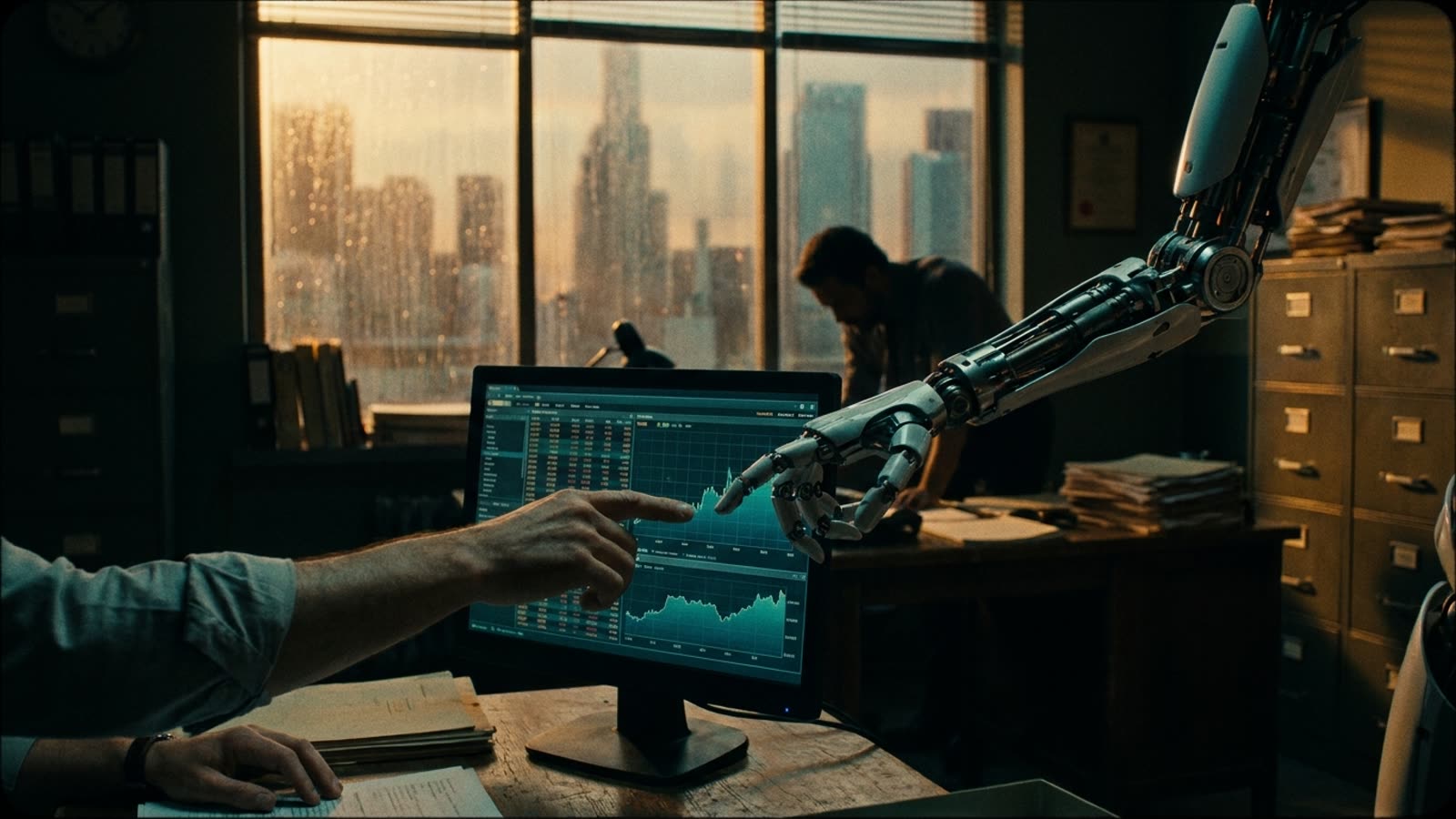
Insurance underwriting has never been a profession that inspires dinner-party conversation. It is methodical, actuarial, and deliberately invisible — the financial plumbing that determines whether a family can afford to protect its home or whether a small business can secure liability coverage. Yet this quiet corner of commerce has become one of the most consequential laboratories for artificial intelligence deployment, with implications that extend far beyond quarterly earnings reports.
The transformation began not with fanfare but with spreadsheets. Insurers discovered that machine learning models could process applications in minutes rather than days, correlating thousands of variables that human underwriters would never have time to consider. A homeowner's claim history, neighborhood crime statistics, satellite imagery of roof condition, credit patterns, even social media activity — all fed into systems that spit out risk scores with mechanical confidence.
The efficiency bargain
The business case is irresistible. Traditional underwriting required experienced professionals to review applications manually, a process that was slow, expensive, and inconsistent. Two underwriters examining the same application might reach different conclusions based on intuition, fatigue, or simply which guidelines they remembered. Algorithms promised standardization and speed.
Major insurers now process the majority of straightforward applications — term life policies for healthy applicants, auto coverage for drivers with clean records, homeowner policies in low-risk areas — with minimal human involvement. The humans who remain have been repositioned as exception handlers, reviewing only the cases that fall outside algorithmic parameters. Their job titles have not changed, but their work has been fundamentally redefined.
The opacity problem
What insurers gained in efficiency, policyholders may have lost in legibility. When a human underwriter denied coverage, you could theoretically ask why and receive an explanation rooted in identifiable factors. When an algorithm denies coverage, the reasoning often lives inside what engineers euphemistically call a "black box" — a model so complex that even its creators cannot fully articulate why it reached a particular conclusion.
Regulators have struggled to keep pace. Insurance commissioners in various jurisdictions have begun requiring that algorithmic decisions be explainable, but defining "explainable" in the context of neural networks with millions of parameters remains an unsolved problem. The models can identify correlations that predict risk with remarkable accuracy while remaining utterly silent about causation.
This creates a troubling asymmetry. An applicant denied coverage may never know whether the decision stemmed from their driving record, their zip code, their purchasing patterns, or some combination of factors that no human ever consciously identified as relevant. Appeals become exercises in futility when neither the appellant nor the reviewer can interrogate the actual decision-making process.
Who bears the risk of algorithmic risk?
The deeper question is not whether AI makes underwriting more efficient — it demonstrably does — but whether efficiency has become a justification for avoiding harder conversations about fairness. Machine learning models trained on historical data will inevitably encode historical biases. If past underwriting decisions reflected discriminatory patterns, algorithms trained on those decisions will perpetuate them with the veneer of mathematical objectivity.
Some insurers have invested heavily in bias auditing, testing their models for disparate impact across protected categories. Others have treated algorithmic fairness as a compliance checkbox rather than a genuine commitment. The industry's opacity makes external accountability nearly impossible; researchers and regulators cannot audit what they cannot access.
Our take
The AI transformation of insurance underwriting deserves more scrutiny than it receives, precisely because it is boring. Glamorous applications of artificial intelligence attract congressional hearings and magazine covers; unglamorous ones reshape millions of lives while everyone looks elsewhere. The underwriters themselves are not villains — they are professionals adapting to tools their employers have mandated. But the collective effect of these adaptations is a system where consequential decisions about financial security increasingly happen inside machines that cannot be questioned, appealed, or even fully understood. That is not necessarily an argument against algorithmic underwriting. It is an argument for taking it seriously.