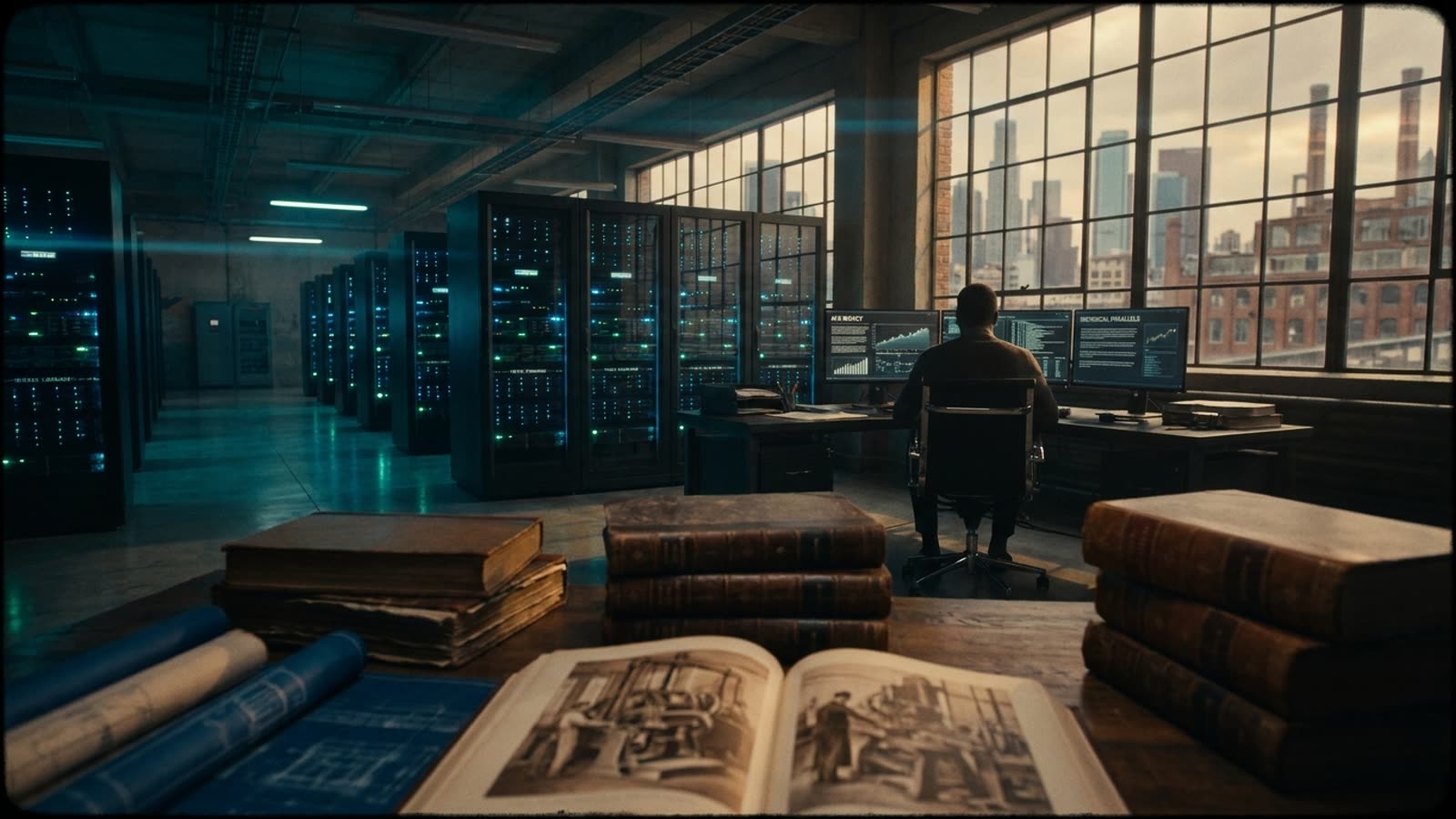
The most important question in labor economics right now cannot be answered by labor economists. How many jobs will artificial intelligence eliminate, create, or transform? The honest answer is that nobody knows—so researchers are doing what academics do when confronted with radical uncertainty: they are looking backward.
A wave of new papers and policy briefs from institutions including MIT, the Brookings Institution, and the OECD has turned to historical episodes of technological disruption for guidance. The Industrial Revolution, the electrification of factories, the automation of agriculture, and the computerization of offices are all being mined for lessons. The hope is that patterns from the past can illuminate the murky future. The problem is that the patterns are not especially encouraging.
The displacement lag
The most consistent finding from historical analysis is that technological transitions take far longer to play out than contemporaries expect—and the interim period is brutal. When mechanical looms arrived in early nineteenth-century England, it took decades for displaced weavers to find comparable work. Real wages for many workers stagnated or declined for a generation. Economists call this the "Engels pause," after Friedrich Engels, who documented the misery of Manchester factory workers in the 1840s. The parallel to today is uncomfortable: AI may ultimately create more jobs than it destroys, but the workers displaced in 2026 may not be the ones who benefit in 2046.
The Great Depression precedent
Some researchers are drawing particular attention to the 1930s, when rapid productivity gains in agriculture and manufacturing coincided with catastrophic unemployment. The lesson is not that technology caused the Depression—monetary policy and financial fragility did that—but that technological displacement can interact with macroeconomic shocks in devastating ways. If an AI-driven productivity surge coincides with a recession, the combination could be far worse than either alone. This is not a prediction; it is a risk scenario that policymakers are beginning to take seriously.
What history cannot tell us
The limits of historical analogy are significant. Previous technological revolutions primarily affected manual labor and routine cognitive tasks. Large language models and their successors are encroaching on non-routine cognitive work—legal analysis, medical diagnosis, software development, creative writing—at a pace that has no real precedent. The optimistic case is that these tools will augment rather than replace professionals, making them more productive. The pessimistic case is that the augmentation phase will be brief before full automation arrives.
Our take
The turn to economic history is intellectually honest and practically insufficient. It tells us that transitions are painful, that the pain is unevenly distributed, and that policy responses matter enormously. What it cannot tell us is whether AI is more like the steam engine—a general-purpose technology that eventually raised living standards broadly—or more like the combine harvester, which emptied rural America in a single generation. The economists are right to study the past. They should not pretend it offers more than a dim lantern in a very dark room.