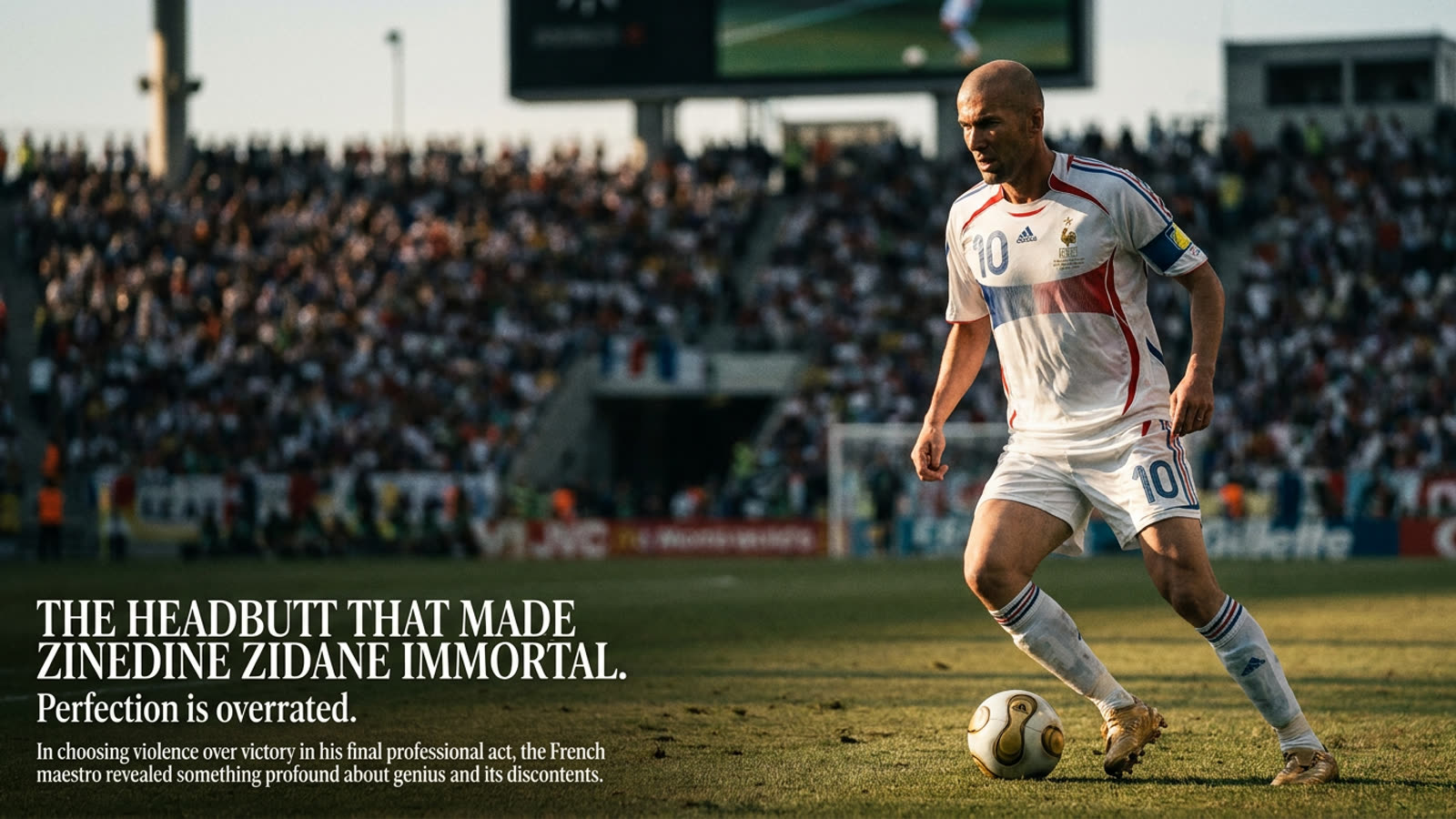
The greatest player of his generation walked off the pitch in Berlin on July 9, 2006, not in triumph but in disgrace, past the World Cup trophy he would never lift, past the teammates who needed him for penalties, past any hope of a storybook ending. Zinedine Zidane had just headbutted Marco Materazzi in the chest, and in doing so, he had committed an act of such spectacular self-destruction that it transcended sport entirely. It became, somehow, the most fitting conclusion imaginable.
This is the paradox of Zidane: his failure in that moment has done more for his legend than victory ever could have.
The architecture of brilliance
Zidane's genius was architectural. He did not dribble past opponents so much as make them irrelevant, finding angles that existed only in his imagination until his body made them real. The roulette turn that bears his name was not a trick but a philosophy — the belief that space could be created through elegance rather than force. At Real Madrid, he scored perhaps the greatest Champions League final goal ever, a left-footed volley against Bayer Leverkusen that seemed to hang in the air for an impossible moment before finding the net. At the 1998 World Cup, he rose twice to head France to their first title, a performance so dominant it felt preordained.
But brilliance of this magnitude comes with weight. Zidane was never comfortable with what he represented — the son of Algerian immigrants who became the face of a multicultural France, a symbol deployed by politicians and corporations alike. His silences in interviews were not mystique but exhaustion. The headbutt, viewed through this lens, was not aberration but release.
What Materazzi understood
Materazzi, the Italian defender, knew exactly what he was doing. The precise words remain disputed — something about Zidane's sister, perhaps his mother — but the intent was surgical. Find the fracture line in the marble and tap it. Zidane had been sent off fourteen times in his career; his temper was not hidden. What Materazzi perhaps did not anticipate was that Zidane would choose the fracture over the trophy, would prefer honest rage to composed triumph.
This is what separates the incident from mere controversy. Zidane was not tricked. He made a decision. With the score level and penalties looming, with the entire football world watching his final act, he chose to be himself rather than the version of himself the moment demanded. There is something almost religious about that refusal.
Our take
We have sanitised our sporting heroes into motivational posters, all grit and gratitude and carefully managed brands. Zidane's headbutt remains a rebuke to that entire project. It insists that greatness is not separable from darkness, that the same intensity that produces transcendent art can produce spectacular destruction. France lost that final on penalties without their best taker. Zidane won something more durable: a legend that accommodates human complexity. The trophy would have made him a champion. The headbutt made him unforgettable.