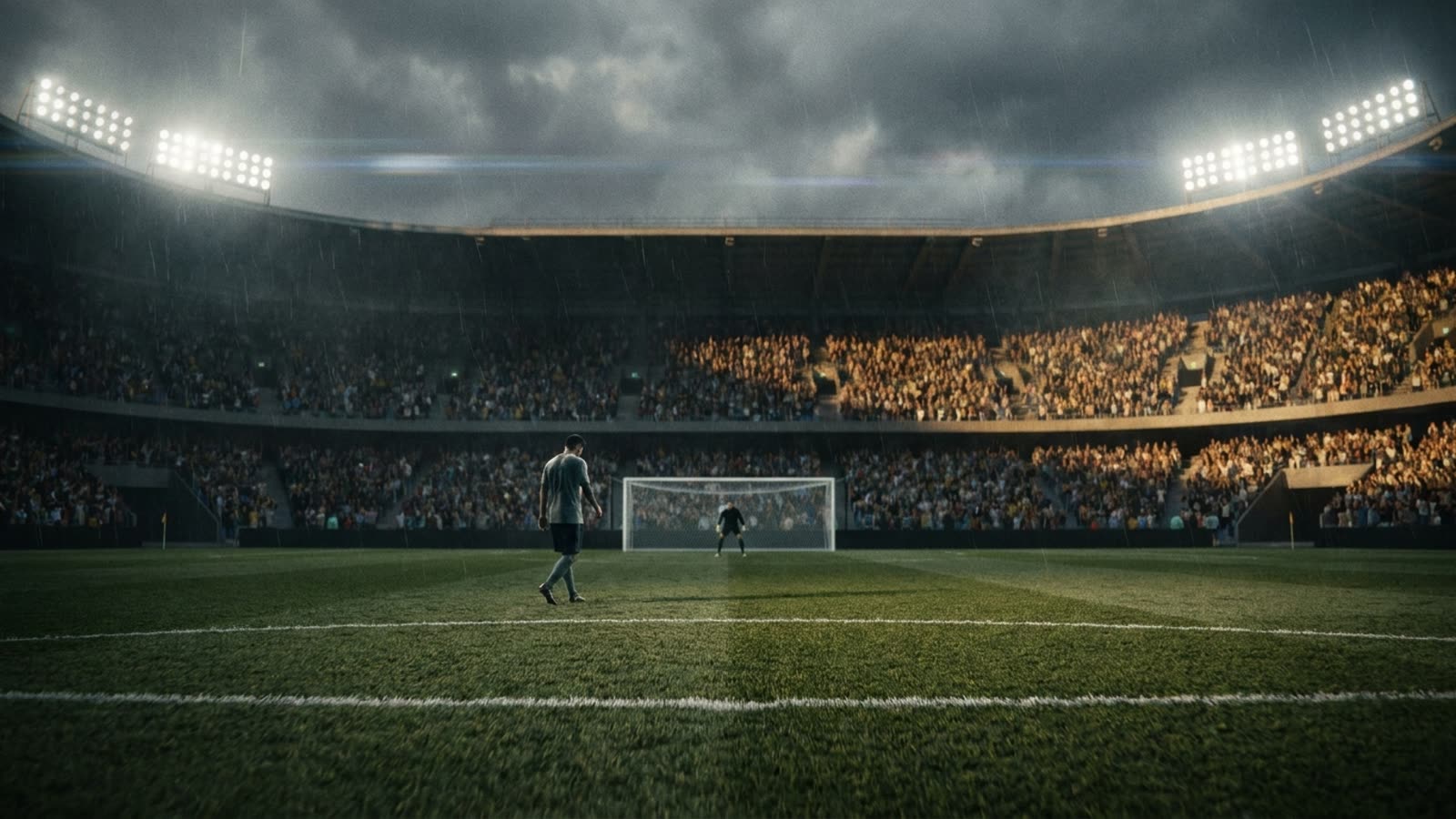
The distance from the center circle to the penalty spot is roughly forty yards, but no measurement captures what that walk actually contains. In those seconds, a player transitions from athlete to isolated performer, from team member to solitary figure against whom an entire nation's hopes or despairs will be measured. The penalty shootout, introduced to World Cup knockout rounds in 1978, was designed as a tidy solution to deadlock. It has instead become football's most reliable generator of trauma, ecstasy, and enduring psychological mystery.
What makes the shootout so fascinating is its inversion of normal athletic logic. In open play, excellence correlates reliably with preparation and talent. From twelve yards, the correlation weakens dramatically. Players who strike dead balls beautifully in training dissolve under tournament pressure. Others who rarely take penalties in club football step up and convert with preternatural calm. The difference is almost entirely mental, which is precisely why the shootout has resisted every attempt to systematize it.
The paradox of overthinking
Sports psychologists have identified a phenomenon they call "paralysis by analysis" — the tendency for conscious attention to disrupt automated motor skills. A penalty kick, mechanically, is simple: the goal is vast, the goalkeeper cannot cover it all, and a well-struck ball to either corner is unsaveable. Yet the very simplicity creates space for the mind to intrude. Players who normally strike instinctively begin calculating angles, second-guessing their chosen corner, watching the goalkeeper's body language for tells that may not exist. The twelve-yard walk provides ample time for this cognitive spiral.
The historical record supports this. Conversion rates in shootouts drop measurably when a miss means elimination — the so-called "decisive penalty" converts at lower rates than earlier kicks in the sequence. The ball hasn't changed, the goal hasn't shrunk, but the psychological weight has increased exponentially. Players know this, which only compounds the problem.
National patterns and their limits
Certain footballing nations have acquired reputations in shootouts — some as reliable converters, others as perennial victims. These reputations, once established, may become self-fulfilling. A player stepping up knowing his country has a history of shootout failure carries that history onto the spot with him. The weight is not rational, but it is real.
Yet the patterns are less deterministic than folklore suggests. Teams that lose multiple shootouts eventually win them. Individuals who miss crucial penalties sometimes return years later and convert. The psychology is powerful but not permanent, which may be the shootout's saving grace — it offers redemption as readily as it delivers devastation.
The goalkeeper's different game
While attention focuses on the taker, the goalkeeper operates under entirely different psychological conditions. Expectations favor the striker; a saved penalty is a bonus, a conceded goal merely the default outcome. This asymmetry liberates. Goalkeepers can guess, dive early, attempt gamesmanship, all without the paralytic pressure that grips the taker. The best shootout goalkeepers understand this and project an exaggerated confidence designed to transfer their psychological advantage into the striker's doubt.
Our take
The penalty shootout endures because it is unfair in exactly the way sport should occasionally be unfair — it isolates human frailty and courage in a way that ninety minutes of collective effort cannot. Football's governing bodies periodically discuss alternatives, but none would replicate the shootout's brutal clarity. Twelve yards, one ball, everything at stake. The format is primitive, arbitrary, and utterly compelling. It asks a question that tactics and training cannot fully answer: who, in this moment, can master their own mind?