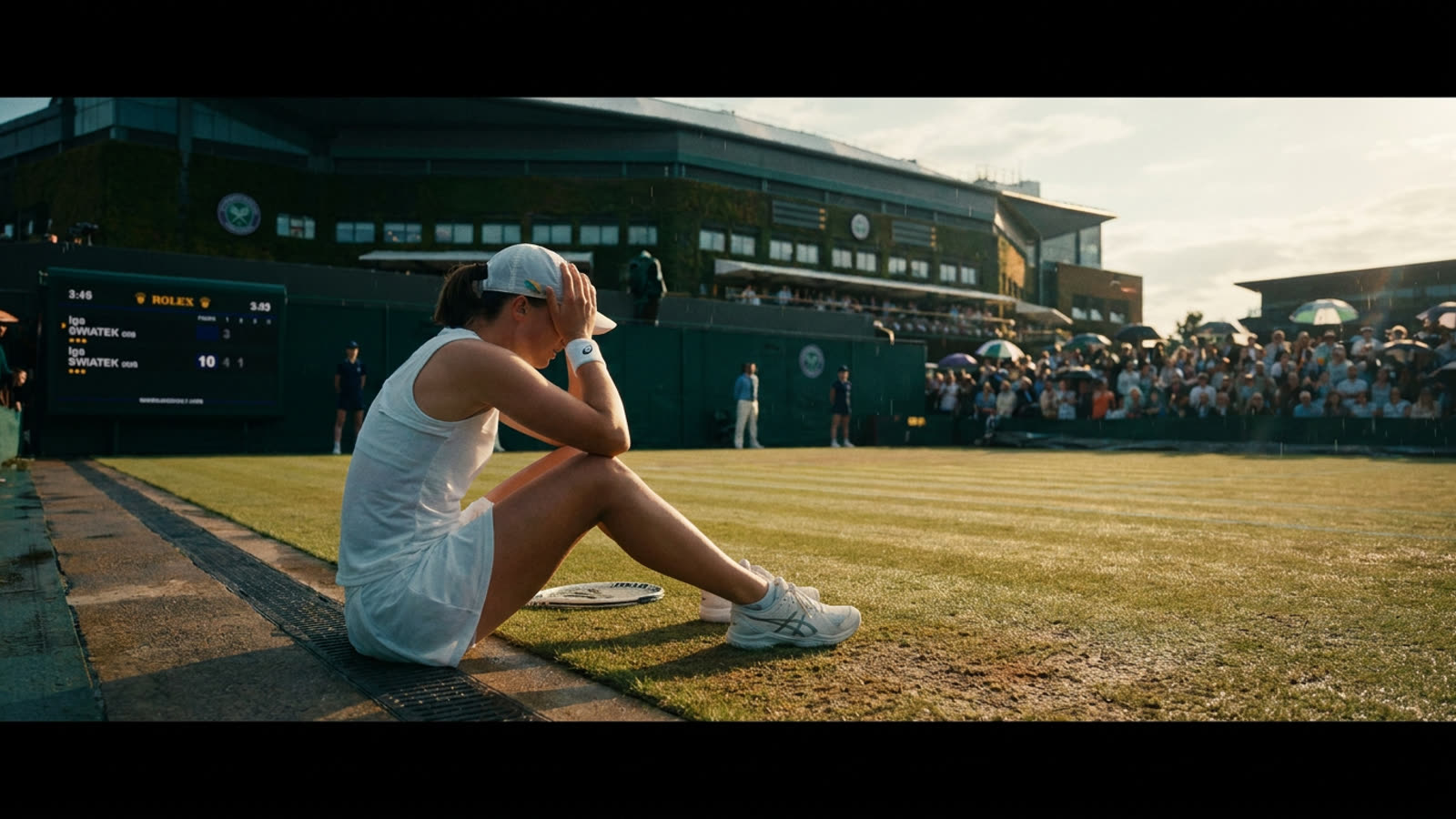
The All England Club has a way of humbling excellence. Iga Swiatek, the world's dominant force on clay and hard courts, and Elena Rybakina, the 2022 Wimbledon champion herself, both exited in the third round this week—casualties of a surface that rewards a skill set increasingly rare in modern tennis.
Swiatek's departure was the more jarring. The Polish star has spent the better part of four years establishing herself as the sport's most complete player, her relentless topspin and court coverage earning her multiple Grand Slam titles. But grass neutralizes precisely those weapons. The low bounce robs her forehand of its vicious kick; the slick surface punishes the heavy footwork that serves her so well on clay. She has now failed to reach the Wimbledon quarterfinals in her career, a statistical anomaly for a player of her caliber.
Rybakina's exit carries different implications. The Kazakh power-hitter seemed built for grass—a booming serve, flat groundstrokes, the willingness to finish points at net. Her 2022 triumph suggested a future of sustained success at SW19. Instead, she has joined the growing list of one-time champions unable to replicate their breakthrough.
The surface that time forgot
Grass-court tennis is an anachronism, and Wimbledon knows it. Only a handful of professional tournaments are played on the surface each year, giving players perhaps three weeks annually to adjust their games. Compare this to the clay season's two-month stretch or the hard-court calendar that dominates the rest of the year. The economics of tennis have made grass a curiosity rather than a specialty.
This scarcity creates chaos. Players who would dominate on any other surface find themselves vulnerable to opponents who have somehow retained—or stumbled upon—the serve-and-volley instincts, the slice backhands, the comfort with bad bounces that grass demands. The sport's increasing baseline orientation, optimized for the slower surfaces where most prize money lives, becomes a liability.
Why upsets cluster here
Wimbledon's draw sheets are littered with early-round shocks in ways that the Australian Open and US Open rarely match. This is not coincidence. The French Open's clay produces its own upsets, but those tend to favor a specific archetype—the patient grinder, the defensive specialist. Grass upsets are more random, more dependent on who happens to be serving well on a given Tuesday.
The compressed preparation window means even elite players are essentially guessing at their form. A practice week at Roehampton cannot replicate the accumulated muscle memory that clay-court specialists bring to Roland-Garros. Every Wimbledon, some top-ten player discovers their game simply does not translate, their ranking rendered meaningless by a surface they encounter too rarely to master.
Our take
There is something admirable about Wimbledon's refusal to modernize into irrelevance. The tournament could, theoretically, slow its courts to reduce upsets and protect its star attractions. Instead, it maintains conditions that make every match feel genuinely uncertain. Swiatek and Rybakina will return to hard courts in a few weeks, where their dominance will reassert itself. But the grass reminded us this week that tennis still has a format where greatness offers no guarantees—where the sport's history and its present exist in productive tension.