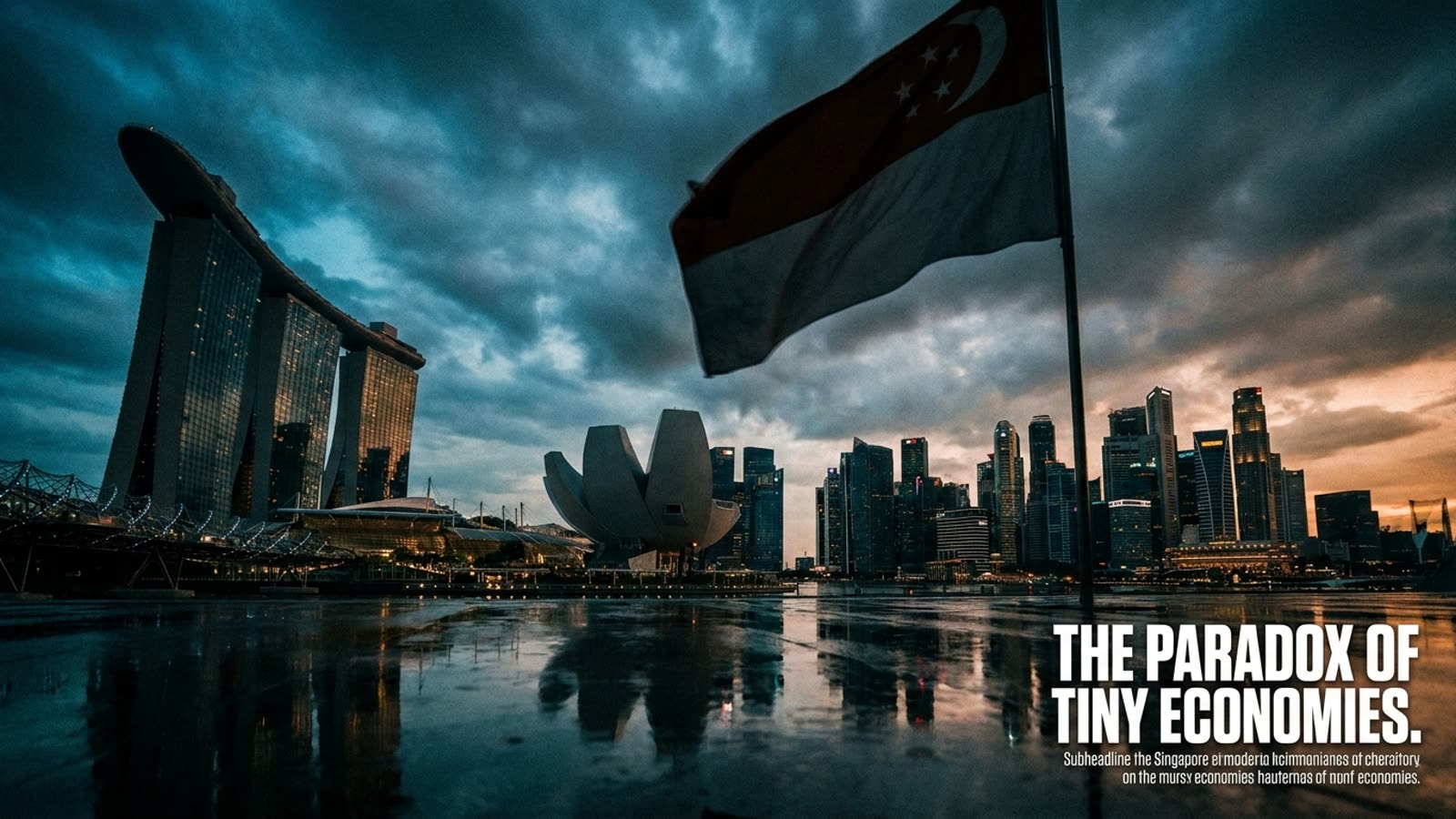
The textbook says economic power flows from natural resources, large populations, and territorial expanse. The textbook is wrong, or at least incomplete. The richest places on Earth per capita — Singapore, Luxembourg, Switzerland, Ireland, Norway — are, with few exceptions, geographically modest, resource-poor, and home to populations smaller than many cities. Their prosperity isn't despite their smallness but, in crucial ways, because of it.
This isn't merely a statistical quirk produced by oil-rich microstates or tax-haven accounting tricks. It reflects something deeper about how modern economies actually function, and why the intuitions of nineteenth-century political economy often mislead us today.
The coordination dividend
Small states can make decisions faster. When your entire country contains fewer people than metropolitan Houston, consensus becomes achievable in ways that sprawling federations can only envy. Singapore pivoted its entire education system toward technical skills within a generation. Estonia digitized its government services while larger nations were still debating pilot programs. Switzerland coordinates among linguistic communities with a fluency that would be unthinkable across a continental landmass.
This isn't just about bureaucratic efficiency. It's about the compounding value of coherent long-term strategy. When policy can be adjusted quickly and implemented uniformly, mistakes get corrected before they calcify into institutional failures. The feedback loop between policy and outcome tightens, and learning accelerates.
Specialization as survival
Large economies can afford mediocrity across many sectors because domestic demand provides a cushion. Small economies cannot. They must specialize or stagnate. This constraint, counterintuitively, becomes a gift. Luxembourg became indispensable in financial services. Switzerland in precision manufacturing and wealth management. Singapore in logistics and high-end manufacturing. Ireland in pharmaceutical production and technology.
The pressure to find a niche — and then to defend it through relentless quality — creates economies that are less diversified but more resilient in their chosen domains. They become nodes that the global system cannot easily route around.
The openness imperative
Small economies cannot retreat into protectionism because there is nothing to protect behind. They must trade, which means they must remain attractive to trade with. This forces a discipline on governance that larger nations can defer. Corruption becomes existentially expensive. Regulatory unpredictability drives away the foreign capital and talent on which survival depends.
The result is a selection pressure toward institutional quality. Not because small countries are inherently more virtuous, but because they face consequences faster.
Our take
The prosperity of small nations is not a trick of accounting or a lucky accident of geography. It is a demonstration that in a connected global economy, the old advantages — size, resources, autarky — matter less than adaptability, specialization, and institutional coherence. The lesson for larger nations is not that they should somehow become smaller, but that they might consider governing as if they were: with the urgency of those who know that the world will not wait for them to get their act together.