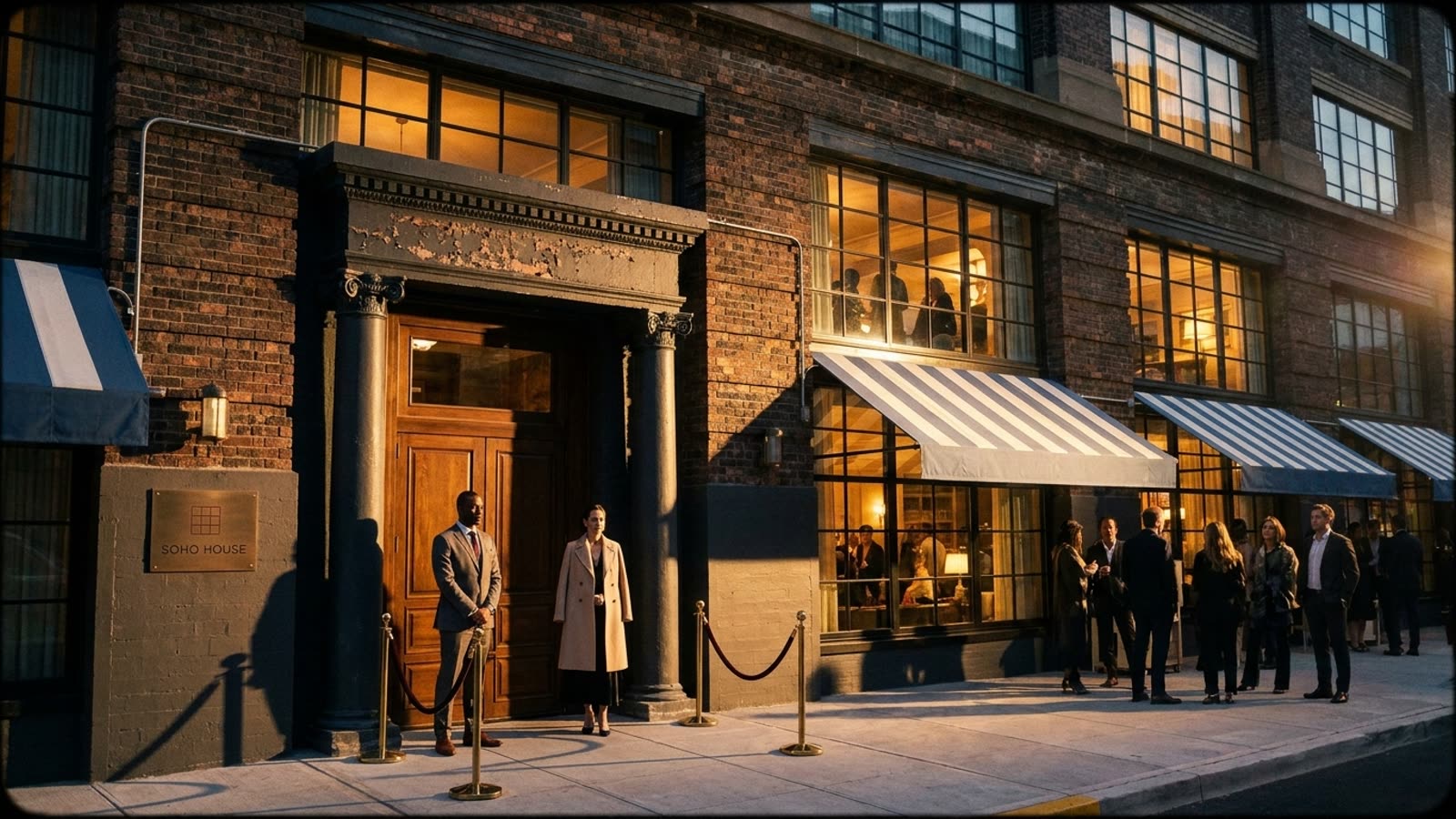
The waiting list for Soho House membership in New York now stretches into years. The membership fee at London's Annabel's would cover a month's rent in most cities. And yet applications keep climbing, driven not by aging aristocrats but by millennials and Gen Z professionals who grew up with unlimited digital access to everyone and everything.
The paradox is only apparent. Private members' clubs are flourishing precisely because connection has become too easy. When anyone can message anyone, when every restaurant is reviewable and every party is documented, scarcity becomes the ultimate luxury. The velvet rope, that ancient technology of social sorting, turns out to be recession-proof.
The economics of exclusion
Modern members' clubs operate on a model that would make software companies envious: recurring revenue, high switching costs, and a product that improves as it becomes harder to obtain. The more people a club rejects, the more valuable membership becomes to those inside. This is not a bug but the entire business proposition.
The numbers reflect this. Soho House's parent company went public in 2021 and now operates dozens of locations worldwide, each carefully calibrated to feel intimate despite the corporate scale. Newer entrants like Zero Bond in Manhattan and San Vicente Bungalows in Los Angeles have compressed the traditional club timeline, achieving cultural relevance within years rather than decades. The playbook is consistent: architectural distinction, aggressive curation of the membership rolls, and strict prohibitions on photographing fellow members.
What money actually buys
The stated amenities—restaurants, bars, pools, workspace—are available elsewhere, often at lower cost. What members are actually purchasing is a pre-filtered social environment. The application process, typically requiring existing member referrals and committee review, functions as a distributed vetting system. By the time someone gains entry, they have been credentialed by the tribe they wish to join.
This explains why club culture has migrated from inherited wealth to creative industries and technology. The new members are not seeking refuge from the public but from the wrong public. A founder raising capital, a screenwriter seeking representation, an artist building collector relationships—all benefit from environments where serendipitous encounters are weighted toward useful ones. The membership fee is a networking expense disguised as a lifestyle purchase.
The algorithm's blind spot
Digital platforms excel at connecting people who share interests but struggle with the ineffable qualities that make someone good company. LinkedIn can surface professional credentials; it cannot assess whether someone is tedious at dinner. Dating apps optimize for initial attraction; they cannot predict conversational chemistry. The club solves this problem through human judgment, applied at the gate.
There is something almost premodern about the arrangement. In an economy that has systematically removed friction, the private club reintroduces it deliberately. The waiting period, the application ritual, the sponsor requirement—these are not inefficiencies but features, each adding weight to the eventual membership.
Our take
The private members' club boom reveals a truth the technology industry prefers to ignore: abundance creates its own scarcities. We have more ways to connect than any previous generation and yet loneliness statistics keep climbing. The clubs are not selling drinks or workspace or even status, though all three are present. They are selling the promise that the person at the next table has been chosen by the same opaque process that chose you—that you belong to something that not everyone can join. It is an ancient human craving dressed in contemporary design. The velvet rope endures because we never really wanted it gone.