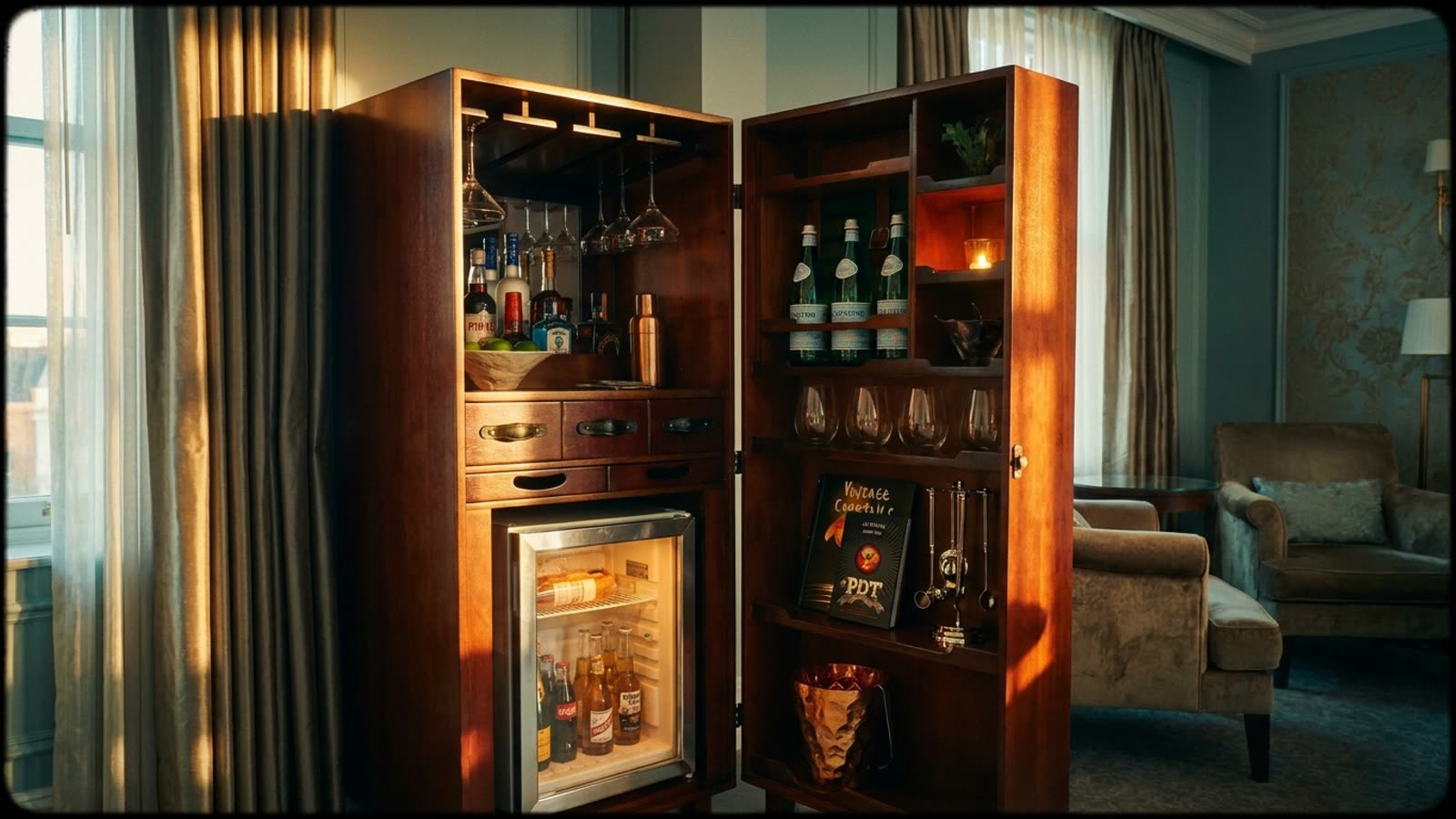
The minibar is perhaps the most irrational fixture in modern commerce. A tiny refrigerator stocked with products available for a fraction of the price in any convenience store, positioned in a room where guests have already spent hundreds of dollars for the privilege of sleeping. By any rational consumer calculus, it should have vanished decades ago. Instead, it persists — and understanding why illuminates the strange psychology that underpins the entire luxury hospitality industry.
The economics are genuinely perverse. A standard hotel minibar generates roughly $5-10 per occupied room night in revenue, against which properties must weigh labor costs for restocking, inventory shrinkage, the capital expense of the units themselves, and the not-insignificant guest complaints about accidental charges from sensors that register a lifted item as purchased. Many hotels have quietly removed them. Yet the upper tier of the market — the Four Seasons, the Aman resorts, the palace hotels of Europe — keeps them meticulously stocked, sometimes with artisanal chocolates and small-batch spirits that push the absurdity further into the realm of performance art.
The Theatre of Abundance
What the minibar sells is not hydration or sustenance but a particular fantasy: that you are the kind of person for whom price is not a consideration. The $14 Evian exists so that you might open the fridge at midnight, take what you want without checking the laminated card, and sign the bill at checkout without scrutinizing the line items. It is a test of your relationship to money, administered in the privacy of your own room.
This is the same logic that governs the $40 hotel breakfast buffet and the $18 glass of house wine at the lobby bar. The prices are not set by supply and demand but by the narrative the property wishes to construct. To stay at a luxury hotel is to enter a temporary world where friction has been eliminated — where someone has anticipated your needs and arranged for their satisfaction. The markup is the cost of maintaining that illusion.
Convenience as Status Symbol
There is also something irreducibly modern about the minibar's appeal. It represents the ultimate convenience purchase, and convenience has become the defining luxury of the professional class. Time-poor, cash-rich guests are precisely the demographic that will pay a 400% premium to avoid putting on shoes and walking to a vending machine. The minibar understands this and exploits it without apology.
Hotels have experimented with alternatives — honor bars, automated dispensing systems, apps that deliver snacks to your door — but none capture the specific pleasure of the minibar's immediate availability. It is there when you want it, already cold, requiring nothing of you but the willingness to pay.
Our take
The minibar endures because it has transcended its nominal function. It is no longer about selling Toblerone; it is about selling a version of yourself back to you — one who can afford not to care. In an era when every purchase is optimized and every dollar tracked, the minibar offers a small, overpriced escape from rationality. That this escape costs $9 for a bag of peanuts is, in its way, the entire point.