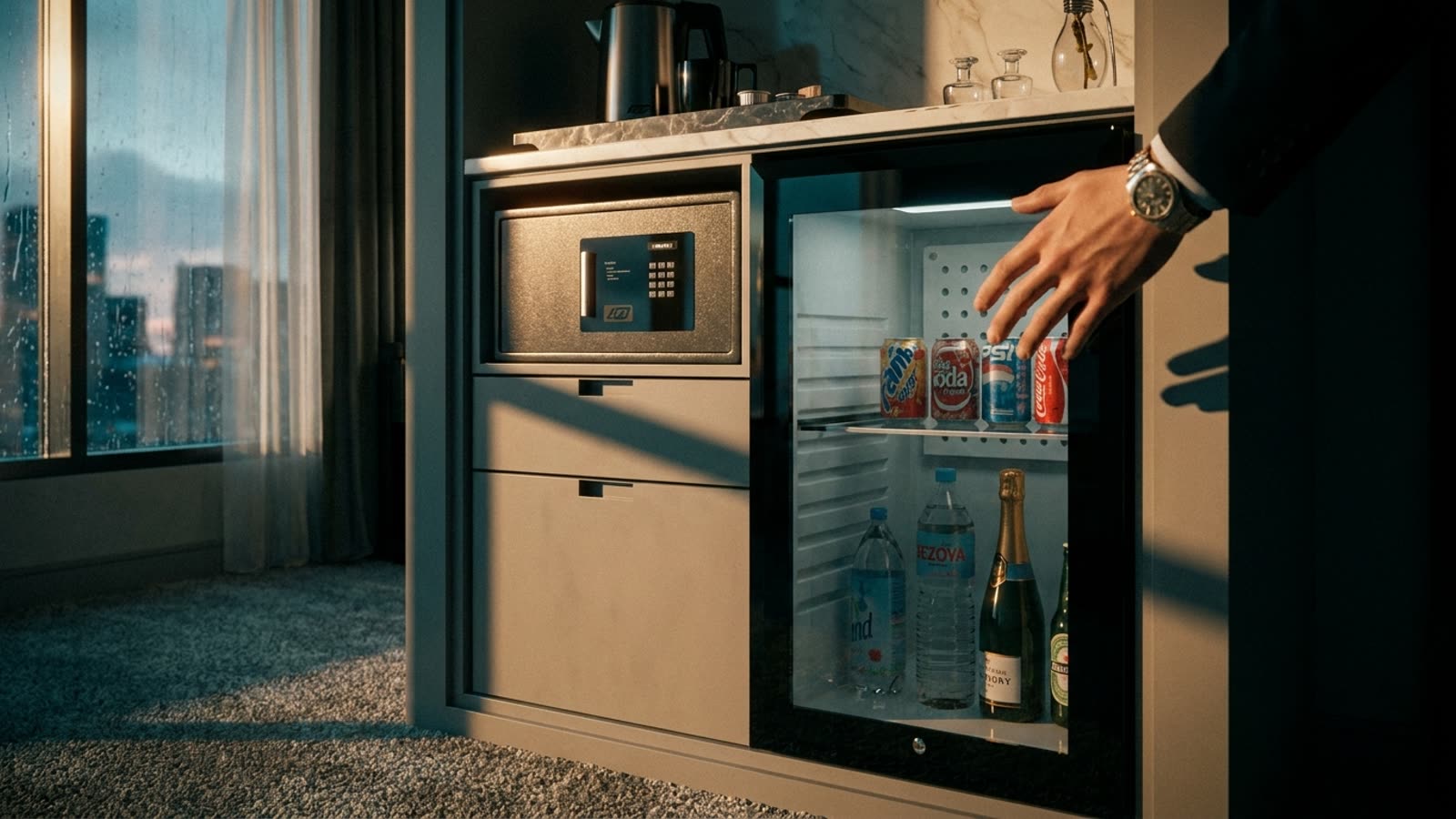
The minibar is perhaps the most despised amenity in hospitality. A tiny bottle of water for six dollars. A bag of cashews that costs more than a restaurant entrée. Guests mock it, travel writers savage it, and yet it persists in virtually every hotel room above a certain price point, its little refrigerator humming away like a shrine to captive-market economics.
This persistence is not an accident of inertia. The minibar survives because it serves functions that have nothing to do with whether anyone actually buys the overpriced Toblerone.
The economics of perceived luxury
Hotel revenue managers will tell you that minibar sales have been declining for years, squeezed by room service apps, nearby convenience stores, and the general awareness that a can of Pringles should not cost nine dollars. Some properties have removed them entirely, replacing the space with yoga mats or Nespresso machines. Yet the minibar remains standard in most four- and five-star hotels, and the reason is psychological rather than financial.
A well-stocked minibar signals abundance. It tells the guest that everything they might want is already here, pre-positioned for their convenience. The message is not "please buy this" but rather "you are the sort of person who doesn't need to think about where to find a late-night snack." The minibar is less a profit center than a prop in the theater of luxury—a small refrigerator performing the role of effortless provision.
Inconvenience as a feature
The pricing itself serves a purpose. Absurdly high minibar prices function as a sorting mechanism, separating guests who will expense anything from those who will walk three blocks for a cheaper bottle of wine. Hotels do not particularly want the second group touching the minibar anyway; restocking is labor-intensive and theft is common. The prices are not designed to maximize sales volume. They are designed to ensure that anyone who does make a purchase either doesn't care about money or isn't spending their own.
This is a common pattern in luxury hospitality. The industry has learned that friction can be profitable when applied selectively. Resort fees, à la carte spa charges, premium Wi-Fi tiers—these are not bugs but features, allowing hotels to quote lower base rates while extracting additional revenue from guests who value convenience over thrift. The minibar is simply the oldest and most transparent version of this strategy.
The delivery app paradox
One might expect food delivery services to have killed the minibar by now. A guest can summon nearly anything to their hotel room within thirty minutes, often at prices closer to retail. Yet this competition has not eliminated the minibar so much as clarified its true function. The minibar is not competing with DoorDash on price or selection. It is competing on immediacy and the absence of decision-making. The guest who reaches for the minibar at midnight is not comparison shopping; they are reaching for whatever is already there.
This is the minibar's final trick: it monetizes the gap between wanting something and wanting it enough to make an effort. That gap is small, but it is not nothing, and hotels have been extracting rent from it for decades.
Our take
The minibar deserves a certain grudging respect. It is a relic of an older hospitality philosophy, one that understood luxury as the elimination of friction rather than the multiplication of choices. That it survives in an age of infinite delivery options suggests something durable about human laziness—and about the willingness of certain travelers to pay handsomely for the privilege of not having to think. The next time you see that twelve-dollar jar of macadamia nuts, consider that you are not the customer. The expense account is.