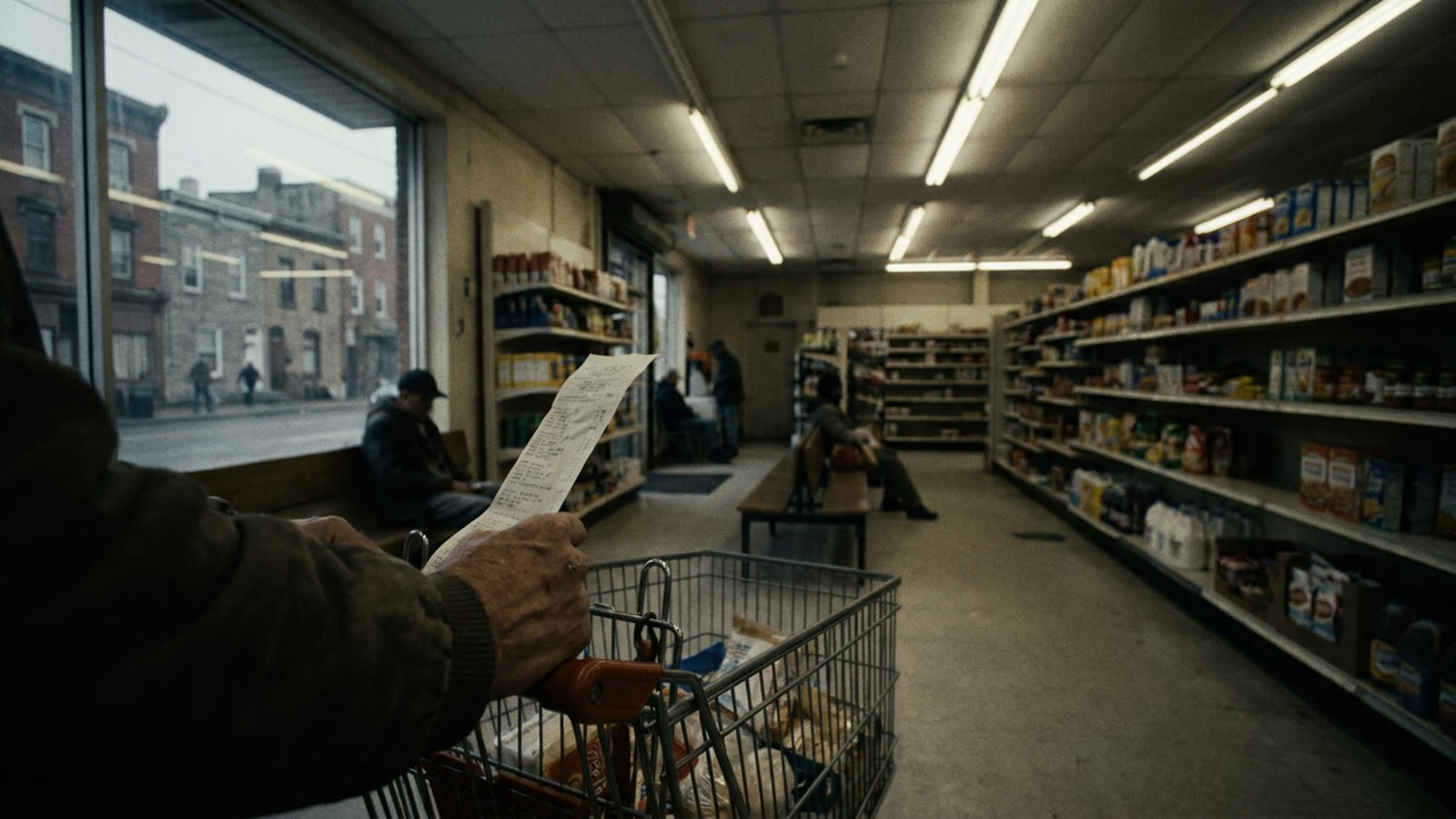
Every month, the Bureau of Labor Statistics releases a number that purports to capture the entire price experience of 330 million Americans in a single figure. And every month, millions of those Americans look at their receipts and conclude that someone is lying.
They are not entirely wrong. The Consumer Price Index is a marvel of statistical engineering, tracking roughly 80,000 items across 23,000 retail establishments. It is also, by design, incapable of measuring what most people mean when they say prices are going up. This disconnect is not a bug in the data—it is a feature of how we have chosen to define inflation, and understanding it explains much of the political fury that surrounds economic policy.
The basket problem
The CPI measures a fixed basket of goods, weighted by how the average American household allocates its spending. This averaging performs a kind of violence to individual experience. A retiree on a fixed income spends dramatically more of her budget on healthcare and prescription drugs than the composite American; a young family with children spends more on childcare and diapers. When drug prices spike, the retiree feels devastated while the index barely moves. When childcare costs surge, young parents feel squeezed while economists shrug at a modest uptick.
The weights themselves lag reality. They are updated periodically based on consumer expenditure surveys, but spending patterns shift faster than the methodology can follow. During supply shocks, consumers substitute cheaper alternatives—chicken for beef, store brands for name brands. The index captures this substitution as inflation moderating, because the basket adjusts. But the family eating chicken when they wanted steak does not experience moderation. They experience deprivation.
The quality adjustment paradox
Perhaps nothing frustrates ordinary consumers more than hedonic adjustment, the practice of reducing measured inflation when products improve. When a laptop costs the same as last year's model but has a faster processor, statisticians record this as a price decline—you are getting more computing power per dollar. The logic is defensible. The lived experience is that you paid the same amount and cannot use last year's price to buy last year's machine.
This adjustment is particularly aggressive in technology and automobiles, where mandatory safety features and efficiency improvements are treated as value additions that offset sticker-price increases. A car that costs several thousand dollars more than its predecessor may register as cheaper in the index because it includes backup cameras and better fuel economy. Try explaining that to someone writing the check.
The shelter distortion
Housing represents roughly a third of the CPI, making its measurement pivotal. Yet the index does not track home prices directly. It uses a concept called owners' equivalent rent—an estimate of what homeowners would pay to rent their own homes. This smooths out the wild swings of housing markets but creates bizarre lags. When home prices and rents surge, the index takes months or years to fully reflect the change. When they stabilize or fall, the index keeps climbing on old data.
The result is that official inflation can be rising while housing costs are actually cooling, or vice versa. Policymakers setting interest rates are, in effect, steering by a rearview mirror mounted on a different car.
Our take
None of this means the CPI is useless or that statisticians are engaged in some grand deception. The index does what it was designed to do: provide a consistent, comparable measure of price changes over time for macroeconomic analysis. The problem is that we have asked it to do something else—to validate or invalidate the felt experience of economic life. It cannot. When politicians cite the number to tell voters the economy is fine, and voters know their grocery bills tell a different story, the result is not enlightenment but corrosive distrust. The inflation gap is not between the data and reality. It is between what the data measures and what people need to know.