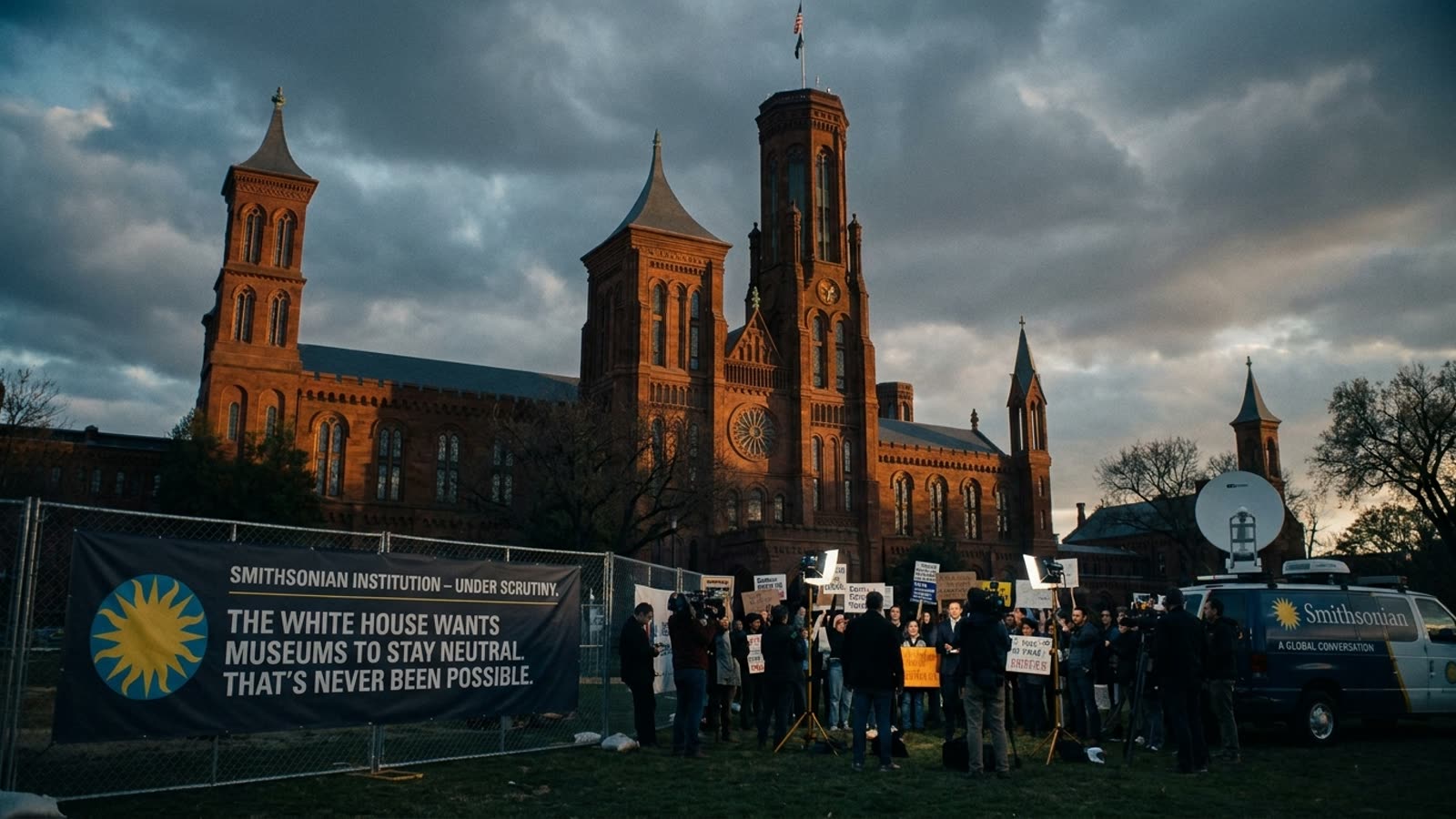
The Trump administration's public rebuke of the Smithsonian Institution for alleged "extreme political activism" marks a significant escalation in the long-running battle over what American museums should say about American history—and who gets to decide.
The White House criticism, delivered with characteristic bluntness, targets curatorial choices at the nation's most visited museum complex, which receives roughly two-thirds of its funding from federal appropriations. The message is unmistakable: institutions that depend on taxpayer dollars should think carefully about how they present contested subjects.
The impossibility of neutral curation
Museums have never been apolitical spaces, despite the comforting fiction that they simply display artifacts and let visitors draw their own conclusions. Every decision—which objects to acquire, how to label them, what context to provide, what to leave in storage—reflects judgments about significance and meaning. The Smithsonian's National Museum of African American History and Culture, which opened in 2016, was itself a political project decades in the making, requiring congressional authorization and sustained advocacy.
The current dispute echoes earlier controversies: the 1995 Enola Gay exhibition at the National Air and Space Museum, which was dramatically scaled back after veterans' groups and congressional Republicans objected to its treatment of the Hiroshima bombing, and more recent debates over how the National Museum of American History should address January 6th. Each time, the question is the same: whose interpretation of history deserves institutional endorsement?
Federal funding as leverage
The Smithsonian occupies an unusual position in American cultural life—quasi-governmental, nominally independent, but ultimately dependent on congressional appropriations that can be adjusted or conditioned. This gives elected officials considerable leverage, even if they cannot directly dictate exhibition content. The mere threat of budgetary scrutiny tends to encourage institutional caution.
Other federally funded cultural bodies, from the National Endowment for the Humanities to public broadcasting, have navigated similar pressures for decades. What distinguishes the current moment is the explicitness of the political demand and the willingness to make the conflict public rather than resolve it through quieter channels.
Our take
The administration is being refreshingly honest about something usually left implicit: governments that fund cultural institutions expect those institutions to reflect, or at least not contradict, official narratives. The Smithsonian can either accept greater political oversight or pursue greater financial independence—but the pretense that a federally funded museum can be simultaneously authoritative and apolitical was always a polite fiction. The question now is whether Americans prefer their cultural institutions captured or contested.