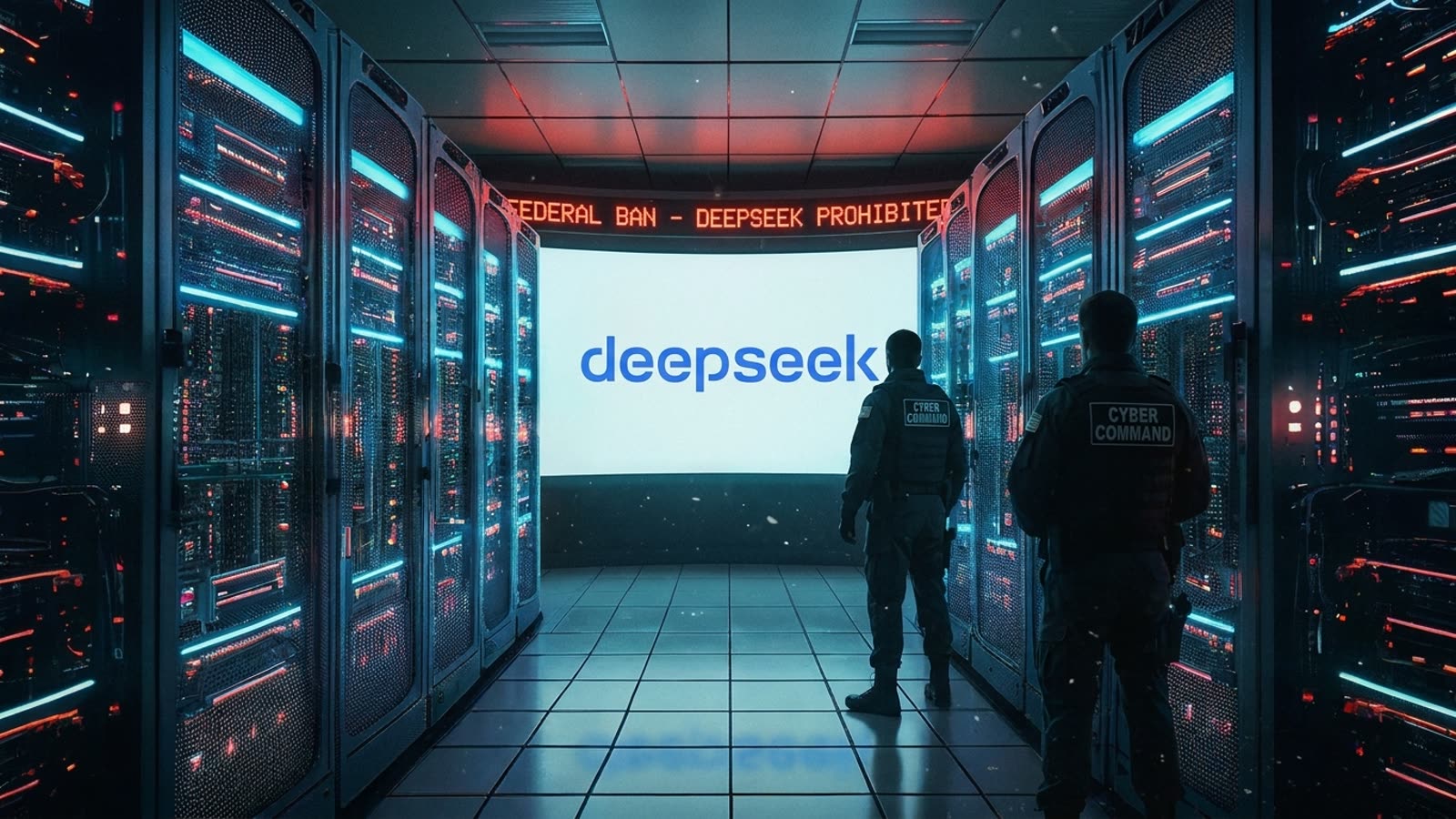
The United States has drawn its clearest line yet in the emerging contest over artificial intelligence supremacy. On Monday, the Department of Defense ordered all federal agencies to cease using AI tools developed by DeepSeek, the Chinese startup whose large language models have rattled Silicon Valley with their performance-to-cost ratio. The stated rationale is blunt: using DeepSeek products "may result in the transfer of sensitive data" to Beijing.
This is not another vague warning about supply-chain risk or a congressional hearing that leads nowhere. It is an operational ban, enforceable immediately, covering every corner of the federal bureaucracy from the Patent Office to the Pentagon. And it arrives at a moment when DeepSeek's models have been quietly seeping into American workflows—academic research labs, municipal IT departments, even some defense contractors seeking cheaper inference costs.
The security logic
The concern is straightforward, if difficult to verify. Modern AI assistants ingest user prompts, documents, and context windows that can contain classified or sensitive material. Even if DeepSeek's servers nominally sit outside China, the company remains subject to Beijing's national-security laws, which compel cooperation with intelligence services upon request. Washington's calculation is that no contractual assurance can override that legal reality.
Critics will note the irony: American tech firms face analogous demands under FISA and the CLOUD Act, a point Chinese officials have made repeatedly. But symmetry of legal exposure does not imply symmetry of intent, and the US government has decided it cannot afford to assume good faith from a strategic competitor.
The market ripple
For domestic AI vendors—OpenAI, Anthropic, Google, Microsoft—the ban is an unambiguous gift. Federal procurement is not the largest revenue pool, but it confers legitimacy and often precedes allied-nation purchasing decisions. Expect Brussels, London, and Canberra to face pressure to follow suit, formalizing a bifurcated AI market that mirrors the semiconductor divide.
DeepSeek, for its part, has said little publicly. The startup's appeal lay precisely in its willingness to undercut Western pricing while matching benchmark performance. That value proposition now carries a regulatory asterisk for any organization that touches US government data.
Our take
The ban is overdue, if imperfect. Governments routinely restrict foreign software in sensitive contexts; the novelty here is applying that logic to AI, where the attack surface is the conversation itself. The harder question—what to do about DeepSeek models already embedded in private-sector research—remains unanswered. Washington has fired a warning shot. The siege, if it comes, will require a far larger arsenal.