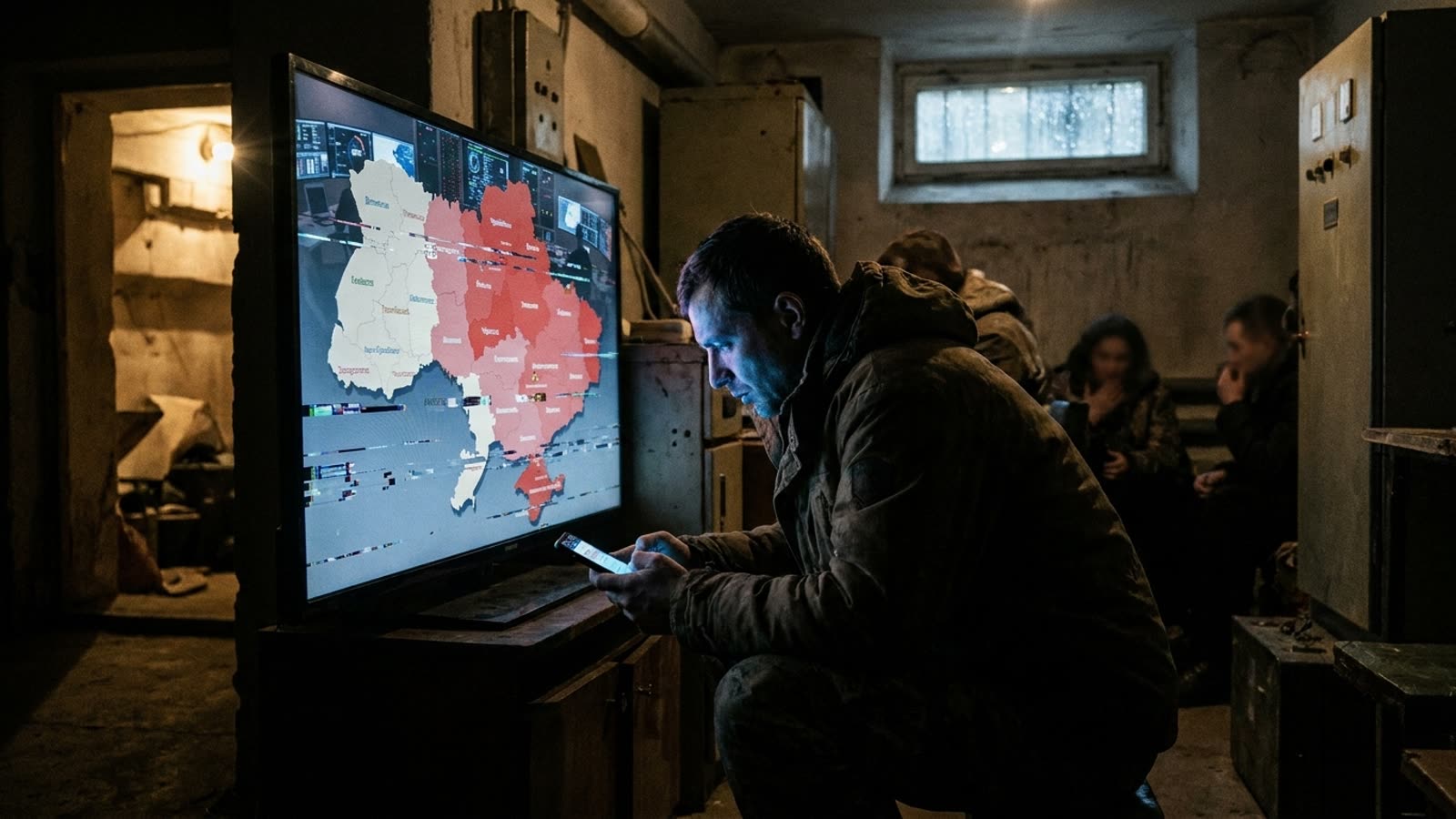
The war between Ukraine and Russia has always been as much about information as ordnance, but the events of November 1 mark a new chapter in the weaponization of civilian infrastructure. Ukraine's Air Force announced that its widely used air-raid warning app had been compromised, sending false alerts about a radiation threat to millions of users. Hours later, Russian authorities claimed their own alert system had been breached, with fake warnings distributed inside the country. Both sides pointed fingers. Neither offered proof. And the world is left to parse competing narratives in a conflict where truth has become as contested as territory.
The simultaneity is the story. If both claims are accurate, it suggests a coordinated operation designed to sow chaos on both sides of the front—perhaps by a third actor, or by one combatant seeking plausible deniability. If one or both claims are false, the incident becomes a propaganda play, a way to pre-emptively blame the other side for future disruptions or to justify retaliatory cyber operations. Either way, the civilian populations of two nations spent hours unsure whether they faced imminent danger, a psychological toll that is itself a weapon.
The app as battlefield
Air-raid warning apps have become essential infrastructure in Ukraine, where missile strikes and drone attacks are a daily reality. Millions rely on push notifications to know when to seek shelter. Compromising that system is not just a technical breach; it is an attack on the social contract between a government and its people. The false radiation alert—particularly resonant in a country still haunted by Chernobyl—was calibrated for maximum panic. Russia's claim of a parallel breach is harder to assess, given the opacity of its domestic information environment, but the timing suggests either tit-for-tat retaliation or a coordinated disinformation campaign.
The technical details remain murky. Neither government has disclosed how the breaches occurred, whether through server compromise, credential theft, or supply-chain infiltration. That silence is strategic: admitting the full scope of a vulnerability invites further exploitation. But it also means the public is left in a state of permanent uncertainty, unable to distinguish between genuine threats and manufactured ones.
The precedent problem
This is not the first time cyberattacks have targeted civilian warning systems, but it may be the most brazen. The 2018 false ballistic-missile alert in Hawaii, caused by human error rather than malice, sent a state into panic for 38 minutes. Imagine that scenario weaponized and deployed across two nations simultaneously. The incident sets a dangerous precedent: if air-raid apps can be hacked, so can emergency broadcast systems, power-grid alerts, and public-health notifications. The line between wartime sabotage and peacetime terrorism becomes impossible to draw.
The broader implication is that cyberwarfare has moved beyond military and industrial targets to the most intimate layer of civilian life—the smartphone in your pocket that tells you whether to run. This is not infrastructure in the traditional sense; it is the nervous system of a society under siege. And once that system is compromised, trust collapses. Even if the apps are secured tomorrow, millions of Ukrainians and Russians will now hesitate before believing the next alert, a hesitation that could prove fatal in a real strike.
Our take
The simultaneous hacks—or claims of hacks—are a reminder that modern warfare is fought as much in the gray zone of perception as on the ground. We may never know the full truth of what happened on November 1, and that ambiguity is itself the point. When civilian warning systems become instruments of psychological warfare, the distinction between combatant and non-combatant dissolves entirely. The international community has spent decades trying to codify rules for cyberwar; this incident suggests those rules are already obsolete. The fog of war has always been thick, but in the digital age, it is permanent.