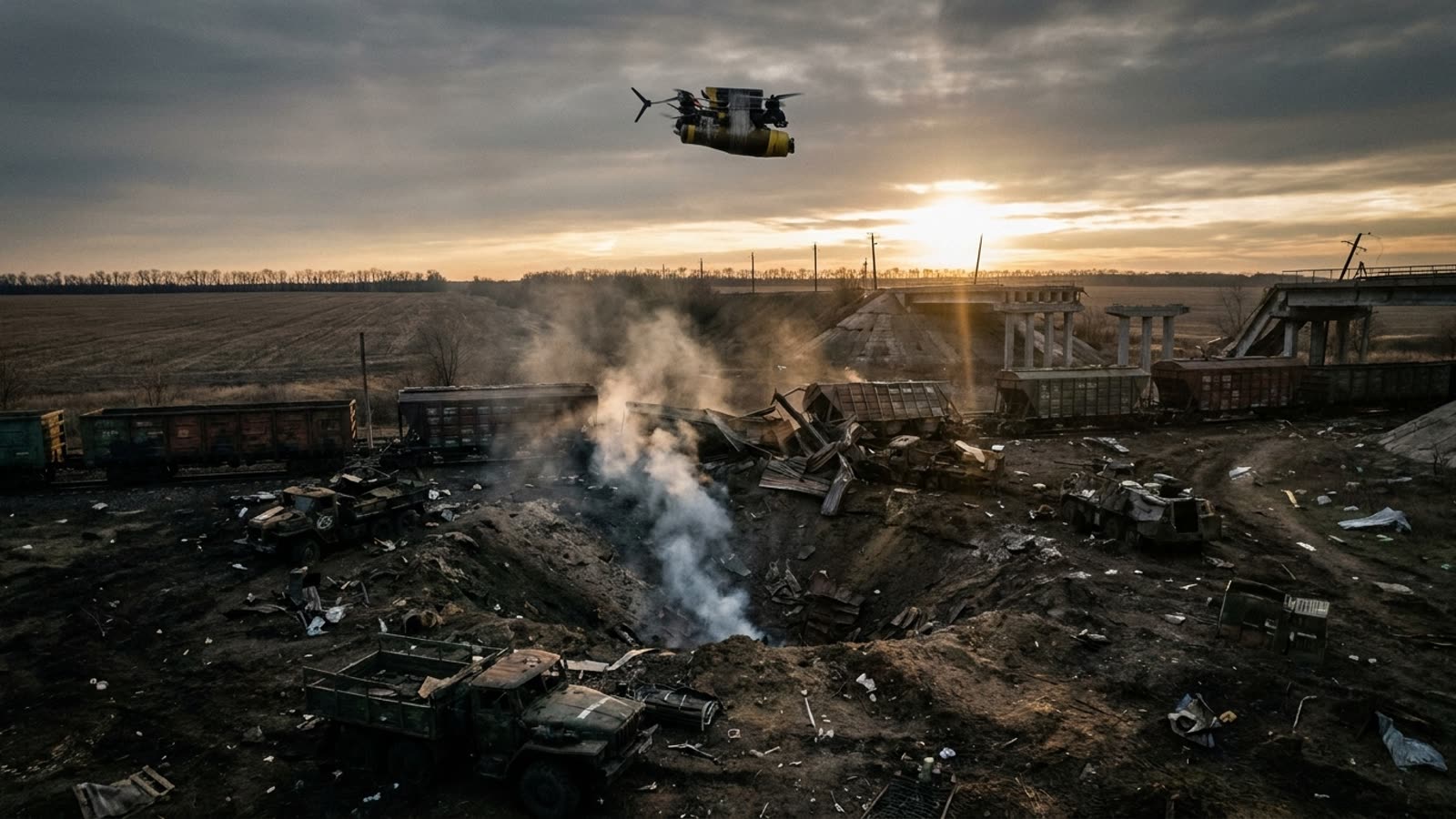
The most consequential shift in the Russo-Ukrainian war this spring has nothing to do with territory gained or lost. It is happening in the skies above Russia's battlefield rear, where Ukrainian drone units have pivoted from frontline harassment to systematic deep-strike campaigns against the logistical arteries that keep Moscow's war machine fed.
Reporting from embedded positions with Ukrainian drone forces reveals an operation that has matured far beyond the improvised quadcopter drops of 2022. These units now conduct coordinated strikes on ammunition depots, fuel convoys, and command posts kilometers behind Russian lines—targets that would once have required expensive cruise missiles or politically fraught incursions by manned aircraft.
The logistics war
Modern warfare is won and lost in supply chains, and Ukraine's drone commanders have internalized this lesson with brutal efficiency. By targeting Russia's rear echelons, they are attempting to impose costs that Moscow cannot easily absorb: every destroyed fuel truck means tanks that cannot advance, every struck command post means orders that arrive late or not at all.
The tactical logic is sound. Russia's front-line troops have adapted to drone threats with electronic warfare and dispersal, but logistics hubs cannot simply scatter. Ammunition must be stored somewhere; convoys must travel predictable routes. These concentrations are vulnerable in ways that dug-in infantry is not.
Technology meets doctrine
What distinguishes this campaign is the integration of indigenous Ukrainian drone production with Western intelligence sharing. The drones themselves are increasingly domestically manufactured, reducing dependence on foreign supply chains that have proven unreliable. Meanwhile, targeting data flows from a constellation of NATO surveillance assets that Kyiv officially does not acknowledge receiving.
The result is a kill chain that operates at machine speed against targets of opportunity. A Russian convoy spotted by satellite can face drone attack within hours rather than days—a tempo that negates many of Moscow's traditional advantages in mass and depth.
Our take
None of this will end the war. Russia retains enormous reserves of men and materiel, and its own drone capabilities continue to improve. But Ukraine's rear-area campaign represents something important: a demonstration that technological asymmetry can partially offset numerical inferiority. The lesson will not be lost on military planners from Taipei to Tallinn. In an era when great-power conflict seems increasingly plausible, Ukraine is writing the textbook in real time—and the chapter on drone warfare just got considerably longer.