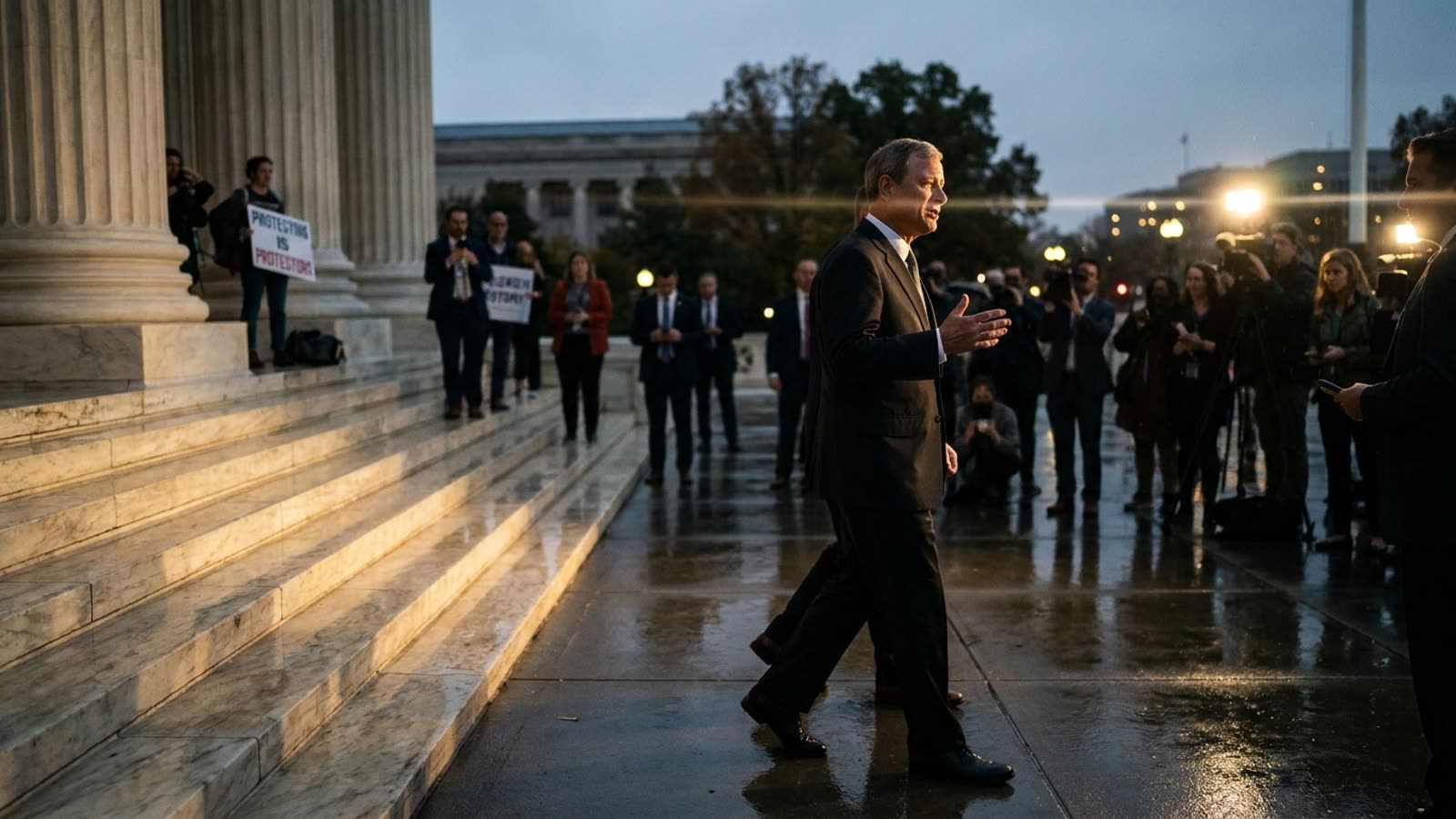
The Supreme Court's recent term has produced a curious pattern: Chief Justice John Roberts, long cast as the institutionalist brake on conservative overreach, has sided with the Trump administration on several high-profile cases where conventional wisdom predicted friction. Commentators have rushed to declare either Roberts's rightward drift or his capitulation to political pressure. Both readings miss the more interesting story.
Roberts is not moving toward Trump. He is moving toward the Court's continued relevance—and in 2026, those vectors occasionally point the same direction.
The Institutionalist's Dilemma
Roberts has spent nearly two decades cultivating the Court's legitimacy through incremental rulings and occasional cross-ideological surprises. His vote to preserve the Affordable Care Act in 2012 and his majority opinion limiting partisan gerrymandering claims in 2019 both reflected a consistent principle: the Court should avoid becoming a naked political actor, even when the law might permit more aggressive intervention.
But the political environment has shifted beneath him. Court expansion proposals, once fringe academic exercises, now command serious attention in Congress. Public approval of the Supreme Court has declined to historic lows. And the conservative supermajority Roberts nominally leads has shown little interest in his go-slow approach, regularly issuing sweeping rulings that invite political backlash.
In this context, Roberts faces a calculation: aggressive opposition to a popular administration's priorities risks accelerating the very court-packing threats that would destroy his life's work. Selective alignment—particularly on cases where the administration's legal position is defensible, if not inevitable—offers a pressure valve.
The Administration's Leverage
The Trump White House, for its part, has learned from its first-term frustrations with the judiciary. Rather than treating courts as obstacles to be circumvented, the current approach emphasizes litigation strategies designed to give institutionalist judges acceptable off-ramps. Executive orders are drafted with clearer statutory hooks. Regulatory actions cite more explicit congressional authorization. The goal is not to win every case but to make losses politically costly for judges.
This creates a dynamic where Roberts can rule for the administration without appearing to abandon principle—the legal arguments are simply better constructed than they were during the chaotic first term. Whether this reflects genuine legal craftsmanship or merely more sophisticated forum-shopping is a question that will occupy law review articles for years.
The Limits of Alignment
None of this suggests Roberts has become a reliable administration ally. His concurrences continue to narrow holdings where possible, and his questions during oral argument remain skeptical of expansive executive claims. The Chief Justice is not converting; he is triangulating.
The more significant development may be what Roberts's positioning reveals about the Court's vulnerability. An institution confident in its legitimacy need not calibrate its rulings to political winds. That Roberts appears to be doing exactly that—however subtly—suggests the Court's post-Dobbs crisis of confidence runs deeper than its defenders acknowledge.
Our take
Roberts is playing a long game that may no longer exist. His careful institutionalism assumes a political system that still values judicial independence as a shared norm rather than a obstacle to be overcome. The Chief Justice's occasional alignment with Trump administration positions is best understood as an attempt to buy time—for the Court, for the norms he cherishes, perhaps for his own legacy. Whether that time can be converted into anything durable depends entirely on forces outside his control. The arithmetic works for now. The question is whether Roberts is solving for the right variable.