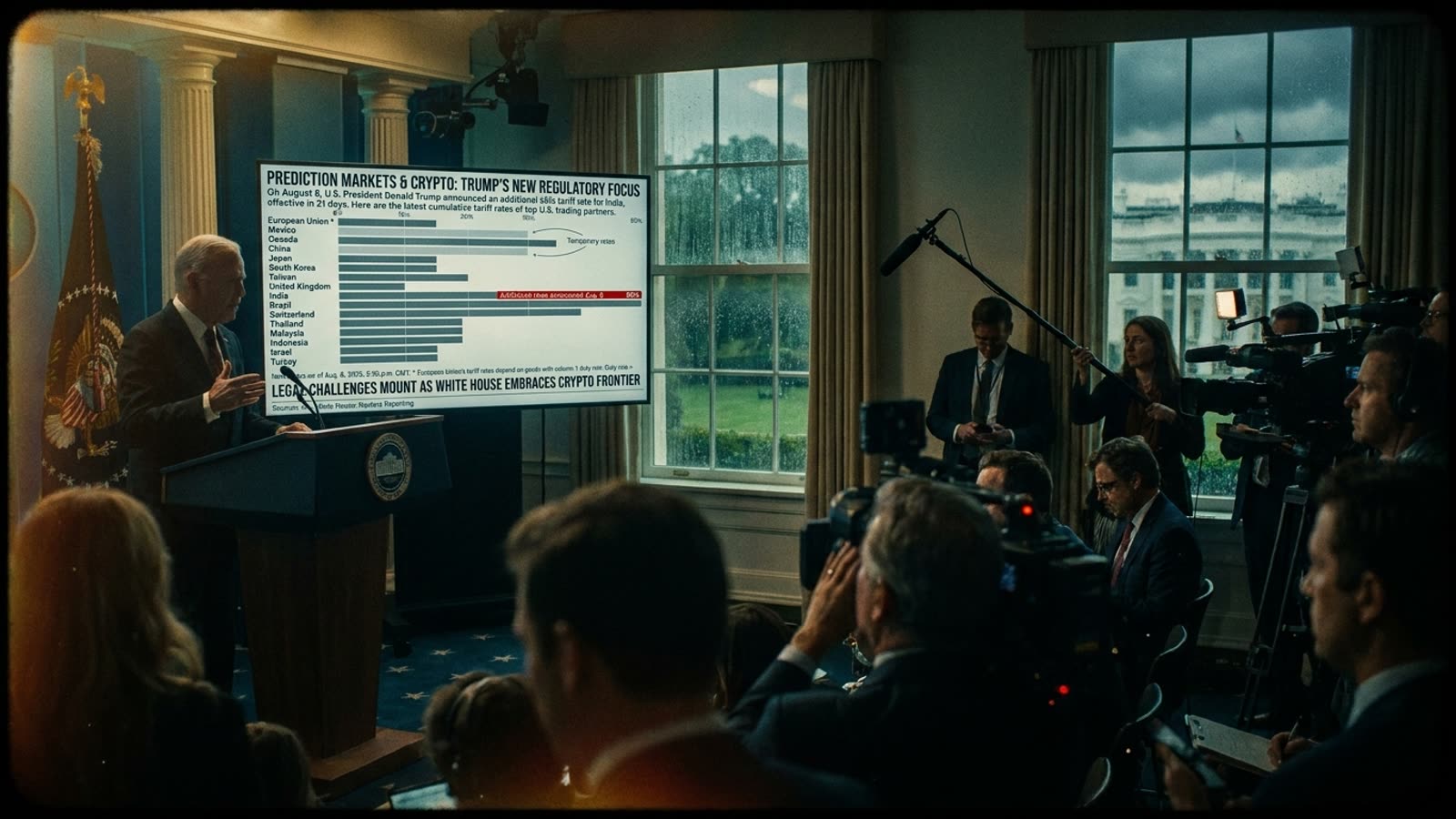
The American president has decided that prediction markets are good, actually, and he would like everyone to know it. Donald Trump's recent public praise for platforms like Polymarket and Kalshi—paired with a pointed defense of the Commodity Futures Trading Commission's jurisdiction over these instruments—marks the clearest signal yet that the administration views prediction markets as a legitimate, even desirable, feature of the financial landscape.
This is not a small thing. Prediction markets have spent years in regulatory purgatory, caught between state gambling laws, federal commodity regulations, and the fundamental question of whether betting on election outcomes or geopolitical events constitutes speculation or something more troubling. The president's intervention suggests the White House has picked a side.
The regulatory tangle
The CFTC has long claimed oversight of prediction markets as derivatives instruments, a classification that allows platforms to operate with some legal cover while avoiding the gambling designation that would invite state-level prohibitions. But this framework has faced persistent legal challenges. Courts are currently weighing multiple cases that could reshape how these markets operate—or whether they can operate at all in certain jurisdictions.
Trump's defense of the CFTC is strategically timed. By publicly backing the commission's approach, the administration is effectively lobbying the judiciary through the bully pulpit, signaling that executive branch policy favors prediction markets' continued existence under commodity law rather than gambling statutes.
The global context
The president's embrace of prediction markets stands in stark contrast to the regulatory mood elsewhere. Indonesia recently blocked Polymarket, joining a broader Asian crackdown that has seen multiple jurisdictions move against these platforms. Spain has taken similar steps. The international trend is toward restriction, not accommodation.
This divergence creates an interesting dynamic. If the United States becomes the permissive jurisdiction for prediction markets while Asia and Europe tighten restrictions, American platforms could capture global market share—but they would also become lightning rods for criticism that the U.S. is enabling what critics call gambling on elections and world events.
The political calculation
There is, of course, a political dimension. Prediction markets famously favored Trump in 2024, and their accuracy in that cycle earned them credibility as forecasting tools. The president's affection for platforms that predicted his victory is not mysterious. But the policy implications extend beyond personal gratitude.
Prediction markets generate information. They aggregate dispersed knowledge into price signals that, proponents argue, are more accurate than polls or pundit consensus. An administration that values this information—and that benefits from markets that have historically been bullish on its prospects—has incentive to ensure these platforms survive their legal challenges.
Our take
Trump's prediction market advocacy is self-interested but not wrong. These platforms do produce useful information, and the regulatory uncertainty surrounding them has been genuinely harmful to innovation. The question is whether presidential cheerleading can actually influence pending court cases, or whether it merely signals to the CFTC that aggressive defense of its jurisdiction will be rewarded. Either way, the administration has made its preference clear: prediction markets are here to stay, at least if the White House has anything to say about it.