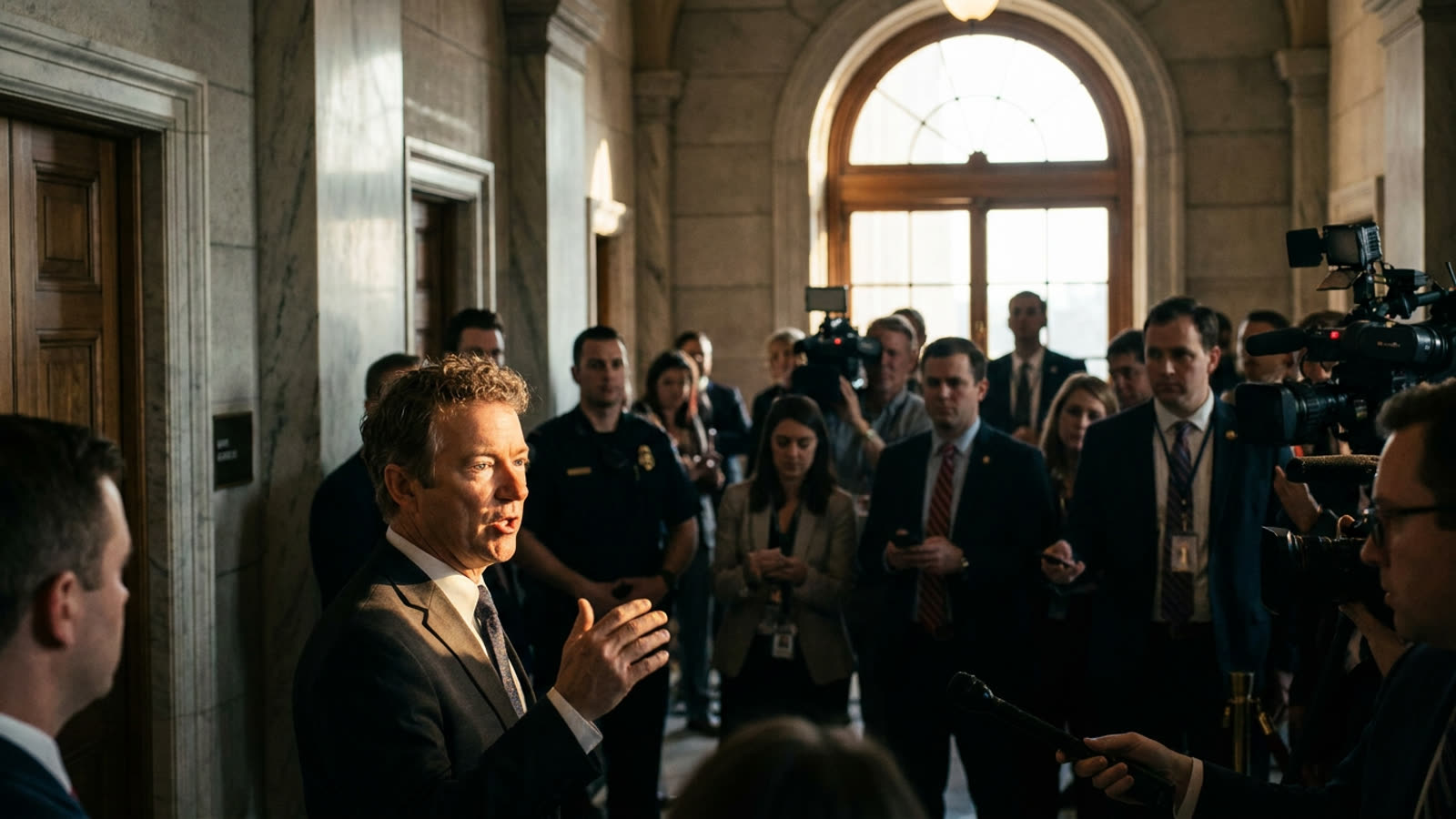
The Republican Party has spent a decade pretending it could contain multitudes on foreign policy—MAGA skepticism of forever wars alongside traditional hawkishness, America First rhetoric beside Reagan-era interventionism. That fiction collapsed in a Capitol Hill conference room this week when President Trump and Senator Rand Paul of Kentucky reportedly engaged in a shouting match over the administration's approach to Iran.
The confrontation, which multiple sources described to Reuters as heated and personal, centered on whether the president's recent diplomatic overtures to Tehran—and the framework deal now taking shape—represent a capitulation or a masterstroke. Paul, the Senate's most consistent non-interventionist voice, apparently pushed Trump to go further and faster toward disengagement. Trump, according to attendees, bristled at the implication that he was being insufficiently bold.
The deal that divides
The emerging US-Iran arrangement has scrambled traditional alliances in ways that make the old hawk-versus-dove framing useless. Trump has positioned the framework as a personal triumph of dealmaking, a Nixon-to-China moment that only he could deliver. But the agreement's critics span the ideological spectrum: neoconservatives who see any accommodation with Tehran as appeasement, progressives who distrust Trump's motives, and libertarians like Paul who worry the deal preserves too much American entanglement in the region.
What made the shouting match notable was not the policy disagreement—Paul and Trump have clashed before—but the venue and the witnesses. This was not a cable news spat or a social media exchange. It was a face-to-face confrontation in front of Republican colleagues who have spent years navigating between the party's factions. The pretense of unity was abandoned in real time.
The Netanyahu factor
The Iran framework's most significant casualty may be external. Israeli Prime Minister Benjamin Netanyahu has staked his political survival on American maximum pressure against Tehran, and the emerging deal represents a repudiation of that strategy. Reports suggest Netanyahu's government is quietly furious, though publicly maintaining the alliance's ceremonial warmth.
This creates an unusual dynamic: a Republican president pursuing détente with Iran over the objections of Israel's right-wing government, while a libertarian Republican senator argues the president isn't going far enough. The old coalitional logic—Republicans support Israel, Democrats negotiate with adversaries—has become incoherent.
What the shouting reveals
Closed-door confrontations between presidents and senators are not unprecedented, but they usually stay closed-door. The speed with which this one leaked suggests that participants wanted the story told—either to signal their own position to constituents or to put pressure on the other side. Neither Trump nor Paul benefits from appearing weak, and both have bases that reward combativeness.
The deeper significance is structural. The Republican Party's foreign policy has been held together by shared enemies—Democrats, the media, the deep state—rather than shared principles. When an actual policy decision forces a choice between America First retrenchment and traditional alliance maintenance, the coalition fractures along lines that cannot be papered over with rhetoric.
Our take
The shouting match is less interesting than what comes after. Trump has shown repeatedly that he values personal loyalty over ideological consistency, and Paul has shown that he will accept considerable humiliation to remain relevant. They will likely find some face-saving formula and move on. But the episode reveals that the Republican foreign policy consensus is not merely fraying—it never existed. The party contains people who want to bomb Iran and people who want to leave the Middle East entirely, and the only thing keeping them in the same room is the shared conviction that Democrats are worse. That is not a governing philosophy. It is a coalition of convenience, and convenience has a way of expiring.