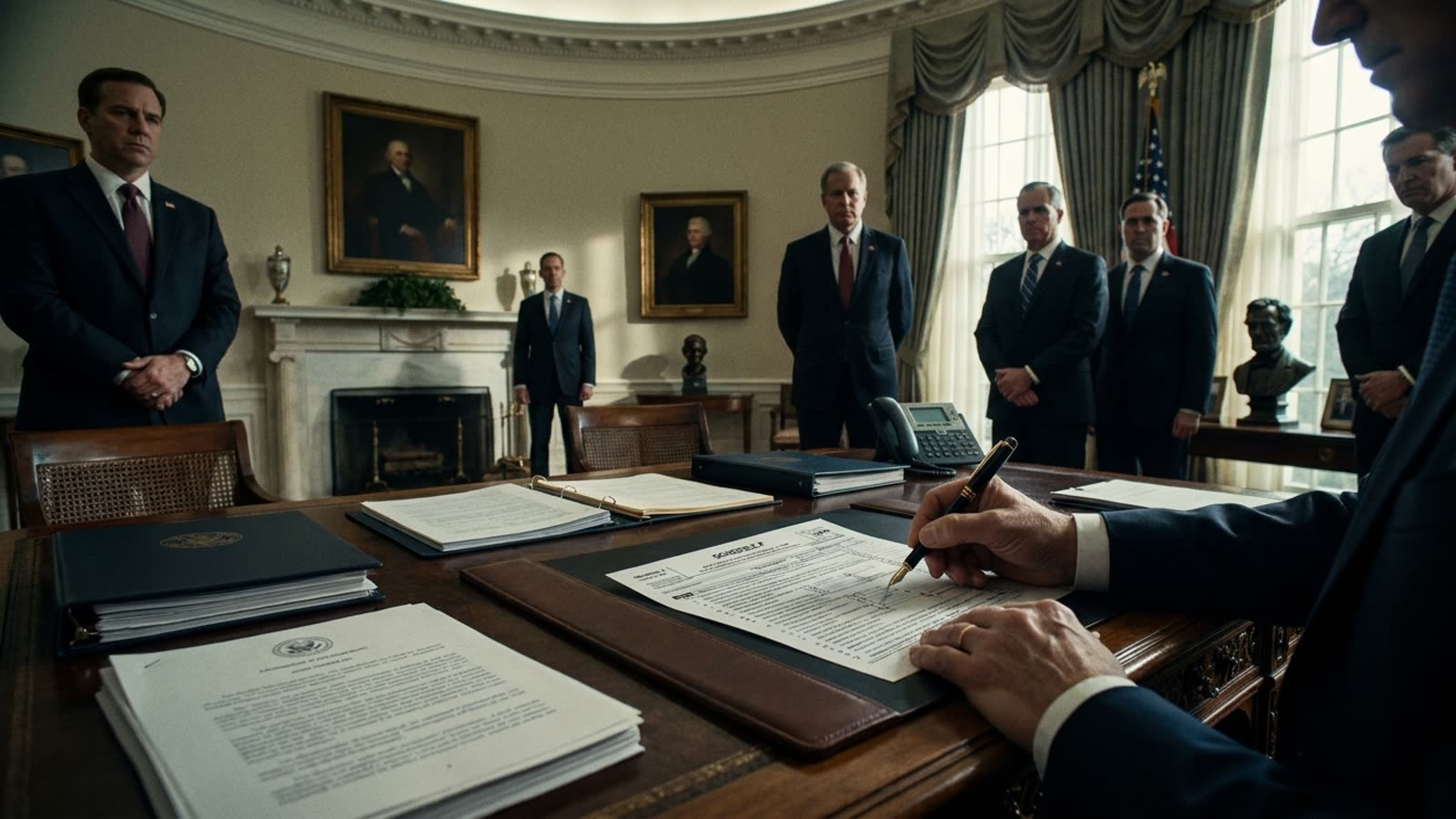
The Trump administration has resurrected Schedule F, the controversial executive mechanism that strips job protections from federal employees in policy-influencing roles, clearing the path to terminate approximately 8,000 workers across agencies. The move, announced this week, represents the most significant assault on civil service tenure in nearly half a century and signals that the second Trump term intends to reshape the bureaucracy far more aggressively than the first.
Schedule F was born in October 2020, lived for roughly three months, and died when President Biden revoked it on his first day in office. Its return was always a question of when, not if. The mechanism reclassifies employees whose work involves policy determination, advocacy, or confidential advisory functions from the competitive service—where termination requires documented cause and appeals processes—to the excepted service, where they serve at the pleasure of their superiors.
The economic logic of a smaller state
The administration frames the move as efficiency-driven. Eliminating layers of career officials who slow-walk presidential priorities, the argument goes, will accelerate regulatory rollbacks and reduce compliance costs for businesses. Proponents point to the $180 billion annual cost of federal civilian compensation and argue that even modest workforce reductions generate meaningful fiscal savings.
But the economics are murkier than the rhetoric suggests. Mass departures of experienced staff create institutional knowledge gaps that can prove expensive to fill. Agencies like the IRS, EPA, and Federal Reserve rely on specialists whose expertise takes years to develop. Replacing them with political appointees or contractors often costs more per capita while delivering less continuity. The Congressional Budget Office has historically found that targeted workforce reductions rarely produce the savings advertised, because the functions those workers perform either migrate elsewhere or generate downstream costs when left undone.
Markets are watching, quietly
Wall Street has not reacted dramatically to the announcement, but the implications for regulated industries are substantial. Financial institutions, pharmaceutical companies, and energy firms have long cultivated relationships with career staff at their respective oversight agencies. Those relationships provide predictability—an underrated commodity in capital allocation decisions. If the people who interpret regulations rotate with each administration, compliance becomes a moving target, and the cost of uncertainty gets priced into investment decisions.
The Federal Reserve, notably, is not directly affected by Schedule F, but the precedent matters. If policy-adjacent employees across government become at-will, the independence of ostensibly apolitical institutions looks increasingly fragile. Bond markets, which have already absorbed significant volatility from tariff uncertainty, may eventually demand a premium for that fragility.
Our take
Schedule F is less a cost-cutting measure than a power-consolidation tool dressed in fiscal language. Whether you find that alarming or overdue depends on your priors about the administrative state. What seems clear is that the move will accelerate brain drain from agencies already struggling to compete with private-sector salaries, and that the institutional memory walking out the door will not be easily replaced. The federal workforce is about to get younger, cheaper, and considerably less experienced. Markets should price that accordingly.