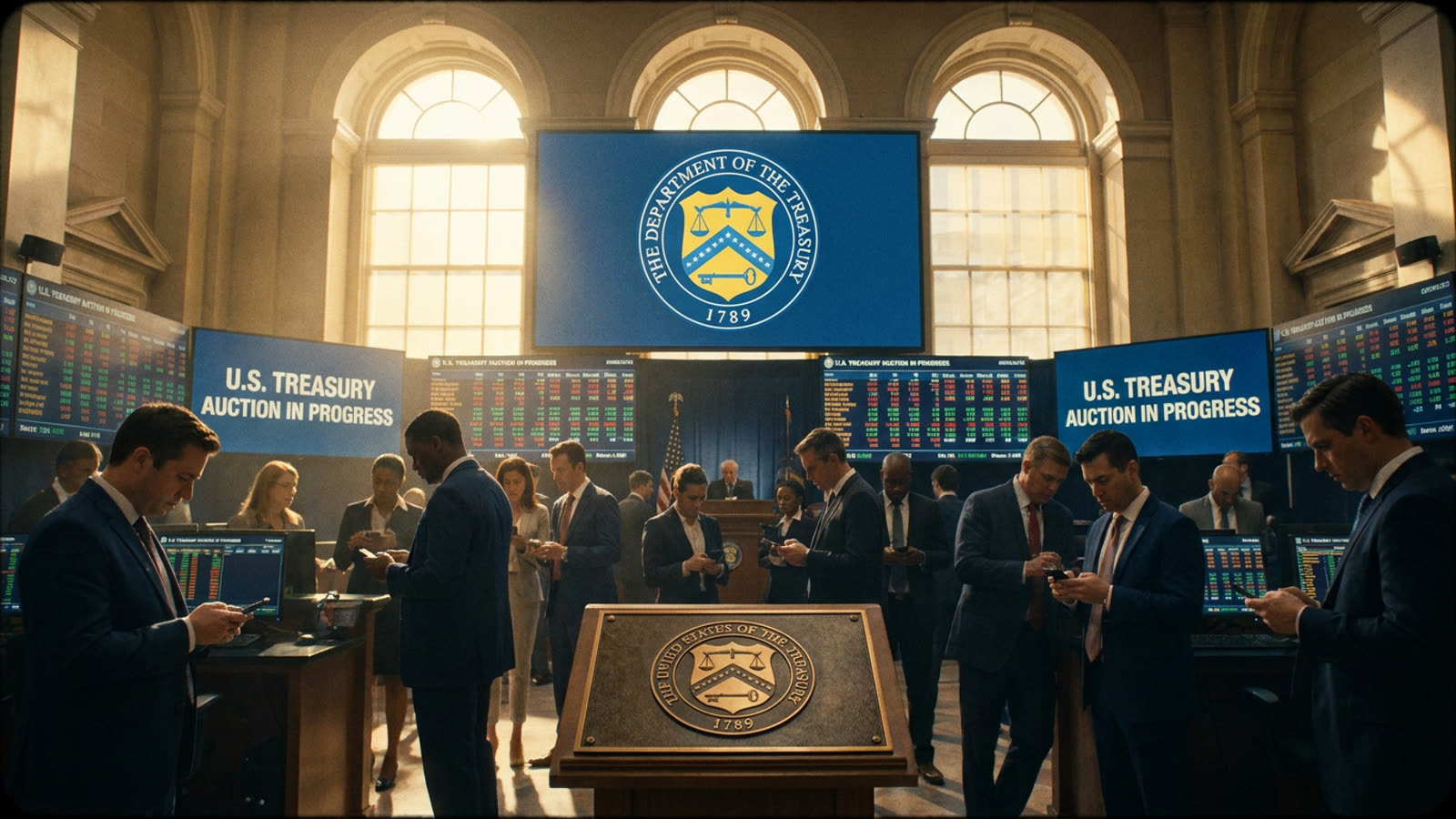
When the United States Treasury announces it will borrow money, the financial world briefly holds its breath. Not because anyone doubts the government will find buyers—it always does—but because the price those buyers demand becomes the gravitational constant around which all other borrowing costs orbit. Your car loan, your company's credit line, the interest on Italy's sovereign debt: all of them trace their lineage back to a process that unfolds in a windowless room and concludes in under two hours.
The auction itself is almost comically mundane. The Treasury posts a schedule months in advance, specifying how much it intends to borrow and in what maturities. On the appointed day, a select group of primary dealers—large financial institutions obligated to bid—submit their offers. Some bids are competitive, specifying both a quantity and a yield; others are noncompetitive, agreeing to accept whatever rate emerges. The Treasury fills orders from the lowest yield upward until it has raised the target sum. The highest accepted yield becomes the "stop" rate, and everyone who bid lower gets their bonds at that price.
Why the world cares about a clerical exercise
The stop rate is not merely a number for bond traders. It is the benchmark against which virtually all dollar-denominated credit is priced. When a ten-year Treasury auction clears at a higher yield than expected, mortgage lenders adjust their rate sheets before the ink is dry. Corporate treasurers recalculate the cost of their next bond issue. Pension funds rebalance their portfolios. The signal propagates outward at the speed of a Bloomberg terminal refresh.
This sensitivity exists because U.S. Treasuries are the closest thing to a risk-free asset that global finance possesses. If the American government must pay more to borrow, then every borrower with even a sliver of credit risk must pay more still. The spread between Treasury yields and other rates can widen or narrow, but the floor is always set in that auction room.
The bid-to-cover ratio and other tea leaves
Market participants obsess over metrics that would bore anyone outside the priesthood. The bid-to-cover ratio—total bids divided by bonds on offer—measures appetite. A ratio above two suggests healthy demand; below that, traders start murmuring about "soft" auctions. The share of bonds taken by foreign central banks, reported with a slight delay, hints at whether the dollar's reserve-currency status remains unquestioned. Even the difference between the auction yield and the prevailing market yield at the moment of pricing, known as the "tail," is parsed for meaning. A long tail implies dealers had to be coaxed; a short one suggests eager buyers.
These indicators matter because the Treasury's borrowing needs are enormous and growing. The Congressional Budget Office projects deficits stretching to the horizon, meaning the auction calendar will only get busier. If demand ever faltered—truly faltered, not the minor hiccups that occasionally rattle markets—the consequences would cascade through every asset class on earth.
Our take
Treasury auctions are the plumbing of global capitalism, and like all plumbing, they are ignored until something backs up. For now, the system works with remarkable efficiency, channeling trillions of dollars from savers to the state and back again with minimal friction. But the complacency this breeds is itself a risk. The day an auction truly disappoints will be the day everyone remembers that even the world's most liquid market depends on confidence—and confidence, unlike Treasury bonds, cannot be printed on demand.