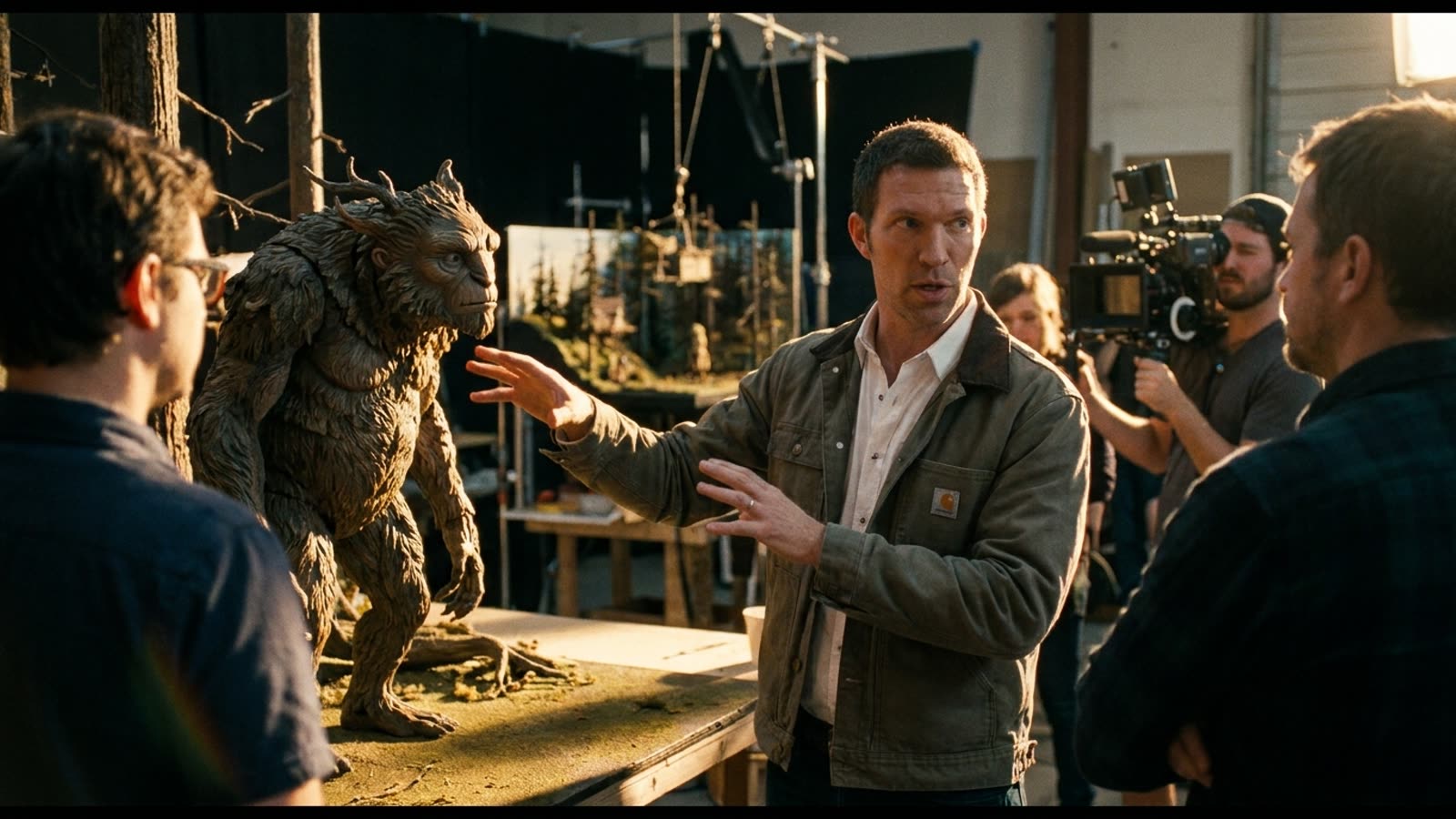
In an industry where studios increasingly greenlight projects based on IP recognition scores and four-quadrant appeal matrices, Travis Knight chose to spend the better part of two decades painstakingly moving puppets frame by frame. "Wildwood," his adaptation of Colin Meloy and Carson Ellis's 2011 fantasy novel, has emerged from Laika's Portland studios to rapturous critical reception—and now faces the far harsher tribunal of the multiplex.
Knight, who inherited both a sneaker empire and an animation studio from his father Phil Knight, has described the project as a "grand experiment." That's underselling it. Sixteen years of development, an undisclosed budget rumored to rival Disney's animated tentpoles, and a creative process so deliberately anti-efficient it borders on performance art. Each second of footage required twenty-four individually sculpted frames. The film runs just over two hours.
The anti-algorithm auteur
What makes Knight's gambit significant extends beyond mere craft fetishism. At a moment when Hollywood's dominant players are strip-mining nostalgia, franchising everything that moves, and increasingly flirting with generative AI to reduce labor costs, Laika has doubled down on the most labor-intensive form of filmmaking imaginable. The studio employs hundreds of artisans—sculptors, painters, fabricators—in an age when such jobs are being automated out of existence elsewhere.
Knight has been characteristically philosophical about the tension. "There's something valuable in the imperfection," he told interviewers, noting that stop-motion's slight wobbles and tactile textures create an emotional register that CGI struggles to replicate. Whether audiences weaned on Pixar's frictionless surfaces agree remains the open question.
The Nike of it all
Knight's position as heir to one of America's great fortunes inevitably colors the reception. He can afford to spend sixteen years on a passion project because his family could buy a small nation. Yet this also liberates him from the quarterly-earnings logic that governs most studio decisions. Laika has never turned a profit in its traditional sense; Knight has reportedly covered shortfalls personally. The studio exists, in essence, as an act of patronage—a Medici arrangement for the streaming age.
Critics have praised "Wildwood" as a technical masterpiece, with particular attention to its rendering of the Pacific Northwest's forests as living, breathing characters. The voice cast—reportedly including several A-list names who worked for scale—suggests the project attracted true believers rather than mercenaries.
Our take
There's something almost perverse about celebrating a billionaire's vanity project as a victory for artistic integrity. And yet. In a cultural moment defined by content farms and engagement optimization, Knight's stubborn commitment to doing things the hard way feels genuinely countercultural. "Wildwood" may or may not succeed commercially—Laika's track record suggests modest returns at best—but its existence proves that someone with resources and taste can still choose craft over convenience. Whether that's inspiring or merely quaint depends on how cynical you've become about movies.