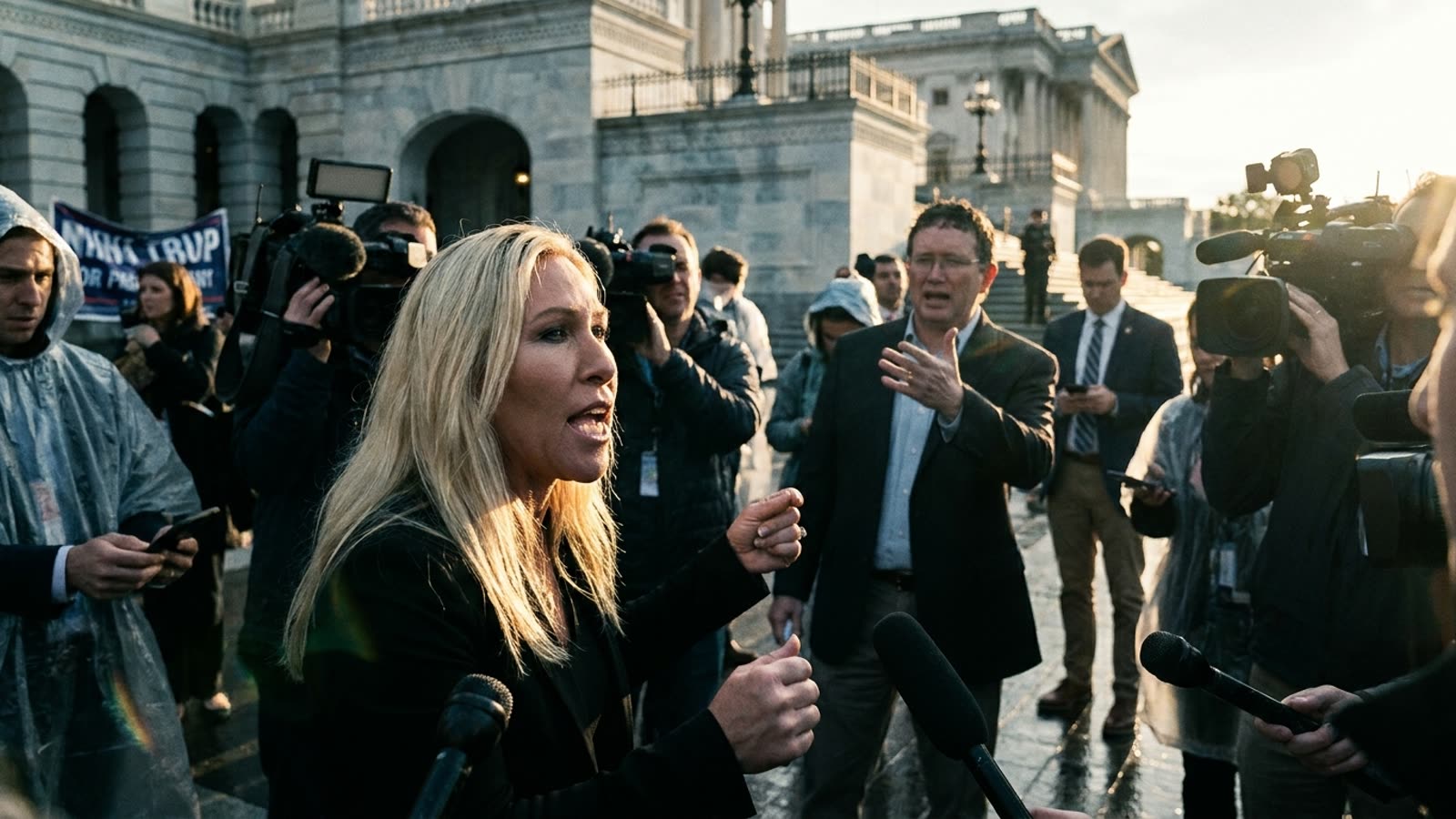
The Republican Party's most reliably chaotic members have found a new target: each other. Representatives Marjorie Taylor Greene and Thomas Massie, both Kentucky-adjacent provocateurs who have made careers out of being thorns in their own party's side, are now engaged in a public feud that has all the sophistication of a middle-school cafeteria dispute and all the political significance of a party eating itself alive.
The confrontation, which has spilled across social media and cable news over recent days, ostensibly concerns legislative strategy and loyalty questions within the House Republican conference. But the substance matters less than the symbolism: two figures who positioned themselves as the authentic voice of grassroots conservatism cannot agree on what that voice should actually say.
The strange bedfellows who weren't
Greene and Massie occupy superficially similar positions in the Republican ecosystem—both vote against their party's leadership with theatrical regularity, both cultivate outsider personas, both have substantial followings among voters who distrust institutional conservatism. But their ideological foundations have always been distinct. Massie is a libertarian-leaning constitutionalist who opposes foreign aid and surveillance with genuine philosophical consistency. Greene is a culture warrior whose positions shift with the prevailing winds of online discourse.
That these two would eventually clash was inevitable. What's revealing is the timing: with Republicans holding a narrow House majority and struggling to pass basic legislation, their internal conflicts have become the party's defining characteristic rather than a colorful sideshow.
Performance art as politics
The feud offers a window into how Republican politics has evolved—or devolved—in the post-Trump era. Both Greene and Massie understand that attention is the currency of modern politics, and both have mastered the art of generating it. But attention-seeking as a strategy only works when there's a common enemy. When the cameras turn inward, the performance becomes self-consuming.
Neither representative has shown much interest in the unglamorous work of coalition-building or legislative craftsmanship. Their brands depend on opposition—to Democrats, to the establishment, to the media. Opposing each other creates a paradox neither seems equipped to resolve.
Our take
This is what happens when a political party mistakes notoriety for influence. Greene and Massie have both been effective at one thing: making themselves famous within their respective niches. But fame without a governing philosophy is just noise, and the Republican House majority increasingly sounds like nothing but. The feud will likely blow over, replaced by some new outrage cycle within days. But the underlying dysfunction it exposes—a party that has elevated performance over substance to such a degree that its performers have nothing left to perform against but each other—is not going anywhere.