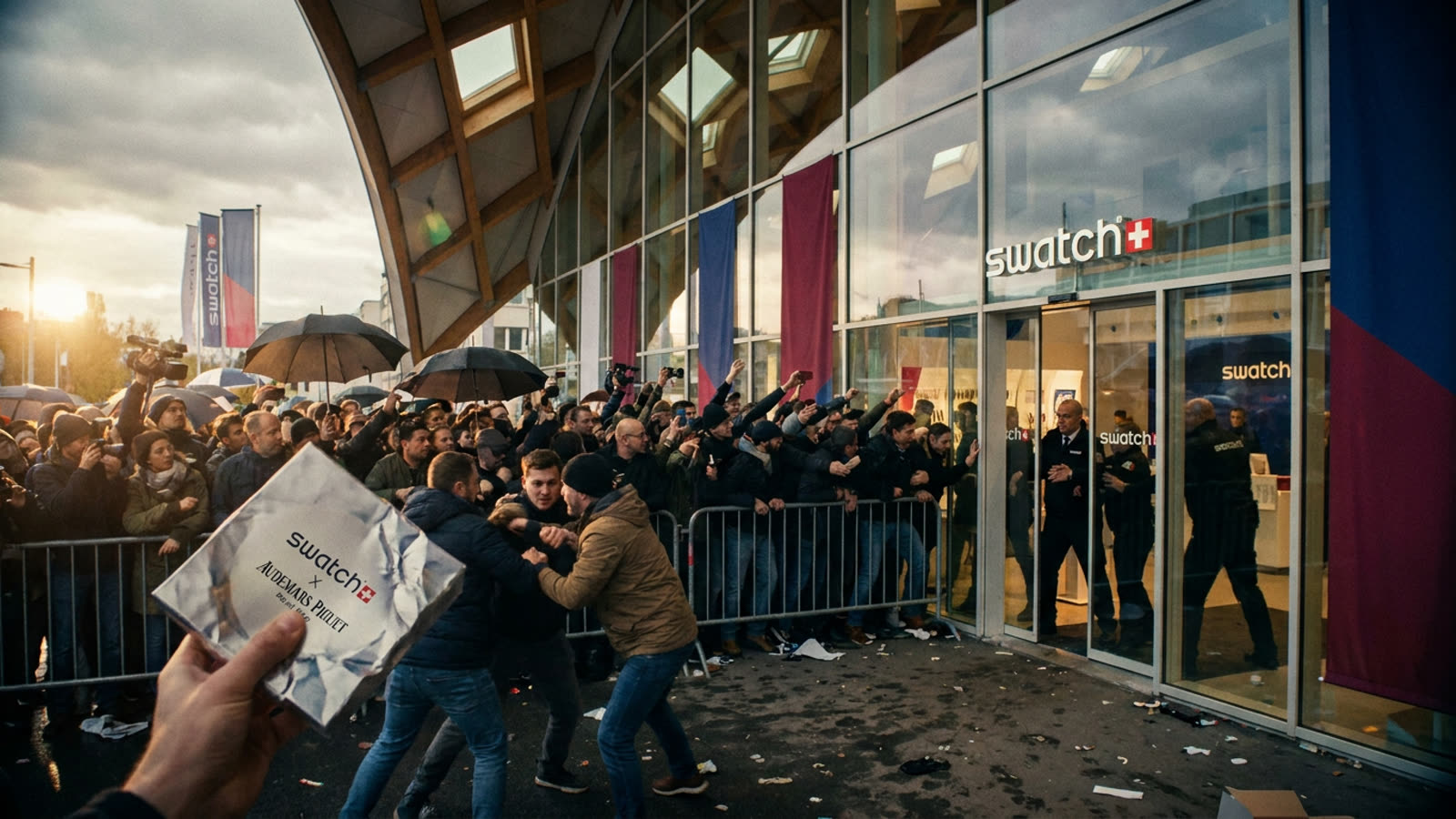
When Swatch announced its collaboration with Audemars Piguet—the storied Swiss house whose Royal Oak has commanded six-figure prices since before most hypebeasts were born—the pitch was democratization. For a mere fraction of the original's cost, ordinary consumers could own a piece of horological prestige. What Swatch got instead was pandemonium.
This weekend, the company was forced to shutter stores across multiple continents as crowds surged for the "Royal Pop" pocket watches, a limited-edition release that blends Swatch's plastic accessibility with Audemars Piguet's octagonal iconography. Videos circulating on social media show security barriers toppled in Singapore, fistfights in Dubai, and queues in London stretching around entire city blocks. In Tokyo, police were called to manage a crowd that had been camping since Thursday.
The Scarcity Playbook, Perfected
This is not Swatch's first rodeo with controlled chaos. The MoonSwatch collaboration with Omega in 2022 pioneered the template: take an unattainable grail watch, strip it down to affordable materials, slap a famous name on it, and release in quantities just scarce enough to generate headlines. The MoonSwatch succeeded beyond anyone's projections, creating a secondary market where $260 watches traded for $2,000.
The Royal Pop escalates the formula. At retail prices reportedly ranging from $400 to $600 depending on the variant, the pocket watches are already listing on resale platforms for upwards of $30,000. That arbitrage opportunity—a potential 5,000% return for anyone lucky enough to purchase at retail—explains why people are willing to camp, shove, and occasionally throw punches.
When Hype Becomes Liability
Yet the store closures suggest Swatch may have miscalculated. The company has historically prided itself on accessibility; its founding ethos in the 1980s was to make Swiss watchmaking affordable for everyone. Scenes of security guards physically restraining customers cut against that brand identity. More practically, shuttered stores mean lost sales—not just of Royal Pops, but of the bread-and-butter Swatch lineup that still pays the bills.
There is also the question of what happens when the hype fades. The MoonSwatch secondary market has cooled considerably from its 2022 peaks, with many variants now trading near or below retail. Speculators who bought Royal Pops expecting to flip them for life-changing sums may find themselves holding plastic pocket watches that, however charming, lack the mechanical sophistication that gives genuine Audemars Piguet timepieces their enduring value.
Our take
The Royal Pop phenomenon is less about watches than about the broader economy of desire that luxury brands have learned to weaponize. Scarcity, real or manufactured, transforms products into status symbols and shopping into spectacle. Swatch has clearly mastered the mechanics of virality. Whether it can manage the consequences—reputational, logistical, and eventually financial—is another matter. At some point, the line between buzz and bedlam becomes a liability. This weekend, Swatch found it.